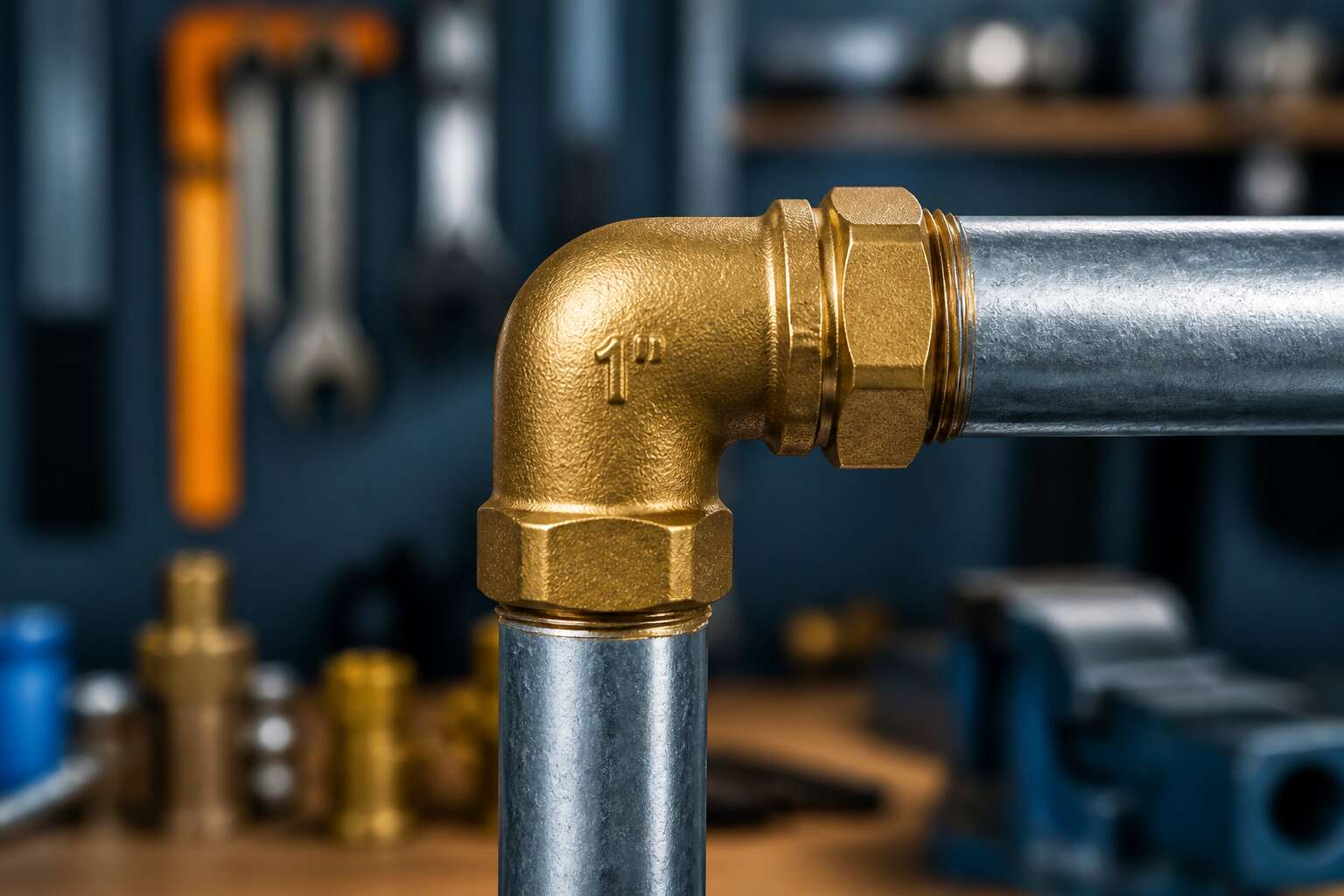
Understanding 1-Inch Pipe Fittings
What Does the 1-Inch Measurement Actually Mean?
Ask any plumber in Johannesburg about pipe fitting 1 inch and you will hear the same refrain. The 1 inch is a nominal measurement, not a literal one.
This nominal sizing traces back to iron pipe standards from the 1800s. A 1 inch pipe fitting usually measures roughly 1.315 inches across its outside diameter. The inner diameter depends entirely on the wall thickness, which varies by schedule.
Consider these examples:
- Schedule 40 pipe fitting 1 inch has an inside diameter of 1.049 inches
- Schedule 80 narrows to 0.957 inches
- Schedule 160 drops further to 0.815 inches
The thread dimensions remain identical across all schedules. That consistency is precisely why the system endures.
Common Types of 1-Inch Fittings: Elbows, Tees, Couplings, and Unions
Walk into any hardware store in Johannesburg and you will find a wall of pipe fitting 1 inch components, each serving a distinct purpose. The elbow redirects flow at tight angles, typically 90 or 45 degrees. The tee splits a single line into two branches, while the coupling simply joins two straight sections of pipe. The union, however, deserves special attention, because it allows for future disconnection without cutting the line.
- Elbows: change direction
- Tees: create branches
- Couplings: extend straight runs
- Unions: enable quick disassembly
Selecting the right pipe fitting 1 inch for each task comes down to how the system needs to behave over time. A union saves hours of labour later, but only if you install it where access matters. These differences seem small until you are under a sink with a spanner in hand. That is when the choice becomes practical, not theoretical.
Thread Standards and NPT Ratings Explained
The world of plumbing runs on a simple principle: threads must align. A pipe fitting 1 inch might look identical on the shelf, but its threading profile dictates whether it seals perfectly or leaks from day one. In South Africa, you will encounter two main standards, and confusing them leads to a frustrating trip back to the supplier. The National Pipe Taper (NPT) thread is the workhorse, tapering slightly to create a wedge-like seal when tightened. The British Standard Pipe (BSP) thread, however, is often parallel and relies on a separate sealing mechanism.
– NPT threads are tapered and self-sealing.
– BSP threads are commonly parallel and need a washer or sealant.
– Thread pitch and angle also differ between the two.
Mating a pipe fitting 1 inch with the wrong standard is the most common error for DIY enthusiasts. The threads might catch for a turn or two, giving false hope, before seizing or stripping. When you consider that a water line pressure can be relentless, understanding the rating matters. A standard rating indicates the maximum working pressure the fitting can withstand, which is vital for hot water systems in Johannesburg homes. Always check the pressure rating on the packaging before assembly, because the thread type is only half the story. Sealing compounds and PTFE tape fill the microscopic spiral gaps, but they cannot compensate for an incompatible thread standard. The result is a joint that holds firm on the bench yet weeps once the system pressurises.
Materials and Durability for 1-Inch Fittings
Metal Options: Brass, Galvanized Steel, and Copper
Ask a plumber in Johannesburg about a pipe fitting 1 inch that failed early, and you will get an earful about premature corrosion. The metal choice decides whether that fitting survives years or just one rainy season. Brass, galvanized steel, and copper each have distinct durability profiles.
Brass resists corrosion but can dezincify in aggressive water. Galvanized steel handles knocks yet rusts internally once its zinc coat fails. Copper survives hot lines and biofouling but costs more and erodes at high velocities.
- Brass: easy to machine
- Galvanized steel: high strength, heavy
- Copper: antimicrobial, conductive
Mixing metals speeds galvanic corrosion, so a pipe fitting 1 inch must match its neighbours. In Gauteng’s variable water, this matters.
Plastic Options: PVC, CPVC, and PEX
The shift from metal to polymer is not an admission of weakness, but a quiet nod to practicality. Where a pipe fitting 1 inch in copper demands careful soldering and a brass unit requires a heavy wrench, the plastic counterparts offer a different kind of resilience. They do not corrode, which eliminates an entire category of failure. However, they are not interchangeable, and selecting the wrong polymer for the specific application, especially in the South African climate, leads to cracking, warping, or a slow, insidious leak.
PVC is the workhorse of cold water systems. It is rigid, cheap, and handles the rough handling of a construction site without complaint. Its limitation is temperature. Hot water will soften the joints and eventually cause deformation. CPVC is the upgraded sibling, formulated to withstand higher temperatures, making it a superior choice for hot water lines. Yet, both share a common enemy: impact in cold weather. A knock that dents copper will shatter PVC.
PEX, on the other hand, bends. It does not fight the installer, and its flexibility is its main asset. It expands, which means it is far less likely to burst in freezing conditions, a rare but possible event in the Highveld. The connection method also differs, often using a crimp ring rather than solvent glue. For a pipe fitting 1 inch, the choice often comes down to how the pipe is routed:
1. Long, straight runs with few bends: PVC or CPVC.
2. Retrofitting through existing wall cavities: PEX.
3. Connecting to a solar geyser: High-temperature rated CPVC.
The solvent welding process for PVC and CPVC is a moment of truth. The primer and cement are aggressive chemicals that soften the plastic, allowing a molecular bond to form. If the installer is impatient and does not allow the joint to cure, the fitting will weep. The true test of a pipe fitting 1 inch in plastic is not its initial strength, but its long term tolerance for the pressure spikes common in municipal supply lines.
Comparing Corrosion Resistance and Lifespan
Corrosion in a pipe fitting 1 inch is the primary cause of premature failure across all metal types. Galvanised steel rusts from the inside out, so damage stays invisible until the first pinhole leak appears in a ceiling. Copper develops verdigris on the outside, which is cosmetic, but internally it erodes where water velocity is highest. Brass is the stubborn exception, surviving decades in aggressive water conditions.
Lifespan figures vary. A galvanised fitting might last 30 years inland, but less than 10 near the coast. Copper suffers from electrochemical reactions when joined to dissimilar metals. Water chemistry in parts of Gauteng is particularly aggressive, with low pH that eats at metal fittings.
- Galvanised steel: 10-30 years
- Copper: 20-50 years
- Brass: 40+ years
The corrosion resistance of a pipe fitting 1 inch determines its real cost. A cheap fitting that fails in a decade costs more in labour than a quality brass unit that outlasts the building.
Temperature and Pressure Ratings by Material
Temperature ratings separate fittings faster than any other specification. A PVC pipe fitting 1 inch handles cold water with ease, but push the heat past 60°C and the pressure rating drops sharply. CPVC survives to 93°C, though the extra cost makes some buyers pause. PEX manages hot and cold without cracking. Copper and brass ignore the problem entirely. They carry boiling water and lose nothing!
Here is what a 1-inch fitting delivers by material:
– PVC: 10 bar at 20°C, dropping to 4 bar at 60°C
– CPVC: 10 bar steady up to 80°C
– PEX: 6 bar at 82°C
– Copper: rated well above 40 bar, no thermal ceiling
– Brass: 60 bar even at 120°C
Gauteng homeowners deal with aggressive water chemistry and high geyser temperatures. The right pipe fitting 1 inch prevents a burst behind a wall. That repair costs more than the fitting ever will.
Applications and Use Cases for 1-Inch Pipe Fittings
Residential Plumbing: Water Supply and Drainage
In a home, the network of pipes is a silent, socially demanding system. When you connect a wall-hung sink or a floor-mounted toilet, the 1 inch fitting is the bridge between your fixtures and the main line. It is the polite handshake between different parts of your property, ensuring water pressure is maintained without causing a scene.
For drainage, a pipe fitting 1 inch handles the unglamorous work. It manages the flow from a single basin or a washing machine standpipe. A common arrangement includes:
– Connecting a dishwasher tailpiece to the branch drain.
– Linking a shower drain to the main 2-inch stack.
– Serving as a cleanout plug for quick access.
This size is rarely the main artery; it is the capillary action that keeps the system functioning. It accommodates the specific volume of a single appliance or a small bathroom group, preventing the gurgling sounds that betray an overworked vent system. In South African homes, pressure variations are common, and relying on a correctly sized pipe fitting 1 inch for these branch lines is a practical decision for maintaining proper flow dynamics. It is the quiet negotiator of your home’s water etiquette.
Commercial and Industrial Piping Systems
I have watched a pipe fitting 1 inch hold its own in a fish processing plant along the Durban coast. These connections feed brine to chilling tanks or carry washdown water to a row of stainless steel tables. The size is neither heroic nor trivial; it is simply the reliable middle child of industrial plumbing.
For compressed air systems, a pipe fitting 1 inch delivers the exact volume needed for a pneumatic stapler or a small parts blaster. Maintenance teams appreciate the easy grip of a 1 inch union when swapping out a worn valve. Common commercial applications include:
- Distribution lines for workshop air tools
- Coolant loops around plastic injection moulds
- Transfer lines for low pressure lubricants
That same fitting appears in boiler blowdown lines and irrigation control panels on large farms. It is the practical choice where a 3 inch main would be overkill, yet a half inch line would starve the equipment. In Johannesburg warehouses, I often see a pipe fitting 1 inch connecting a fire hose reel to the riser, a quiet guarantee of readiness.
Specialized Uses: Irrigation, Gas Lines, and HVAC
A single choked nozzle can stall an entire centre pivot on a hot Karoo afternoon. That is why the pipe fitting 1 inch feeding each sprinkler bank gets checked before every season. The bore diameter keeps pressure steady across long laterals, and the threads seat cleanly against vibration. I have watched irrigators switch from 3/4 inch to this size for better head pressure at the end guns.
Gas installations follow a stricter path. A pipe fitting 1 inch on an LPG vapour line must carry approved thread sealant and solid bracing. HVAC technicians use the same size for condenser bypass loops, where flow must match the pump curve exactly.
- Fertigation injection manifolds
- LPG vapour distribution in restaurant kitchens
- Chilled water branches to air handling units
When to Choose 1-Inch Over Other Sizes
A borehole pump feeding a storage tank across a dusty stand forces a decision. The pipe fitting 1 inch becomes the boundary between starvation and waste. Smaller lines choke supply. Larger lines burn money on capacity never used. This size sits exactly where residential and light commercial demand actually lives.
Contractors adding a workshop to an existing homestead face the same question. A 3/4 inch line serves two outlets fine, but add a third and pressure collapses. The 1 inch fitting provides margin for future expansion without overbuilding the network. Plumbers in Gauteng spec this size for manifold runs to multiple bathrooms.
For installations that need predictable flow characteristics:
- Reticulation from a jojo tank to a pressure pump
- Domestic fire suppression branches
- Water heater recirculation lines
Thread engagement on a pipe fitting 1 inch also matters in confined routes, where elbows and tees multiply friction losses.
Installation Techniques and Best Practices
Essential Tools for Working with 1-Inch Fittings
Precision is a wonderful thing, but in the real world, a pipe fitting 1 inch needs a firm hand, not a delicate one. Start by cleaning your pipe ends thoroughly. Any grit here will act like sandpaper on your threads, causing leaks later. Apply thread sealant to the male threads only, and walk the fitting on by hand for the first few rotations to prevent cross-threading.
For the actual tightening, a solid pair of stillson wrenches is non-negotiable. Never use a single wrench and twist the pipe itself, as you will only stress the joint. When working with brass, pay attention to your grip. Over-tightening is the main culprit for cracked fittings, a mistake that will leave you scratching your head and mopping the floor.
Work in a logical sequence. Install your pipe fitting 1 inch in an order that allows for adjustment:
- Assemble all fittings hand-tight to check alignment.
- Mark the position of the fittings with a pencil.
- Disassemble, apply sealant, and tighten to the mark.
- Torque the last half turn, but stop the moment resistance spikes.
Rough-in work is where most DIYers fail, as they try to make a straight pipe fit a crooked wall. Remember that mastic and pipe dope are your friends, but that a bead of silicone is not a substitute for proper support. Always use clevis hangers or pipe clips to hold the weight, or you will find your beautiful work sagging within a year.
Step-by-Step Guide to Threaded Connections
Threaded connections reward patience above all. When you handle a pipe fitting 1 inch, the sequence of assembly matters as much as the torque you apply. Begin with a dry run, connecting every component without sealant. This single step reveals alignment problems while everything is still easy to correct.
- Squareness of the fitting to the pipe
- Gap between threads, which should be even
- Overall run direction relative to your layout
Mark every joint with a pencil line across the fitting body and the pipe. Disassemble, apply sealant to the male threads, and reassemble to your marks. Tighten to the line, then add a quarter turn maximum. If the alignment shifts during tightening, back the joint out and reseat it. Straight joints carry load evenly. Crooked ones concentrate stress, and that is where cracks appear. For a pipe fitting 1 inch, this check takes seconds but saves you from tearing out an entire wall later.
Soldering and Solvent Welding Methods
Soldering copper demands a clean surface. The oxide layer on a pipe fitting 1 inch resists bonding, so abrasive cloth and flux do the real work before heat ever touches the metal. Proper fit matters more than flame time. Heat the fitting, not the pipe directly, and let capillary action draw solder into the gap. If solder pools on the surface instead of flowing inward, the joint was dirty or overheated.
Before applying heat, check three things:
- The fitting seats fully on the pipe
- The surface is abraded to bright metal
- Flux covers the entire mating area
Solvent welding for PVC follows a different logic. The cement chemically fuses the pipe and the pipe fitting 1 inch into one piece. Primer and cement must be applied with deliberate speed. Insert fully and hold for thirty seconds. The bond is permanent. There is no second attempt.
Common Installation Mistakes and How to Avoid Them
Getting a pipe fitting 1 inch seated correctly starts with patience. I have watched DIY jobs fail because someone forced a fitting onto a pipe that was not cut square. A few millimetres of misalignment puts strain on the whole run, and that strain turns into a weep at the joint later. Measure twice, cut once, and ream the inside edge so burrs do not shave the sealing material.
Support the pipe before you tighten or fuse anything. A pipe fitting 1 inch that hangs unsupported will pull at the joint, especially in hot water lines where expansion and contraction are constant. Use clips or brackets spaced properly for the material.
- Always check that the pipe fitting 1 inch matches the pipe wall thickness.
- Clean the joint area before assembly, even if you are not soldering or gluing.
- Tighten gradually and evenly to avoid cracking the fitting.
Over-tightening is the most common mistake I see. The threads stop when they stop, not when the handle feels tight. If you feel the metal give, you have already damaged the fitting!
Leak Prevention: Sealants, Tapes, and Proper Torque
The dry joint remains the primary culprit behind most leak complaints, yet the remedy starts long before the wrench touches the fitting. The choice of sealant dictates the longevity of a pipe fitting 1 inch, and using the wrong material for the thread metal is a recipe for a slow weep. PTFE tape works well for brass and stainless, but it needs to be wrapped in the direction of the thread rotation. Pipe dope, on the other hand, offers a forgiving seal for cast iron and galvanised lines where surface imperfections are common. Apply the sealant to the male threads, not the inside of the fitting.
Torque plays a more subtle role than most assume. A pipe fitting 1 inch benefits from a firm seating, but the metal deforms under excessive force, thinning the thread crests. This deformation creates micro gaps that sealant cannot bridge. For a correct fit, tighten the joint until the resistance increases sharply, then stop.
– Use a sealant rated for the fluid and temperature.
– Apply tape in a clockwise wrap.
– Replace the fitting if the threads show wear.
A pipe fitting 1 inch that seats properly without binding will hold its seal through thermal cycling. The extra quarter turn past snug is often the difference between a solid connection and a future repair. Remember, the threads should carry the load, not the sealant. If the paste is forced out during assembly, you have used too much or turned too far. Work with a clean, dry hand and let the material do its job.
How to Select the Right 1-Inch Fitting
Key Factors: Material Compatibility and Pipe Material
Selecting the correct pipe fitting 1 inch begins with knowing exactly what your pipe is made of. Brass will not behave the same on a PVC line as it will on copper. The fitting must match the pipe material to prevent galvanic corrosion, a slow deterioration caused by dissimilar metals touching.
Check the wall thickness and the joining method. A threaded fitting suits a galvanized steel pipe, while a solvent weld fitting belongs on PVC. Some plumbers mix materials, but they do so with dielectric unions to break the electrical path.
- Identify the pipe material first.
- Match the fitting alloy to the pipe.
- Confirm the joining method.
Environment also matters. Coastal South African homes face salt air, which attacks certain metals faster. A pipe fitting 1 inch made of brass handles that exposure better than untreated steel.
Assessing Pressure, Flow Rate, and Environment
Pressure ratings tell you what a fitting can survive, not what your system actually demands. A pipe fitting 1 inch rated for 300 psi means little if your pump delivers 400 psi on a cold morning. Flow rate matters just as much. The internal bore diameter, not the outer thread size, determines litres per minute. A schedule 40 PVC fitting restricts flow more than a brass fitting of the same nominal size, something I have learned the hard way.
Environment extends beyond salt air. Inland South African towns face wider temperature swings than coastal cities. Highveld water is harder, accelerating scale buildup inside any pipe fitting 1 inch. Three variables decide the outcome:
- Working pressure versus the pump’s maximum output
- Required flow rate from the total fixture count
- Ambient temperature range at your specific elevation
The rating on the box is a laboratory figure. Your installation is real life, and real life rarely matches the test bench.
Cost Considerations Without Sacrificing Quality
Choosing a pipe fitting 1 inch based on price alone seldom ends well. I have seen contractors buy the cheapest galvanized elbows only to replace them within two seasons. Quality costs more upfront, but the real expense hides in leaks and downtime.
Consider the total ownership cost, not the ticket price. A brass fitting may cost three times more than PVC, yet it holds up in aggressive water conditions common across the Highveld. The cheapest options often share three traits:
- Thinner walls that deform under modest torque.
- Threads cut with less precision, inviting seepage.
- Pressure ratings that barely match your pump’s peak output.
Spending a little extra on a reputable brand for any pipe fitting 1 inch saves labour costs later. That is the practical math.
Industry Standards, Certifications, and Trusted Brands
Choosing a pipe fitting 1 inch without checking its credentials is like trusting a stranger with your water bill. The SABS mark means the product passed testing under South African conditions. An imported fitting without that mark may perform well, but the paperwork tells you which corners were cut.
- Look for the SABS or ISO number stamped into the body.
- Confirm the brand has a local technical representative.
- Compare the stamped pressure rating against your system’s actual peak.
Trusted manufacturers make the boring details visible. The right pipe fitting 1 inch should arrive with clear batch markings and consistent thread depth. Certifications are not decoration. They are the difference between a fitting that seals for decades and one that turns your ceiling into a fountain.
Buying Guide: What to Look For in Retail or Online
When you stand in a hardware aisle or scroll through an online catalogue, the pipe fitting 1 inch you need can hide behind packaging that looks identical. Verify the details before you pay.
Start with the physical cues. Check the weight in your hand. A heavier pipe fitting 1 inch usually indicates thicker walls. Look at the thread ends. They should be sharp and free of burrs. Ask the supplier about return policies and batch traceability. Reputable South African stockists will share the origin and SABS status without hesitation.
- Compare the stamped pressure rating with your system’s operating range.
- Verify the thread standard matches your existing pipes.
- Ask for the manufacturer’s technical data sheet before buying online.
Online purchases carry more risk. Use product images to inspect the casting finish and thread depth. If the listing omits the brand or pressure rating, treat it as a warning.

0 Comments