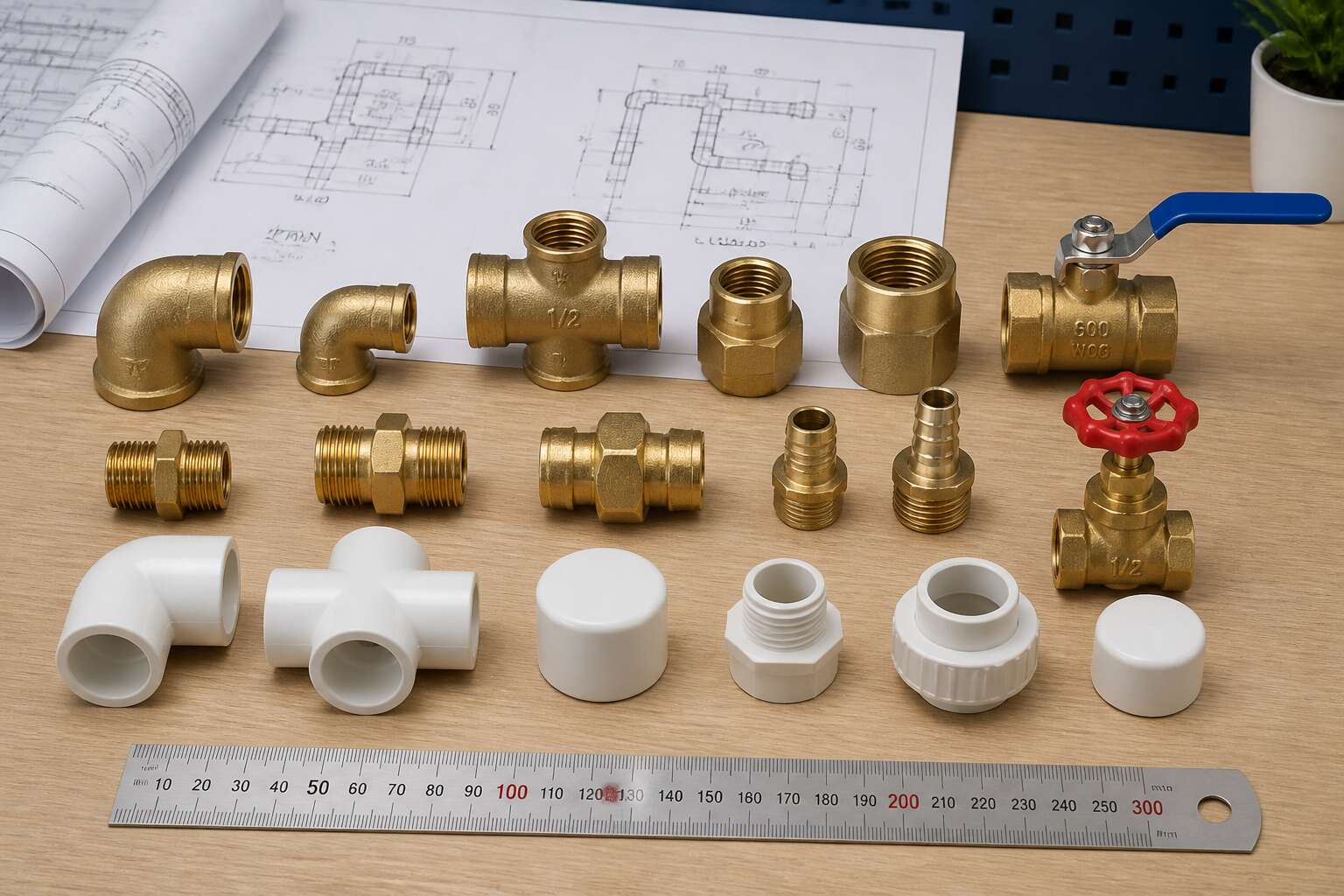
Understanding Pipe Fittings
What Are Pipe Fittings?
Roughly a third of South Africa’s treated water never reaches its destination, much of it escaping through poorly selected or wrongly installed fittings. Understanding what pipe fittings are is essential to preventing that loss.
A pipe fitting is any component that connects, terminates, or changes the direction of piping. Couplings join straight sections. Elbows redirect flow. Reducers step between diameters. Each one introduces a potential point of failure.
Experienced technicians keep detailed pipe fittings notes on every job. Those notes record material compatibility, pressure ratings, and torque specifications. They capture lessons that no manual includes. I have seen a single mismatched fitting drain an entire storage tank overnight!
Three factors determine whether a fitting will perform.
- The medium it carries.
- The pressure it must hold.
- The environment it sits in.
A mismatch in any one of these creates leaks, corrosion, or burst lines.
Role in Piping Systems
Without fittings, a piping system is just a stubborn straight line. They are what turn a static pipe into an actual network. Elbows redirect around obstacles, tees split the flow, reducers adapt the line to a different diameter, and flanges make future maintenance possible instead of a demolition project.
Their role is practical, but it is also strategic. Consider the functions that matter on a real job:
– Isolating sections for urgent repairs
– Allowing capacity to be added later without tearing everything out
– Directing flow exactly where it is needed
Every one of those functions adds a potential leak point. That is why pipe fittings notes separate orderly layouts from chaotic ones. A fitting that looks fine on paper will fail in the field if its role in the entire system was never understood.
Key Industry Terminology
Anyone who has read a specification sheet knows the distance between a fitting and its description. The term “nominal bore” refers to a standard size, not an actual measurement. A 50 mm fitting will never measure exactly 50 mm. That distinction separates seasoned engineers from novices who learn to trust pipe fittings notes above intuition.
Terminology also governs pressure. The “schedule” of a fitting determines wall thickness, and with it, the allowable working pressure. In South Africa, where high temperatures and aggressive soils affect material performance, misreading these numbers leads to premature failure. Common terms worth knowing include:
- NPS and DN, which standardise sizing across suppliers
- Schedule, which defines wall thickness
- Pressure rating, which sets the safe operating limit
- End connection type, which determines how the fitting joins the line
These definitions appear simple, but each carries consequences. Pipe fittings notes that ignore terminology create delays, rework, and unsafe installations.
Typical Applications Across Industries
Walk into any petrochemical complex in Secunda or a gold mine in the Free State, and you will find thousands of fittings controlling volatile media. Applications across industries show why pipe fittings notes matter. A failure here halts production and endangers personnel.
Mining operations use abrasion-resistant fittings to move slurry across vast distances. Water utilities depend on ductile iron and PVC fittings to distribute potable water under fluctuating pressures. Sugar refineries in KwaZulu-Natal require stainless steel fittings that withstand corrosive juice at high temperatures. Each environment imposes its own demands:
- Chemical plants need fittings that resist aggressive acids and solvents.
- Power stations demand fittings for superheated steam and thermal cycling.
- Food and beverage plants require hygienic crevice-free designs.
The selection process always returns to pipe fittings notes that document material grade, pressure rating, and joint compatibility. Ignore those details, and failure follows!
Types of Pipe Fittings
Elbows and Bends
In piping, direction changes are rarely arbitrary. A 45 degree elbow might look mundane, but it affects flow more than you think. I have seen South African plants where a simple bend saved the entire layout, proving that geometry is a performance decision.
Elbows are precisely angled fittings, typically 45, 90, or 180 degrees. Bends, by contrast, have a larger radius and are formed by curving the pipe itself. This distinction directly impacts pressure drop and erosion.
- Bends reduce turbulence and are gentler on abrasive media.
- Elbows save space and weight, but add friction.
- For tight installations, elbows win. For longevity in slurries, bends are safer.
The choice also depends on fabrication cost and clearance. That is why pipe fittings notes always emphasise verifying the actual radius before ordering. Every millimetre of curvature changes how the fluid behaves, so pay attention to the numbers.
Tees and Crosses
A tee is where a pipeline decides where to go. In a South African process plant, a tee sends flow into two branches, and the sudden change in direction creates localised turbulence. A cross adds a second branch, which doubles the disturbance. This is where pipe fittings notes earn their keep, because they record the exact bore sizes and branch orientations that determine how the fluid behaves.
- Equal tee: same bore on all openings.
- Reducing tee: one branch is smaller than the main run.
- Cross: four openings, often used for instrument connections or line cleaning.
Crosses are less common in high pressure lines. Many engineers avoid them due to stress concentrations at the weld joints. The fabrication code and the process medium dictate whether a cross is acceptable or a pair of tees is the safer option. Pipe fittings notes from major South African suppliers always list the pressure rating for each branch, so verify that before you finalise the purchase order.
Couplings and Unions
Couplings and unions perform distinct duties in a pipeline. A coupling joins two pipes in a straight line, permanently. A union offers a break point, allowing a pump or valve to be removed without cutting the line. South African plants use unions wherever equipment requires regular servicing.
Pipe fittings notes from major suppliers list thread types and pressure ratings for each fitting. A threaded union suits low pressure water duties. A flanged coupling handles higher temperatures with greater reliability.
- Match the fitting schedule to the pipe schedule.
- Check whether the union uses a metal to metal seal or an O ring.
- Confirm the pressure rating before ordering.
Record each selection in your pipe fittings notes, and future maintenance becomes considerably easier.
Reducers and Expanders
Reducers and expanders alter the bore size of a line. A reducer narrows the flow path, while an expander widens it. Concentric versions keep the centreline consistent, which suits vertical runs. Eccentric versions align the bottom or top of the pipe, making them ideal for horizontal drainage in South African process plants.
I mark each transition in my pipe fittings notes, because the wrong taper angle creates turbulence. Before ordering, consider these points:
- Check the eccentric orientation for air or vapour handling.
- Confirm the reducer length against the pressure drop.
- Record the exact bore dimensions for future spares.
For slurry lines, use a long radius reducer. For gas lines, verify the pressure rating. Always match the fitting schedule to the pipe schedule.
Caps, Plugs, and Wyes
One blocked branch line can stop a South African process plant for a full shift. That is why caps, plugs, and wyes deserve a place in your pipe fittings notes. These components close, isolate, and redirect flow, yet they are often specified without enough thought.
Caps seal a pipe permanently. Plugs thread into a fitting for temporary closure or pressure testing. Wyes join a branch at a 45 degree angle, which keeps solids moving in slurry applications. A standard tee creates turbulence, but a wye preserves the streamline.
- Use a plug for test points and future tie ins
- Specify caps for permanent ends on small bore lines
- Select wyes for drainage and slurry branches
The metallurgy matters. Match the fitting schedule to the line schedule, and always record the pressure class in your pipe fittings notes.
Flanges and Adapters
Flanges and adapters join a piping system to pumps, valves, and vessels. They also let a crew separate those components for maintenance. In South African process plants, this ability to pull a line apart is essential. Nobody can afford to cut a pipe every time a valve needs service.
A flange spec is more than a bolt pattern. The facing type dictates the seal. Raised face, flat face, or ring joint. Each serves a different pressure regime. The rating matters too. A Class 150 flange will not hold what a Class 600 can. These details belong in your pipe fittings notes.
- Raised face for standard service
- Flat face for low pressure or cast iron mating
- Ring joint for high pressure and high temperature
Adapters change connection types. They move a system from threaded to welded, or from metric to imperial. A flange and adapter together give a pipeline flexibility across equipment brands. When the flange class and adapter type appear in pipe fittings notes, the next team avoids guesswork. I have seen this combination save an entire shutdown!
Materials and Manufacturing Standards
Common Materials: Metal, Plastic, and Composite
Nearly 40% of piping failures trace back to material selection. That fact should sharpen your focus on manufacturing standards. For any engineer, the material defines the system’s lifespan. Metal offers strength under high pressure, plastic resists corrosion, and composite balances weight with resilience. But standards govern every step. ASTM and ISO specifications dictate alloy composition, wall thickness, and tolerance. Without these, a fitting becomes a liability!
Manufacturers must verify raw material traceability. Consider these common approaches:
- Spectrochemical analysis for metal grade confirmation
- Hydrostatic testing to validate pressure integrity
- Ultrasonic inspection for internal defects
These checks separate reliable fittings from hidden failures. Recording every test result in your pipe fittings notes is standard practice. A poorly documented batch can compromise an entire network. Temperature, fluid type, and installation method all matter. The material’s microstructure tells a story. Pipe fittings notes from past projects reveal patterns that prevent future leaks.
Manufacturing Processes and Quality Control
Manufacturing processes determine how a fitting performs. Forging aligns grain structure, casting suits complex shapes, and machining achieves precise tolerances. Each method influences the final product.
Quality control continues after production. Hardness tests confirm heat treatment, thread gauges verify connections, and pressure tests expose weaknesses. All these results belong in your pipe fittings notes.
Here is a checklist for site audits:
- Visual inspection for surface defects
- Dimensional checks against specifications
- Traceability records from melt to finished piece
Without these steps, a fitting is just a component. With them, it becomes a predictable part of the system.
Critical Standards and Certifications
One wrong alloy specification can crack a steam line at 250 degrees Celsius! Standards determine whether a component survives high-pressure steam or hot water circulation in a Johannesburg plant. Without verified compliance, your pipe fittings notes remain incomplete.
Critical certifications vary by application:
- SANS 1123 for welded steel fittings
- ISO 9001 for manufacturing consistency
- EN 10204 3.1 material certificates
Each standard locks down chemical composition, mechanical properties, and thread integrity. A certificate without a heat number is worthless. Certifications from SANAS-accredited labs carry legal weight in South Africa. Ignore them, and you inherit unpredictable failures. Record the standard numbers, certificate references, and heat numbers within your pipe fittings notes. That paperwork turns raw steel into a traceable, predictable system component.
Installation and Maintenance Practices
Pre-Installation Preparation
Most pipe fitting failures trace back to errors made before a single wrench turns. Pre-installation preparation decides whether a system holds pressure for a decade or fails within weeks. You cannot fix a contaminated socket after the pipe is buried. You cannot correct a mismatched thread once the system is under load.
Every installation begins with verification. The pipe material, the wall thickness, and the exact fitting dimensions all get checked against the pipe fittings notes. A casting mark that looks identical on paper can differ by a millimetre in reality. That millimetre becomes a leak.
Before any connection is made, the site gets scrutinised:
- Burrs and scale inside the pipe end will ruin a seal
- Oxidation on the surfaces changes the effective diameter
- Poor tool access forces angled torque, which cracks the fitting
The working area is inspected thoroughly. Debris, moisture, and temperature swings alter how a fitting seats. Surfaces are cleaned twice. A single overlooked measurement in the pipe fittings notes is the difference between a temporary seal and a permanent one.
Joint Assembly and Sealing Techniques
The moment of assembly is where the pipe fittings notes demand full attention. Each joint behaves differently under load. Threaded connections need clean cutting oil and torque that respects the wall thickness. Over-tightening stretches the metal, under-tightening invites weepage. I have seen a two-inch line fail at 40 psi because the operator guessed the turns instead of checking the chart.
Sealing techniques follow a quiet logic. PTFE tape wraps clockwise, always three full wraps. Pipe dope fills the voids that tape cannot reach. For flanged joints, the gasket must centre itself before the bolts take tension. Tighten in a star pattern, then repeat. The pipe fittings notes specify the bolt torque as a boundary, not a suggestion.
- Wipe the mating surfaces once more before final closure
- Confirm the gasket material matches the medium
- Torque in stages, never in one pass
Soldered joints require a precise gap for capillary action. A sloppy fit leaves a void that fails under thermal cycling. The pipe fittings notes record the acceptable range and the correct flux for the application. Measure twice, heat once, and inspect the fillet for a full, even seal.
Testing for Leaks and Pressure Integrity
After the wrenches go quiet, the real installation begins. I follow a simple ritual: first visual inspection, then hydrostatic testing for leaks and pressure integrity. Water, not air, is the safer messenger. The pipe fittings notes remind me to isolate the section and purge the line of debris before the pump goes on.
Soapy water on a threaded connection reveals a bubble that no chart can predict. The pipe fittings notes also cover the maintenance cycle. Do not take pressure test results for granted.
Here is a checklist I keep printed:
– Verify the test pump gauge is calibrated.
– Bleed all high points of air.
– Hold the test pressure for at least thirty minutes.
– Check every union, flange, and weld.
Temperature changes can distort readings. I record the ambient temperature at the start and finish. The pressure reading must return to baseline. Only then does the system earn its integrity.
Long-Term Maintenance and Inspection Schedules
Most pipe failures arrive after a decade of quiet neglect, not in the first year. My pipe fittings notes carry one truth: the schedule matters more than the torque.
I revisit every joint each season. Galvanised fittings show white rust before red. Plastic fittings grow brittle under the Highveld sun. I run fingers along welds, feeling for pitting that paint hides. The notes remind me that gauges drift, so I replace them on rotation, not on failure.
My maintenance cycle follows the calendar:
- Inspect exposed fittings every three months.
- Test buried lines annually before the rains.
- Re-torque flanged joints after thermal cycling.
Each pass adds a page to the pipe fittings notes. That record catches trouble before it speaks.
Selection and Sizing Considerations
Key Factors in Fitting Selection
Choosing the right pipe fitting starts with reading the system’s behaviour under load, not merely the label on the box. Pressure, temperature, and fluid composition all shape the decision. A fitting that suits a chilled water line may fail in a steam loop within weeks.
For sizing, measure the actual outside diameter and wall thickness. Nominal sizes mislead. Tolerances vary between manufacturers, and a mismatched pair creates stress points. Reliable pipe fittings notes always include a call to verify the dimension table before ordering.
- Check the pressure rating at operating temperature
- Compare the fitting’s bore with the pipe’s internal diameter
- Confirm the end connection matches the planned joining method
Material selection follows from chemical compatibility, not from habit. South African water chemistries and aggressive soil conditions demand a closer look at corrosion resistance. The fitting’s wall thickness should also account for erosion from particulates.
Pressure and Temperature Ratings
One overlooked degree of thermal swing can shift a fitting’s sealing geometry permanently. Pressure ratings on a spec sheet only hold true at a single reference temperature. As the medium gets hotter, allowable working pressure drops faster than intuition suggests.
Selection and sizing start with reading the rating curve, not the maximum stamped number. The fitting material, wall thickness, and end connection all relax at elevated temperatures. For steam, superheated water, or aggressive chemical lines, check the derating factor before finalising the bore size.
Pipe fittings notes should include these verification steps:
- Confirm the pressure class at the actual operating temperature
- Compare the fitting’s material derating curve against the system’s transient peaks
- Measure the outside diameter and wall thickness on site
Cold water systems are forgiving. High temperature loops reveal guesswork quickly!
Flow Capacity and Sizing Calculations
Flow capacity is not determined by the nominal bore alone. Internal geometry, such as the radius of an elbow or the taper of a reducer, creates local velocity changes that affect head loss. A pipe fittings note that records only the size misses these hydraulic effects.
For sizing calculations, divide the flow rate by the internal cross-sectional area to get the mean velocity. The constraint is the maximum velocity the system can sustain without erosion, noise, or water hammer. For most South African water and chemical lines, this sits between 1.5 and 3 metres per second.
- Verify the fitting’s actual internal diameter against the pipe schedule.
- Check the pressure drop across the fitting at the design flow rate.
- Account for the cumulative effect of every fitting in the run.
These pipe fittings notes keep the hydraulic model honest. A bore that looks correct on paper can deliver insufficient flow when the real internal diameter is narrower than specified.
Cost, Availability, and Lifecycle Implications
In South Africa, the cost of a single fitting often matters less than the downtime spent waiting for it. A cheap imported elbow might arrive weeks late, forcing the entire line to sit idle. Pipe fittings notes that record only the unit price miss the real expense: transport, storage, and the admin burden of tracking odd sizes.
Availability follows a similar logic. Local stockists may not carry fittings with the required SANS approvals, and the delay between order and delivery reshapes the project plan. Lifecycle implications override both. A fitting that corrodes after two years costs more than a premium fitting that lasts twenty. Good pipe fittings notes capture this reality. Consider recording:
- Lead time from each supplier
- Expected service life under the actual process conditions
- Replacement part availability and vendor support
These notes turn a simple purchase into a long-term decision.

0 Comments