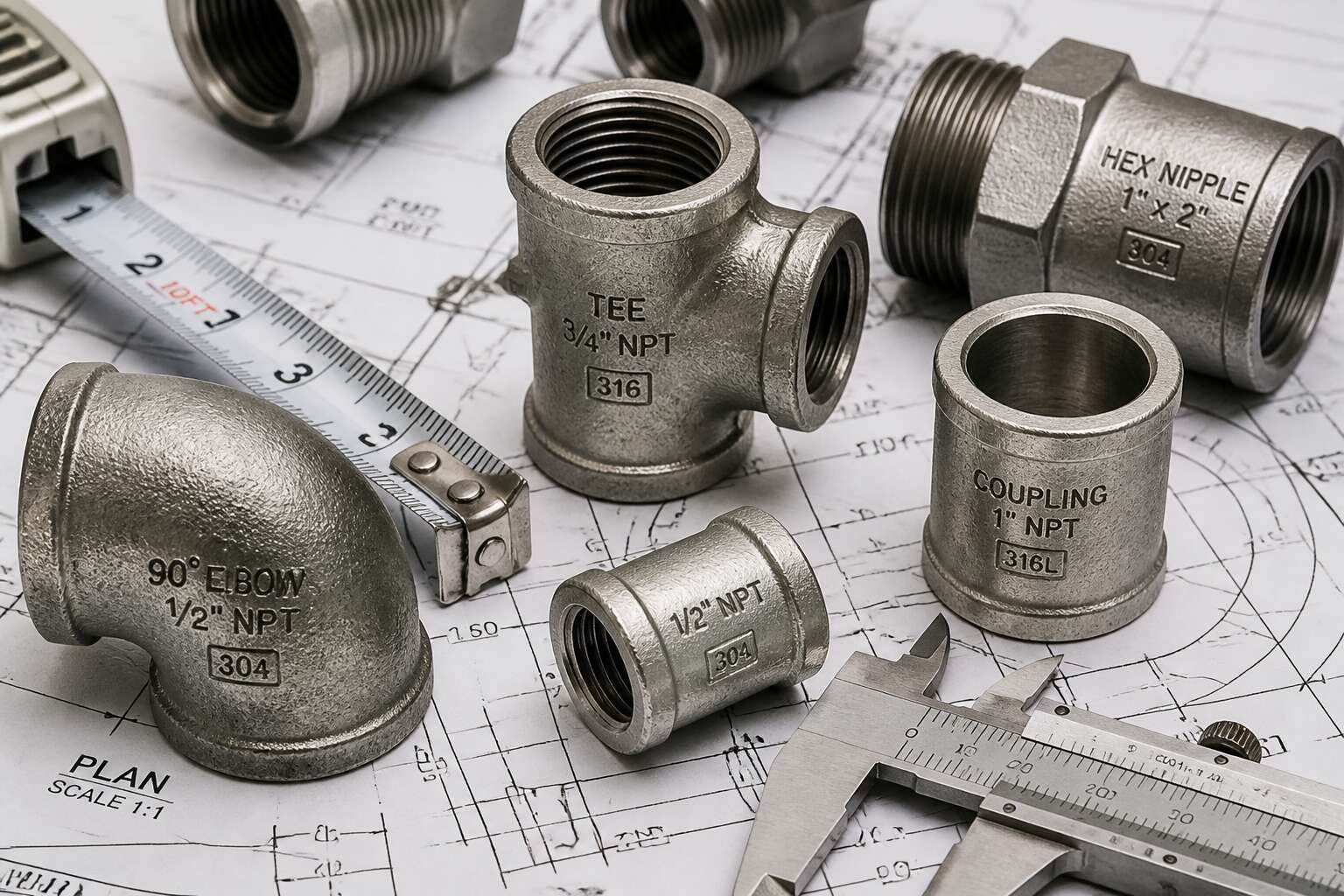
The Essential Nipple and Coupling Shortcuts
NPT and NPS Explained
In the trade, the difference between a secure joint and a costly leak often comes down to a string of letters. A 2019 survey of plumbers and engineers in Gauteng revealed that nearly 60% of callbacks were traced back to the misreading of these critical identifiers. The confusion usually begins with the fundamental distinction between NPT and NPS, which are the workhorses of your pipe fitting abbreviations.
National Pipe Tapered (NPT) threads rely on a tapered profile to create a mechanical seal through interference, while National Pipe Straight (NPS) threads demand a gasket or sealing compound. The thread geometry itself dictates the purpose. Tapered threads wedge themselves tighter under pressure, making them ideal for fluid lines where vibration might loosen a straight thread. Straight threads, in contrast, are precise and machined, often used in mechanical applications where sealing relies on the compression of a soft face.
This divergence is crucial when reading a spec sheet for a Durban petrochemical plant or a residential installation in Cape Town. Selecting the wrong profile breaks the joint, plain and simple. The shorthand gets even stickier with the sizes. A 1/2 inch NPT fitting does not measure 1/2 inch across the outside. The nominal size references the approximate inside diameter of the pipe, not the thread’s actual physical width. Misreading this dimension remains a primary reason for stripped connections in stainless steel systems.
Consider these common points of failure found in the field:
– Forgetting that NPT threads are slightly wider at the end than the base, requiring a different reaming tool.
– Assuming an NPS fitting will thread onto an NPT port, a mistake that guarantees a cross-threaded mess.
– Overlooking the pitch, which is the distance between threads, because a coarse pitch and fine pitch look identical to the untrained eye.
Understanding these pipe fitting abbreviations forces you to check the taper and the pitch before you ever lay a wrench on the fitting. The visual difference is subtle, but the pressure rating change is immense. You must know that a straight thread holds position, while a tapered thread holds pressure. This knowledge is the line between a system enduring its specified rating and one that fatigues and fails at the union. Every spec sheet demands a moment of quiet verification, not a guess.
FIP and MIP Designations
Walking a supplier floor in Gauteng, the letters FIP and MIP appear on nearly every bin. These pipe fitting abbreviations tell you the mating orientation instantly. FIP, Female Iron Pipe, are internal threads. MIP, Male Iron Pipe, are external. A nipple uses MIP on both ends to penetrate a coupling, while a coupling relies on FIP to capture that nipple.
The shortcut saves real time on a mixed installation. When a spec calls for 15mm MIP for a Geyser valve, you know the external thread faces the water line. Check these field conditions:
- Match the thread count to the pressure rating.
- Confirm the bore size matches the nominal specification.
- Verify the orientation, internal or external, against the drawing.
For a sensor housing, you might need FIP to accept a probe. A frequent slip is ordering a complete nipple when you only need a thread rod with MIP on one side and a hex head on the other. Verify the orientation before you cut!
Understanding SW and LW Codes
Pick up any nipple and coupling batch and the stamped letters tell a deeper story. SW, meaning socket weld, signals a recessed bore that holds the pipe end while a fillet weld seals the joint. LW, short for leakproof weld, calls for full penetration at the collar.
These pipe fitting abbreviations are not interchangeable. A socket weld nipple fits into a countersunk coupling, while an LW coupling demands a clean, square pipe cut and a certified welder.
On a Cape Town site, you might see both codes on one order sheet:
- SW for high-pressure steam branches.
- LW where vibration could crack a shallow weld.
The Difference Between FNPT and MNPT
On a piping order sheet, the letters FNPT and MNPT are the difference between a coupling that slides over a pipe and a nipple that threads into a fitting. FNPT means female national pipe taper, the threads cut inside the bore. MNPT marks the male threads on the outside of a nipple. These pipe fitting abbreviations save a line of description once you know which end you are looking at.
A nipple typically carries MNPT on both ends. A coupling carries FNPT internally. When a spec calls for a nipple and coupling set, these pipe fitting abbreviations tell the fitter which side is which.
- FNPT on a coupling: the pipe screws in.
- MNPT on a nipple: the fitting screws on.
- A close nipple uses MNPT on both ends with no bare pipe between.
The thread direction dictates the joint. Mixing them up, say a male nipple into a male threaded valve, means the threads clash and the joint fails.
Common Reducer and Bushing Notations
A spec sheet rarely says “reducer” without a size pairing. The true shorthand sits in the numerals. A 25 x 15 mm reducer tells you the larger bore and the smaller bore in one breath. This is where pipe fitting abbreviations pull their weight.
Concentric reducers keep the centreline true, while eccentric reducers align one side flat to prevent air pockets. Bushing notations are tighter still! A bushing is a solid block with both thread sizes cut into it. The abbreviation “RED” or “BUSH” prefixes the dimensions.
For nipples and couplings, the shortcuts are length and style. “CL” stands for close, meaning threads run the full length. A “hex coupling” uses a hex exterior for wrenching, while a “reducing coupling” joins two sizes directly.
Consider these common callouts:
- C x E means concentric by eccentric
- H x F means hex bushing to female
- S x M means socket weld to male
These combinations save a line of description and prevent a fitter from ordering the wrong piece.
Dimensional and Connection Type Notations
ANSI and ASME Standards in Fitting Markings
The ANSI and ASME standards quietly govern how a fitting reveals its dimensional truth. A marking like “Class 150” or “3000” is not decorative. It tells the installer the pressure-temperature ceiling, the exact wall thickness, and the connection type expected at the flange face. These notations are part of the broader pipe fitting abbreviations language that keeps a plant running safely in Johannesburg or Durban.
Look at a forged steel fitting: the schedule number, the material grade, and the standard reference, such as ASME B16.11. Each element maps to a specific dimension. The connection type notation, whether BW (buttweld), THD (threaded), or SO (slip-on), determines the installation method. Misreading these codes can lead to a leak.
- SCH 40 or SCH 80 for wall thickness
- Class 150 or 300 for pressure ratings
- A105 or 316L for material composition
These markings do not exist in isolation. They work as a system that rewards the careful reader.
Flange and Fitting Classifications
The bolt circle diameter is the silent architect of a flanged connection. In pipe fitting abbreviations, the face type changes that geometry completely. A raised face (RF) flange seats a gasket within a confined area, while a flat face (FF) relies on full surface contact. These notations are dimensional keys, not decorative stamps.
Compare a 300 weld neck flange with a 150 unit. The pressure class dictates the hub length, the ring thickness, and the bolt hole count. Each upgrade shifts the physical envelope. For plants along the Vaal Triangle and the coast, mixing these classifications is a recipe for leakage.
- RF faces demand a thicker gasket and higher bolting torque.
- FF faces need full contact for fragile piping materials.
- RTJ (ring type joint) seals are reserved for extreme pressure services.
Connection type notations also govern dimensions. A buttweld (BW) fitting distributes stress through the pipe wall, whereas a threaded (THD) connection relies on thread engagement. The classification you specify determines which tolerance rules apply. Remember that pipe fitting abbreviations carry the weight of a plant’s integrity.
Slip-On and Hub Connection Acronyms
A plant shutdown often traces back to two letters on a drawing. Slip-on flanges use the acronym SO, and they attach by sliding over the pipe before welding. The hub is the short tapered section that carries the stress. In pipe fitting abbreviations, a hub connection may appear as HU, though many plants now spell it out to avoid confusion.
Dimensional tolerance for an SO hub depends on the pressure class. A 150 pound hub stays short, while a 300 pound hub grows thicker and taller. Mixing these dimensions causes leaks. The connection type dictates measurement points: from the face to the hub shoulder, not the pipe end. One wrong decimal on an order sheet costs real rand.
Material-Specific Acronyms for Piping Components
PVC, CPVC, and ABS in Context
Three letters can determine whether a pipeline lasts decades or collapses within a year. PVC, CPVC and ABS are material acronyms that govern temperature tolerance, chemical resistance and installation method. Misreading these pipe fitting abbreviations means selecting a product that fails under real pressure. PVC suits cold water and drainage, while CPVC tolerates hot water up to 200 degrees Fahrenheit due to its chlorinated structure. ABS delivers impact strength, making it a staple for sanitary waste lines.
These labels appear on every fitting, yet their implications are often ignored! I have seen premature failures from confusing the materials.
- PVC: best for low temperature and corrosive environments.
- CPVC: designed for high heat applications like domestic hot water.
- ABS: known for durability in underground drainage.
The choice demands attention because each abbreviation carries a physiological limit.
Copper and Brass Fitting Markings
Copper and brass fittings carry stamped codes that are easy to misread. On a South African job site, DZR might appear on a valve body. That stands for dezincification resistant, critical for brass exposed to aggressive municipal water. Copper tube markings often read Type K, L, or M, but the pipe fitting abbreviations tell a different story. C refers to copper content, while W indicates wrought construction. These letters separate cast fittings from forged ones.
I have seen brass fittings fail because the alloy was misread. DZR brass prevents zinc leaching that weakens fitting walls over time. Non-DZR brass can fail quietly in corrosive water.
Common abbreviations on copper and brass components:
- DZR: dezincification resistant brass
- Cu: copper
- BR: brass
- W: wrought
The lettering is small, often hidden under flux or scale. Scrape it clean and read it properly! These pipe fitting abbreviations reveal more than size. They reveal the material’s integrity under stress.
Stainless Steel and Alloy Designations
Stainless steel components speak a language of alloy designations rather than thread types. On a coastal plant near Durban, a spec might call for 316L. The L indicates low carbon, which prevents carbide precipitation during welding. Miss that suffix and the fitting risks intergranular corrosion. CF8M, meanwhile, marks the cast equivalent of wrought 316. These pipe fitting abbreviations are metallurgical signatures that determine chloride resistance and weldability.
Common stainless codes appear on valve bodies and flanges:
- SS: stainless steel base
- 304: standard chrome nickel alloy
- 316: adds molybdenum for saltwater resistance
- L: low carbon for welded joints
- H: high carbon for elevated temperature service
Reading the stamped alloy tells you whether the fitting survives Johannesburg’s acidic mine water or Cape Town’s aggressive municipal supply. A 316L fitting outperforms 304 in both cases. These pipe fitting abbreviations encode the material’s endurance, not its size.
Common Non-Metallic Material Codes
Non-metallic materials carry their own pipe fitting abbreviations, and they often matter as much as the thread geometry. EPDM, or ethylene propylene diene monomer, resists hot water and ozone, making it a standard in municipal systems. PTFE, polytetrafluoroethylene, appears on gaskets and valve seats where chemical inertness is non-negotiable. Consider these common codes:
- NBR: nitrile rubber for oil and fuel contact
- FKM: fluoroelastomer for high heat and acids
- CR: chloroprene for weather resistance
A single letter can change a fitting’s lifespan. NBR works fine in a workshop hose but swells in a chlorinated line. That is why reading the stamped material code is as critical as checking the pressure rating. These pipe fitting abbreviations reveal what the component will tolerate before it fails.
Pressure and Temperature Rating Abbreviations
Deciphering Class and Schedule Ratings
Pressure ratings dictate safety. Temperature ratings govern material limits. Together they define a fitting’s lifespan. In the world of pipe fitting abbreviations, Class and Schedule stand apart. Class (CL) applies to flanges and cast fittings. Schedule (SCH) applies to welded and threaded pipe. Both answer one question: how much pressure can this withstand?
Common markings you will encounter:
– CL150, CL300, CL600
– SCH40, SCH80, SCH160
Flanges use Class with a psi value at a specific temperature. Schedule uses wall thickness as the variable. Higher SCH means thicker walls. Thicker walls handle more pressure. Temperature shifts alter these numbers. A CL150 flange at 260°C rates differently than at 38°C. Keep this in mind when selecting South African stock.
Understanding PN, WOG, and CWP
Pressure ratings hide in the letters PN, WOG, and CWP. These pipe fitting abbreviations serve a different purpose than Class or Schedule. PN, or Pressure Nominal, is a European standard that rates fittings in bars. A PN16 fitting handles 16 bar at ambient temperature. WOG stands for Water, Oil, Gas. It marks the working pressure for those three services. CWP means Cold Working Pressure. It applies at lower temperatures, typically under 100°F.
- PN16, PN25, PN40
- WOG 200, WOG 400
- CWP 300, CWP 600
Here is the catch! These ratings shift with heat. A WOG rating at 38°C drops significantly at 120°C. I regularly see PN markings on imported stock in South African supply yards. When reading these pipe fitting abbreviations, remember that temperature is the governing factor. Always check the temperature column on the spec sheet.
Temperature Derating Terminology
Here is where the math gets honest. Temperature derating is the practice of lowering a fitting’s pressure rating as the mercury climbs. Most spec sheets show a derating curve, not a single number. Some pipe fitting abbreviations hint at this, but the real story lives in the charts.
Take a standard fitting stamped 200 WOG. At 38°C, you get the full pressure. At 120°C, expect the rating to drop by 15 to 30 percent depending on the material and the gasket material.
Common temperature derating benchmarks:
– 38°C ambient, full rating applies
– 66°C moderate derating for most plastics
– 93°C significant reduction for elastomeric seals
A numeric rating alone is meaningless without the temperature column. Always pair these pipe fitting abbreviations with the ambient conditions. South African supply yards bake in summer, so ignoring derating is a costly gamble.
Common Testing and Rating Acronyms
A rating without a testing acronym is a guess. Reading pipe fitting abbreviations means separating what a component can handle from how that claim was verified. Testing acronyms carry the burden. HST refers to hydrostatic testing, where a fitting is water filled and pressurised beyond its working limit. PT marks a generic pressure test, often using air or nitrogen. These appear on certificates, not always on the fitting.
MAWP, maximum allowable working pressure, is the design limit. It accounts for corrosion allowance and operating temperature, making it more conservative than a burst rating. BP, burst pressure, is the failure point, usually four to five times the working pressure.
Common testing acronyms to recognise:
- HST: hydrostatic test
- PT: pressure test
- MAWP: maximum allowable working pressure
- BP: burst pressure
South African fittings often carry SANS test marks with different thresholds than ASTM. The pipe fitting abbreviation only matters when you know the standard behind it.
Installation and Inspection Terminology
Hydrostatic Testing Symbols
There is a moment on every job site when the inspector squints at a fitting and then at you. That squint is usually about pipe fitting abbreviations. HYDRO on a test tag means the joint must survive a hydrostatic pressure test, not a casual glance. NDT, non destructive testing, is the quiet cousin here, verifying integrity without wrecking the part.
Hydrostatic testing symbols often travel with pressure units like BAR or PSI. In South Africa, you might see both on the same certificate, which keeps everyone honest. Some inspectors hunt for the API monogram before they sign anything.
Common terms that appear in inspection reports include:
- PMI, positive material identification
- UT, ultrasonic testing
- DP, dye penetrant
Each one is a different level of scrutiny. Knowing these pipe fitting abbreviations keeps your project moving and your inspector smiling, or at least not frowning.
Acceptance Criteria Abbreviations
On any South African installation, the inspector’s stamp on a test sheet decides whether a fitting is acceptable. Acceptance criteria abbreviations tell you precisely what standard that fitting must meet before it earns approval. FAT, factory acceptance test, happens at the manufacturer’s yard. SAT, site acceptance test, happens where the pipe will actually live.
- FAT, factory acceptance test, confirms the fitting meets spec before shipping.
- SAT, site acceptance test, verifies it holds up after installation.
- MTR, material test report, traces the metal back to its melt.
- ITP, inspection and test plan, sets the order of checks.
Without a working grasp of pipe fitting abbreviations, your quality assurance paperwork becomes guesswork. I have watched inspectors flip through MTRs searching for a single heat number, and when they find it, the approval comes quickly! Knowing the difference between FAT and SAT is the difference between a fitting that merely arrives and one that actually performs.
Solvent Cement and Fusion Codes
A solvent weld that fails at 3 a.m. does not announce itself. It just leaks. These pipe fitting abbreviations exist to prevent that silence. The abbreviation SC marks a solvent cemented joint, and it tells the inspector which chemical bond was used. Installers who ignore the difference between SC and a threaded joint invite a slow, invisible failure. On a South African installation, that distinction matters during the first pressure test and every year after.
Fusion codes demand the same respect. HF means heat fusion, the butt-welding method for HDPE. EF means electrofusion, where an embedded coil melts the joint from within. These pipe fitting abbreviations separate a permanent bond from a temporary fix. An inspector checks the code before the trench is closed, because after that, the pipe is out of reach. That is the moment a single letter can save a pipeline.
Torque and Assembly Notations
Torque is where pipe fitting abbreviations become essential. The notation FT-LB tells an installer exactly how much force a joint needs. N-M does the same for metric systems. Guesswork at this stage creates leaks that show up during hydrostatic testing, not during assembly.
Inspection terminology has its own shorthand. VT means visual test, the first check every joint faces. RT and UT go deeper, using radiography or ultrasound to find flaws the eye cannot see. These pipe fitting abbreviations are not suggestions. They are contractual requirements on most South African projects.
Some assembly notations appear as simple directives:
- HT means hand tight.
- TT means torque to spec.
- WR means wrench tight.
Each one changes the method of assembly. A worker who confuses HT with WR may overstress a brass fitting. That mistake costs time and money. The abbreviations exist to prevent it.
Safety and Certification Markings
Certification markings turn a component into a documented promise. In South Africa, the SABS mark and NRCS approval are the ones inspectors recognise instantly. A missing stamp can halt an entire pipeline. These pipe fitting abbreviations separate verified parts from unverified substitutes. The on-site cost of confusion is simply too high to risk.
Installation crews look for specific pipe fitting abbreviations before any torque is applied. The markings tell them what the fitting can survive. Explosion-proof environments use codes like EE or IIC. Certification stamps link the metal back to a traceable test record. When those markings are absent, responsible contractors stop and escalate. It is a quiet but firm discipline.
Common certification references on local projects include:
- SABS, the South African Bureau of Standards mark
- NRCS, the National Regulator for Compulsory Specifications
- MTC, or mill test certificate, for material verification
These marks are not decorative. They are legal traceability. Hydrostatic testing proves a joint on a given day. Certification proves the fitting was manufactured to a standard from day one. Both readings matter to a project that must last decades.

0 Comments