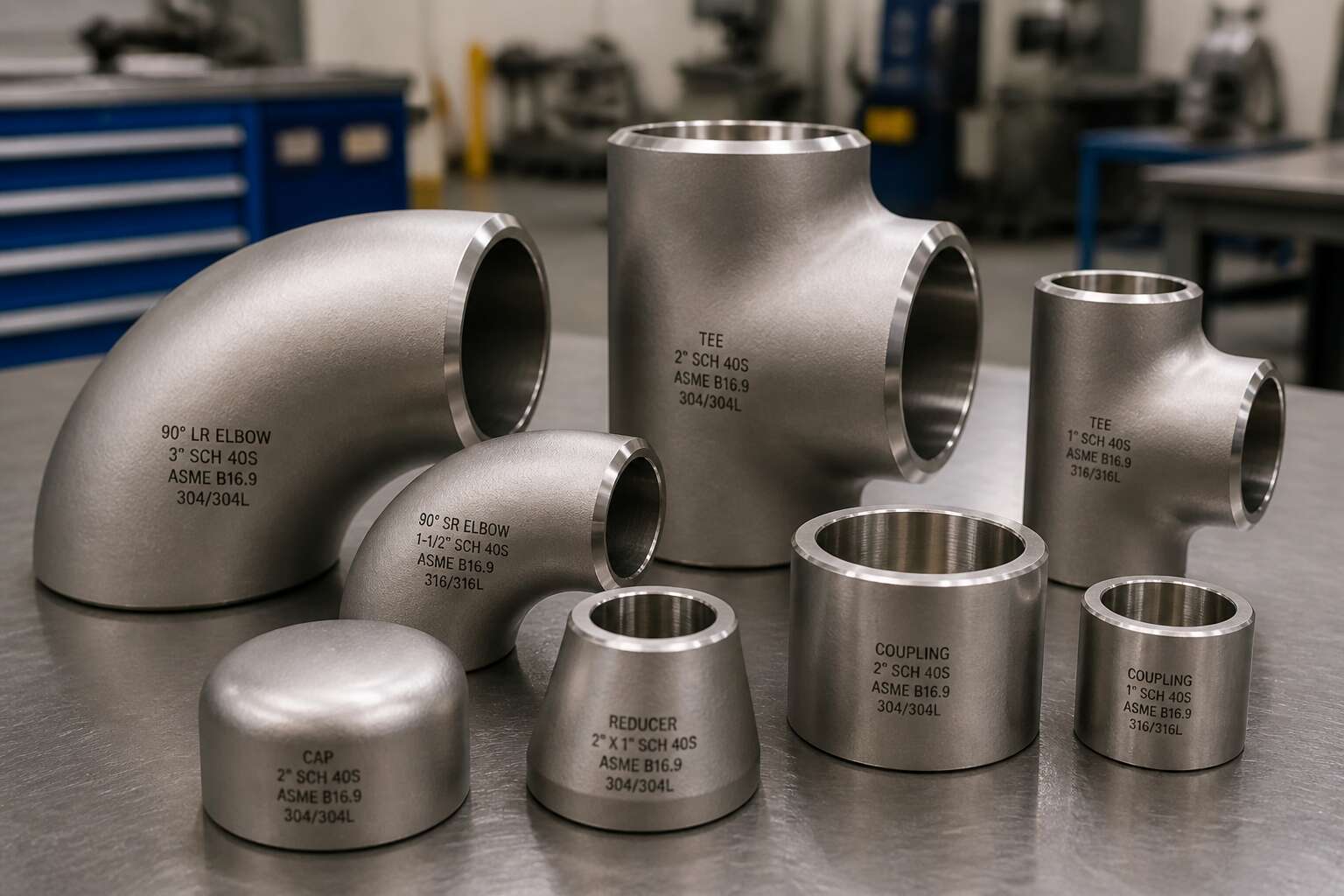
Understanding the ASME B16.9 Standard
What Does ASME B16.9 Cover?
Precision is the price of admission in high pressure piping. One dimensional error, a few millimetres off on a bore or face, can cascade into catastrophic system failure. That is why the industry leans so heavily on the ASME B16.9 standard. This specification governs the design and manufacturing of factory made wrought steel buttwelding fittings, ensuring that a 90 degree elbow from Durban mates perfectly with a tee fabricated in Johannesburg. It is the benchmark for dimensional accuracy, and it is not optional.
The standard does more than just dictate physical size. It sets strict tolerances for wall thickness, angularity, and overall alignment. For pipe fittings asme b16 9, the rules define everything from the radius of the bend to the exact length of a stub end. You cannot simply cut a straight pipe and bend it; the standard demands consistency across the entire production run.
Specifically, ASME B16.9 covers a range of critical parameters:
– Dimensional requirements for all fitting types, including elbows, tees, reducers, and caps.
– Tolerances for outside diameter and wall thickness.
– Marking requirements to ensure traceability of material and heat codes.
– Testing procedures to verify the integrity of the finished product.
Ultimately, this standard is the common language between fabricator and engineer. When a spec sheet calls for pipe fittings asme b16 9, everyone knows exactly what will arrive on site. It removes guesswork from the procurement process and provides a legal baseline for quality control. For any project manager, this document is the first line of defence against substandard components.
Key Terminology and Definitions
In piping, a ‘nominal’ size is rarely the actual size. Nominal pipe size, or NPS, is a standard designation, not a physical measurement. A two inch fitting measures close to two inches outside, yet the bore shifts with the schedule. The schedule dictates wall thickness and governs pressure capacity.
For pipe fittings asme b16 9, these terms carry contractual weight. If a spec calls for schedule 40, you cannot deliver schedule 80! The standard locks down the precise definitions. You will see these terms on datasheets:
- Bevel end: the angled edge prepared for buttwelding.
- Stub end: a short pipe section used with lap joint flanges.
- Bore: the internal diameter of the fitting.
ASME B16.9 uses these definitions to remove guesswork. When a supplier in Durban quotes pipe fittings asme b16 9, the bevel angle, bore tolerance, and wall thickness are fully specified. That consistency keeps a high pressure line safe.
Material Specifications and Grades
One mislabeled grade can close an entire refinery for days. For pipe fittings asme b16 9, the standard does not invent new alloys. It simply references existing material specifications. That is why a 304L fitting and a 316L fitting share identical dimensions. The difference lives entirely in the chemistry.
- ASTM A403 for stainless steel, split into WP and CR classes.
- ASTM A234 for carbon steel, covering WPB and WPC.
- ASTM A420 for low temperature service.
The standard also demands traceability. Each heat of material must carry a mill certificate. Without it, you cannot verify the exact composition. This matters in South African plants where a mismatched grade can fail without warning. Always demand that certificate with your delivery.
Dimensional Tolerances and Marking Requirements
A fitting that measures perfectly on paper can still fail in the field if its markings lie. ASME B16.9 sets dimensional tolerances that govern wall thickness, centre-to-end dimensions, and out-of-roundness for pipe fittings asme b16 9. These tolerances exist because every weld joint depends on precise alignment. A few tenths of a millimetre may decide whether a pipeline holds pressure or leaks at the seam.
Marking requirements are equally unforgiving. Every fitting must carry the manufacturer’s name, grade, size, and the B16.9 designation. Heat numbers connect each piece to its mill certificate. For South African plants, this traceability is the difference between a routine shutdown and a catastrophe.
Here is what inspectors check first:
- The stamp’s legibility and placement
- The heat number’s match with documentation
- The wall thickness at both ends
Ignore these details, and you are betting the entire pipeline on a stamp you cannot read.
Common Types of ASME B16.9 Pipe Fittings
Elbows and Bends for Directional Changes
Somewhere in South Africa, a pipeline is about to turn right. Elbows and bends negotiate such corners with a precision that straight pipe cannot offer. The ASME B16.9 standard governs these directional changes, specifying exact radii so that engineers can anticipate pressure loss rather than discover it the hard way.
A 90 degree elbow is the most common specimen. It turns the flow abruptly, which suits cramped plant rooms. The 45 degree variant offers a gentler transition, and long radius elbows reduce friction for high velocity lines. Choosing between them is a matter of manners as much as mathematics.
Common options include:
– 45 degree elbows for subtle adjustments
– 90 degree elbows for standard turns
– Long radius elbows to ease flow
– Short radius elbows for tight spaces
Each fitting in the pipe fittings asme b16 9 family has a role. Selecting the wrong one is a social faux pas that your pressure gauge will not forgive. For South African industrial sites, where space is often at a premium, the short radius elbow is a frequent guest. The pipe fittings asme b16 9 catalogue rewards those who study their bends.
Tees and Crosses for Branch Connections
Flow rarely travels in a straight line. When a pipeline must split or combine service, tees and crosses handle the junction. The ASME B16.9 tee creates a clean 90 degree branch from a main run. It redistributes pressure without forcing site welders to shape custom outlets. Equal tees keep the branch at the same nominal size, while reducing tees taper the outlet to match downstream conditions.
Common configurations include:
– Equal tee for identical branch and run sizes
– Reducing tee for a stepped down outlet
– Cross fitting for four way flow paths
The cross appears less often because it concentrates stress from every direction at one node. Still, South African mining and water operations rely on the cross where space rules out paired elbows. These pipe fittings asme b16 9 components carry specific pressure ratings and dimensional schedules. The same standard governs both tees and crosses, so engineers can compare options with confidence. Choosing correctly means the difference between a stable junction and a persistent leak.
Reducers for Diameter Transitions
A pipeline rarely maintains a single diameter from source to destination. When the service must transition between sizes, the reducer takes over. The pipe fittings asme b16 9 standard covers these essential components, which are engineered to handle the resulting velocity changes and pressure shifts. These fittings come in two primary forms, each suited to a specific physical orientation.
The eccentric reducer keeps the pipe centreline on one side flat. This design is critical for horizontal runs where air pockets must be avoided, or where drainage is a priority. The concentric reducer, on the other hand, tapers evenly from the larger end to the smaller. It is the go-to choice for vertical lines and pump suction applications where maintaining a symmetrical flow profile matters.
– Eccentric reducers: Prevent air trapping in horizontal piping systems.
– Concentric reducers: Maintain equal wall thickness and axis alignment.
In the field, the decision often comes down to gravity and flow dynamics. I have seen many a site team struggle with cavitation issues that were traced back to an improperly specified reducer. The inner profile affects the liquid’s path. The transition zone must be smooth. A sharp lip or an off-centre bore creates turbulence and accelerates erosion. Proper selection of these pipe fittings asme b16 9 parts ensures a steady, reliable connection between different sized lines. Whether you are dealing with mine dewatering systems or high rise building services, the reducer is the quiet workhorse that keeps the flow moving forward. The manufacturer’s tolerance on the bore and the schedule of the metal both play a role in long term service life.
Caps and Plugs for Pipe Closure
Every pipeline eventually needs to stop. Caps and plugs perform the quiet work of closure. A cap welds over the pipe end, sealing the line entirely. A plug seats inside the fitting, offering a removable barrier that keeps pressure contained while allowing future access.
The pipe fittings asme b16 9 standard governs the dimensions and pressure ratings for both. Butt weld caps handle high pressure and permanent service. Threaded plugs suit low pressure lines where access matters. I have watched site teams cut off a welded cap for a routine inspection, costing hours that a plug would have saved.
Within the same standard, closure options vary by bore size and service. The common forms are:
- Butt weld caps: permanent, high pressure closures.
- Threaded plugs: removable, threaded into a boss or coupling.
- Socket weld plugs: compact closure for small bore lines.
Stub Ends and Lap Joint Flanges
Stub ends and lap joint flanges solve a problem that fixed flanges cannot. The stub end welds to the pipe, while the lap joint flange rotates freely behind it. That freedom means bolt holes can align without spinning the entire pipe section, which saves real time in tight corners and on long runs.
For pipe fittings asme b16 9, the stub end dimension follows the same schedule as the pipe itself. The flange pressure rating must match the system, and the gasket seats against the faced stub end. I have seen maintenance crews thank this design when a pump needs removal in under an hour.
The useful variants are:
- Long pattern stub ends for larger bores where bolt access is tight
- Short pattern stub ends for compact installations
- Lap joint flanges with raised faces for standard gasket seating
Manufacturing Processes and Quality Control
Seamless vs. Welded Fittings
The manufacturing process determines whether a fitting can withstand the pressures of its intended service. Seamless fittings begin as a solid billet of steel, heated and pierced to form a hollow shell. This process eliminates any longitudinal seam, which is why seamless fittings are preferred for high-pressure and high-temperature applications. Welded fittings, by contrast, are formed from plate or strip that is rolled and joined along a single seam. The weld itself becomes the critical point of inspection.
Quality control for pipe fittings asme b16 9 demands rigorous testing at every stage. Dimensional verification ensures compliance with the standard’s strict tolerances. Non-destructive examination methods detect internal flaws that might otherwise go unnoticed. Common techniques include:
- Radiographic testing to reveal subsurface discontinuities
- Ultrasonic testing to measure wall thickness and detect laminations
- Liquid penetrant inspection for surface cracks
For seamless fittings, the inspection focuses on surface defects and wall thickness consistency. For welded fittings, the weld seam receives additional scrutiny, including hardness testing and visual examination of the weld profile. I have seen the difference this makes in the field with pipe fittings asme b16 9, and it is never subtle.
Hot Forming and Cold Forming Techniques
Hot forming begins with heating steel above its recrystallization temperature. The material becomes ductile, allowing substantial deformation with less mechanical force. This technique suits thick wall sections and complex geometries. Cold forming, by contrast, shapes the steel at ambient temperature. The process imparts strength through strain hardening while preserving a cleaner surface finish.
In my own work, I have seen both processes shape pipe fittings asme b16 9 in ways that affect ductility and residual stress. Hot forming alters the grain structure to relieve internal stress. Cold forming delivers tighter dimensional accuracy but may require subsequent heat treatment to restore ductility.
Consider the tradeoffs:
- Hot forming handles larger reductions in cross section.
- Cold forming delivers superior surface quality and tolerance control.
- Both methods demand careful monitoring of temperature and pressure.
Heat Treatment Procedures
Quality control begins before the first weld or forming pass. Material verification is the first gate, where mill certificates are cross-checked against the specified grade and chemical composition. Traceability matters in South African projects, where penalties for premature failure are severe.
Once forming is complete, heat treatment procedures for pipe fittings asme b16 9 determine whether the fitting will survive its service life. The schedule depends on the base metal and the degree of cold work introduced during shaping. Austenitic stainless steels often require solution annealing. Carbon steel fittings may need normalizing or post-weld heat treatment.
Common procedures include:
– Solution annealing to dissolve precipitated carbides
– Normalizing to refine grain structure
– Stress relieving to reduce internal stresses
Every batch must pass dimensional inspection and hardness testing before release. I have seen fittings fail when shortcuts are taken in this stage. South African engineers rely on these procedures to ensure fittings perform under high pressure and corrosive media.
Non-Destructive Testing and Inspection
Heat treatment alone does not guarantee a fitting will survive. Non destructive testing is where hidden flaws reveal themselves. For pipe fittings asme b16 9, the inspection phase separates reliable components from latent failures.
Radiographic testing examines internal soundness of welds and parent metal. Ultrasonic testing catches laminations and inclusions that radiography might miss. Dye penetrant inspection reveals surface cracks in austenitic stainless steel fittings.
- Hydrostatic testing proves pressure containment
- Positive material identification confirms alloy composition
- Dimensional verification checks against ASME tolerances
I have watched third party inspectors reject entire batches based on a single questionable reading. South African engineers demand these procedures because a small flaw can fracture with little warning. Certified reports travel with the fitting from factory to site. That documentation is the final proof of quality.
Industry Applications and Selection Criteria
Oil and Gas Piping Systems
When a refinery on the Highveld starts acting up, the culprit is rarely the pipe. It is usually the fitting. In South Africa’s oil and gas sector, pipe fittings asme b16 9 are the components that keep hydrocarbons moving from Sasolburg to the coast. Selecting them is part engineering, part common sense.
Selection criteria start with pressure and temperature ratings, but the real test is corrosion resistance. Sour gas service demands materials that hold their ground. Engineers weigh up:
- The operating environment, from coastal humidity to inland dust
- Fluid composition, especially hydrogen sulfide content
- Maintenance access, because nobody enjoys digging up a buried line
Mismatched alloys still appear in the field. A carbon steel fitting in a stainless line is a recipe for unplanned shutdowns. Match pipe fittings asme b16 9 to the parent pipe’s metallurgy and the system runs without drama.
Chemical and Petrochemical Plants
Chemical and petrochemical plants demand more from pipe fittings asme b16 9 than any other industrial setting. The fluids are aggressive, the cycles are punishing, and the margin for error is thin. A fitting can fail silently and bring a Secunda unit down within hours.
These facilities expose pipe fittings asme b16 9 to chlorides, caustics, and organic solvents. Temperature cycling causes thermal fatigue. The grain structure matters as much as the alloy grade. We often trace failures to a fitting that met the pressure rating but ignored the corrosion mechanism.
Engineers should weigh:
– Service life expectations between scheduled turnarounds
– The compatibility of every fitting with cleaning chemicals
These decisions lack glamour. They determine whether a plant operates for twenty years or is scrapped early.
Power Generation and Water Treatment
At a typical Eskom power station, the condensate loop carries water stripped of oxygen but still holding trace chlorides. These attack pipe fittings asme b16 9 in ways that pressure calculations never predict. Temperature swings between cold start and full load create cyclic fatigue, especially in feedwater heater connections.
Water treatment plants face a similar challenge. Chemicals used for pH correction and disinfection, sodium hypochlorite and sulphuric acid, are relentless. Fittings must resist internal corrosion and external corrosion from humid, chemical laden air. Selection criteria here differ from other industries. Engineers should weigh:
- The exact water chemistry, not just nominal flow rates
- Frequency of chemical shocking or cleaning cycles
- Thermal expansion forces from neighbouring equipment
These factors, more than catalogue ratings, determine how long pipe fittings asme b16 9 last on site.
Pressure Ratings and Temperature Limits
Pressure ratings are quoted at ambient temperature, but service conditions rarely match that ideal. A pipe fittings asme b16 9 that handles 150 psi at 20°C may lose half its allowable stress at 400°C. Engineers must read the derating curves, not the headline numbers.
South African plants face particular strain. High ambient temperatures and aggressive cooling water narrow the gap between rated and actual conditions. The critical checks:
- The pressure rating at maximum sustained temperature, not nominal values
- The effect of thermal cycling on fatigue life
- How the specified end connections alter the pressure boundary
Every rating carries a hidden set of assumptions about temperature, cycle frequency, and connection integrity.
Matching Fittings with Pipe Schedules
Selecting a fitting is not about the nominal size on the tag. In South African process plants, the real question is whether the fitting’s wall thickness actually matches the pipe schedule upstream. A schedule 40 pipe joined to a schedule 80 fitting creates a pressure boundary mismatch, and that transition becomes the weak link under thermal stress. I have seen this exact issue cause premature failure in a mining slurry line.
The industries I work with, from petrochemical to water treatment, all face the same challenge: schedule mismatches introduce turbulence and erosion at the weld neck. The choice of pipe fittings asme b16 9 must be verified against the pipe’s actual bore, not just the outside diameter.
- Check the schedule number on both pipe and fitting
- Confirm the inside diameter matches for smooth flow
- Verify the material grade aligns with the pipe specification
Getting this right means the assembled system behaves as one continuous pressure vessel, which is exactly what the standard intends.
Installation, Maintenance, and Compliance
Welding and Joining Best Practices
Installation of pipe fittings asme b16 9 demands discipline before a single arc strikes. Verify the mating surfaces, check the fit-up gap, and ensure the bevel matches the welding procedure specification. In South African plants, humidity and dust already add complications; adding negligence finishes the job. Welders must control heat input because the fitting’s wall thickness dictates interpass limits, not a vague preference. Compliance with ASME B16.9 also requires documentation. Every joint deserves a record, from batch number to welder stamp. Maintenance comes later but starts now. A poorly aligned fitting creates stress concentrations that ultrasonic testing will eventually expose. Follow these steps:
- Clean the component ends with approved solvents.
- Align within twice the wall thickness tolerance.
- Use backing gas to prevent oxidation on stainless steel.
Then inspect, record, and move forward. The standard cannot save you from a sloppy tack weld, but honest adherence to its dimensions will.
Proper Alignment and Fit-Up
In South African process plants, the difference between a fitting that endures and one that fails often appears in the first few millimetres. Proper alignment and fit-up of pipe fittings asme b16 9 dictate how the joint handles thermal cycling and vibration.
Fit-up demands precision. The gap between pipe and fitting must respect the specified root opening, and the bevel angle must match the welding procedure. Misalignment beyond half the wall thickness creates uneven stress distribution.
- Check the internal alignment with a bore gauge.
- Secure the fitting with tack welds at equidistant points.
- Re-measure after every clamp adjustment.
Maintenance starts at installation. A clean surface prevents weld defects that later become leak paths. Compliance requires recording the batch number and the fitter’s identity, because traceability matters when a line fails. For pipe fittings asme b16 9, the standard is the contract.
Corrosion Protection and Coating Options
In South African process plants, corrosion waits in the shadows of every uncoated joint. For pipe fittings asme b16 9, the fight starts before the first weld cools. Installation crews must understand that surface preparation determines coating longevity. Blast cleaning to SA 2.5 removes mill scale and rust, exposing bare metal that accepts protective layers properly.
Once installed, maintenance becomes a routine of inspection and touch-up. High-temperature service demands specialised coatings, while chemical exposure requires resistant epoxies. Galvanising suits milder environments but fails under aggressive conditions.
Consider the coating system before installation:
– FBE for underground lines
– PTFE for chemical resistance
– Inorganic zinc for atmospheric exposure
Compliance with the standard ensures dimensional accuracy, but only disciplined coating practices keep pipe fittings asme b16 9 alive through decades of harsh service.
Common Installation Mistakes to Avoid
A pipe fitting that arrives at your site in perfect ASME B16.9 trim is just art waiting to be ruined. The fitting itself plays no tricks. It is the installers, often in a hurry to beat the weather, who turn precision steel into a headache. You will not find a single fitting that misbehaves, not a one. But you will find plenty of engineers pulling hair out over a spool that now sits one millimetre too tight because someone rushed the gap.
Force is the enemy. When a pipe does not line up perfectly, the instinct is to pull it into place with a come-along or shift it with a hammer. This action creates residual stress at the weld joint. That stored tension shifts during operation, a mystery crack appears months later, and the plant loses a line. You do not fix fittings courtesy of brute muscle. You re-cut and re-fit. When you read your pipe fittings asme b16 9 dimensions, you accept those numbers as a promise, not a suggestion.
Here is what an assembled crew has to confirm before the first arc strike:
1. The inside is clean of debris and moisture.
2. The lands are completely aligned with the pipe.
3. All alignment clamps are released before the final weld pass.
4. The fitter checks the welding gap against the WPS, not against his memory.
Skipping these steps makes mockery of an expensive fitting. Likewise, a heat input that goes over the limit in a bending zone will strip a fitting of its properties. You are no longer working with the ASME standard alloy; you are working with scrap metal that looks correct. There exists a time to mark, and there exists a time to ignite. The absolute rule is that the crew never attempt to match the fitting into a gap that is too close. A snug fit is decent; a overly tight one is a start of a rejection. Keep the standards on site, inspect the full radius of the butt weld, and leave the “we will fix it on the next plant break” mentality for less critical pieces of the machinery.
Standards Updates and Code Compliance
A fitting can meet every pipe fittings asme b16 9 dimension and still fail the moment it meets the pipe. Installation decides that outcome. In South Africa, where plants run hard and maintenance windows shrink, the first installation is your best chance to get it right!
Maintenance follows a simple rhythm. Inspect, measure, record. Wall thickness readings reveal more than any visual scan. Compare those readings against the original pipe fittings asme b16 9 dimensions, and you spot erosion before it becomes a leak. Keep those records close; they protect the next shift.
Compliance standards updates arrive without fanfare. The ASME B16.9 revision you installed last year may differ from the current one. Track those changes in your maintenance manuals. Code compliance rests on current records, not memory.

0 Comments