Understanding Pipe Fittings and AN Fittings
What Are Pipe Fittings? Definitions and Common Types
Pipe fittings are the unsung heroes of any fluid system, but they come with a stubborn identity crisis. When you ask are pipe fittings interchangeable with an fittings, the answer is a firm no. Pipe fittings typically use tapered threads that wedge themselves together to create a seal. Common types include elbows, tees, and couplings. AN fittings, however, rely on a 37 degree flare and a precision nut. They belong to the aerospace world and thrive under vibration and high pressure.
The confusion is understandable. Both look like metal connectors at a glance. Yet mixing them without an adapter invites leaks or worse, a sudden spray of hydraulic fluid. Consider this quick reality check:
– Pipe threads seal by crushing the threads themselves.
– AN fittings seal on the outer cone, not the threads.
– Adapters can bridge them, but that does not make them interchangeable.
So before you force that fitting, measure the thread pitch. Your sanity, and your engine, will thank you.
What Are AN Fittings? Origins and Typical Applications
Picture a hydraulic line on a mining rig outside Johannesburg. A mechanic holds two connectors and asks a question that every workshop faces: are pipe fittings interchangeable with an fittings? I hear this often, and the answer is a firm no. AN fittings originated in the 1940s for military aircraft. They seal on a 37 degree flare with a precision nut. Pipe fittings rely on tapered threads that crush themselves together. That geometric difference explains the incompatibility.
Understanding the two families means respecting their design.
- Pipe threads seal by deformation.
- AN fittings seal on the outer cone.
This design difference matters under vibration and high pressure. AN fittings dominate aerospace and motorsport. Pipe fittings appear in plumbing and industrial lines. So when you ask are pipe fittings interchangeable with an fittings, look at the flare, not the threads. Adapters can bridge them, but that does not make them interchangeable!
Core Differences in Design, Thread, and Intended Use
Look at the threads first! The pitch, the taper, the sealing surface. The question are pipe fittings interchangeable with an fittings answers itself once you see the geometry. A pipe thread wedges metal against metal through tapered crushing. An AN thread is straight, and the seal happens on a precision 37 degree cone. Different geometry, different torque, different failure modes. The taper and the cone do not coexist.
Intended use separates them further. Pipe fittings serve static plumbing where vibration is modest. AN fittings handle hydraulic pulses, fuel lines, and high pressure.
The differences in practice:
- Pipe threads require sealant or tape.
- AN fittings rely on the flare alone.
- AN nuts are sized by dash numbers, not nominal pipe size.
So when someone asks are pipe fittings interchangeable with an fittings, the honest reply is no. Adapters exist, but they do not make the two systems equivalent.
Thread Compatibility and Standards
National Pipe Thread (NPT) vs. AN Thread (UNF)
Do not let appearances deceive you! A single mismatched thread can wreck a fuel line. NPT, the National Pipe Thread, uses a tapered thread that deforms on tightening to create a seal. AN fittings use UNF, a straight 60 degree thread form that depends on a separate O-ring or flared interface. These two standards come from separate engineering traditions, and they are not compatible by design.
So why do people ask are pipe fittings interchangeable with an fittings? Often it comes down to the naked eye. A hydraulic hose and an AN hose can look nearly identical on a workbench. The geometry underneath tells a different story.
The critical differences in thread compatibility:
- NPT is tapered; UNF is parallel.
- NPT seals through thread interference; AN seals through a third component.
- NPT follows nominal pipe sizes; AN sizing uses dash numbers tied to hose inner diameter.
Forcing an NPT male into an AN female will likely gall the threads and leak under pressure. The standards bodies designed them for entirely separate systems, and no amount of brute force will change that.
Why Thread Pitch, Angle, and Diameter Must Match
Thread compatibility is a matter of geometry, not visual similarity. Pitch, angle, and diameter must align within tolerances measured in thousandths of a millimeter. When someone asks me are pipe fittings interchangeable with an fittings, I point to these measurements. A wrong pitch cross-threads instantly. A wrong angle binds or slips. A wrong diameter never seats.
Consider the three critical parameters:
- Pitch: the distance between adjacent threads, expressed as threads per inch. AN uses 20 threads per inch for smaller sizes; NPT pitches vary by pipe size.
- Thread angle: NPT and AN both use the 60 degree profile, which creates false confidence. Pitch still separates them.
- Diameter: nominal pipe sizes do not match actual outside diameter, while AN dash numbers track hose inner diameter.
Standards exist to prevent mismatches. Ignoring them invites failure, which is why the question, are pipe fittings interchangeable with an fittings, remains dangerous for any pressurized system.
Tapered Threads vs. Straight Threads: A Critical Distinction
A tapered thread seals by mechanical deformation. The taper wedges into its mating surface as you tighten it. A straight thread seals by precise geometry alone. It does not wedge. It seats. This distinction carries real consequence in pressurised systems.
So when someone asks, are pipe fittings interchangeable with an fittings, the taper angle and thread form settle the question quickly.
Vibration and thermal cycling expose the difference:
- Tapered threads gradually relax their grip as temperature shifts move the wedge
- Straight threads maintain preload when properly torqued
- Tapered threads require sealant, while AN straight threads seal at the angled face
Both families carry separate standards, and those standards refuse to overlap for a reason. A tapered thread inserted into a straight-threaded port will contact on a single edge, localise stress, and leak under pressure. The two simply do not share the same sealing logic.
When Adapters and Fittings Can Bridge the Gap
The answer to whether are pipe fittings interchangeable with an fittings is not a simple yes or no, but rather a question of context. Between these two worlds, there is a grey zone where adapters create a physical bridge. These adapters are machined with the correct male or female threads on each end, one side speaking the language of NPT while the other speaks the UNF dialect of AN. This mechanical translation allows a system to cross over, but it does not change the fundamental physics at play. The adapter does not fix a mismatched seal; it correctly transitions from one sealing method to another.
Understanding what these components do requires a strict view of their limitations. An adapter is not a universal remedy. It cannot correct a damaged thread or a poorly machined port. It only works when the host components conform to their respective standards.
Consider the practical application of these crossover fittings:
1. Adapters allow you to connect a pressure gauge with an NPT thread to an AN hose end.
2. They enable the use of an AN filter on a vehicle with a factory NPT oil cooler port.
3. They provide a method to transition from a straight-threaded ORB port to a flared AN line.
The real question of whether are pipe fittings interchangeable with an fittings is settled by the integrity of the connection point. A straight thread and a taper will always deform against each other in a single, unpredictable line. The adapter, however, replaces that destructive contact with two separate, correctly sealed joints. It is a practical solution for a mixed system, but it is not a license to mix threads at will. The bridge only holds when the original standards are respected.
Sealing Mechanisms and Fluid Compatibility
Pressure, Temperature, and Fluid Type Considerations
Sealing mechanisms determine real compatibility. AN fittings use a 37 degree flare that bites into the mating surface for a metal to metal seal. Pipe fittings, especially NPT, depend on thread deformation and often need sealant tape or paste. This is why are pipe fittings interchangeable with an fittings is not a simple yes or no. Pressure ratings diverge sharply. AN lines maintain a smooth bore and handle high pressure. Pipe threads leave a spiral leak path under vibration.
Temperature and fluid type also dictate choices. AN o-rings and flares resist synthetic oils well. NPT can weep with thin solvents. Keep these factors in mind:
- Operating pressure and surge spikes
- Fluid temperature range and chemical compatibility
- Thermal cycling and mechanical vibration
If the sealing mechanism is wrong, even perfectly matched threads fail. So, are pipe fittings interchangeable with an fittings? Only with proper adapters and careful derating. Otherwise, prepare for leaks at the worst possible moment.
Common Scenarios Where Mixing May Seem to Work
In the workshop, the temptation to force a fitting is almost spiritual. I have watched a NPT male thread start turning into an AN female port, especially in softer metals. It bites, it holds, it looks sealed. That is the illusion! Threads engage just enough to grip, but the 37 degree flare has nothing to seat against. You have created a hybrid that works briefly.
Common scenarios where mixing seems to work:
- Low pressure fuel return lines on older engines
- Bench testing with thick oils that mask small leaks
- AN to NPT adapters that have been hammered, not torqued
Each one of these is a trap. So, are pipe fittings interchangeable with an fittings? In these moments, the answer feels like yes. Then the system heats up, the metals expand at different rates, and the seal starts talking. A weeping connection is a haunting sound.
Practical Applications and Safety Considerations
Automotive, Marine, and Hydraulic Systems: What Works
On a Cape Town fishing trawler, mixing threads is a gamble with expensive consequences. In automotive and marine systems, the question of are pipe fittings interchangeable with an fittings usually answers itself once you inspect the sealing surface. A pipe fitting relies on a tapered crush, while an AN fitting seals on a 37 degree cone. These are different philosophies.
Consider a hydraulic steering circuit. You might be tempted to use a brass reducer to save a trip to the supplier. The result is often a weep, then a drip, then a complete loss of pressure. The practical hierarchy looks like this:
- AN fittings dominate high vibration, high flow return lines.
- Pipe fittings appear in static, low pressure plumbing.
- An adapter is needed to join mismatched threads.
The marine environment adds galvanic corrosion, and saltwater accelerates every mistake. That alone should end the debate.
The Hidden Risks of Forcing Incompatible Fittings
Temptation whispers that a brass reducer is close enough, but the question of are pipe fittings interchangeable with an fittings answers itself at the moment of contact. A pipe fitting crushes its taper, an AN fitting seats on a cone. Forcing one into the other creates a fracture you cannot see.
In practice, this becomes a safety hazard. High pressure systems store energy. A mismatched thread can release that energy without warning. The marine environment only deepens the peril, as salt creeps into micro gaps.
Consider the hidden costs of a weep that becomes a spray. The repair bill, the downtime, the risk to nearby hands. These are the real expenses.
- Check the thread angle with a gauge.
- Look for a flared seat on the male end.
- Match the thread form, never the thread size alone.
Each connection tells a story. Read it before you force it.
Warning Signs of Leaks or Premature Failure
Roughly 80% of hydraulic failures begin with a leak that somebody noticed, and somebody ignored. When you ask are pipe fittings interchangeable with an fittings, the answer is that they are not. The fittings will tell you when they are being stretched into a role they were never cut out to play.
In marine work around Cape Town, the warning signs are subtle. A fitting that refuses to seat, or a flare that rocks instead of gripping, is an early sign of premature failure.
- Dampness around the seal that returns after you wipe it clean.
- A visible wear mark where the taper meets the thread.
- New play in a connection that was tight a week ago.
Safety depends on reading those clues before the pressure rises, because the answer to are pipe fittings interchangeable with an fittings never changes after the fact.
How to Properly Convert Between Pipe and AN Systems
Converting between pipe and AN systems in practice comes down to discipline. In Cape Town’s marine workshops, I have watched mechanics replace old pipe fittings on fuel coolers and oil lines with AN hose ends. The process works, but only when every connection is treated as a new engineering problem, not a parts bin swap.
The correct method always involves a proper adapter. You measure the pipe thread pitch and the AN thread size separately. Then you match each side independently. A NPT to AN adapter is a precision part, not a shim. When you tighten it, the pipe thread needs sealant, while the AN thread seals on the cone, not the threads.
- Clean the old pipe thread and inspect for corrosion before fitting the adapter.
- Tighten the AN side with a wrench designed for the flats, never with pliers.
- Always pressure test the converted line before putting the system back to work.
These steps matter because the underlying question, are pipe fittings interchangeable with an fittings, still has the same answer. Conversion adapters open a safe path between two worlds, but they do not make the fittings themselves interchangeable. Respect the boundary and the system holds. Ignore it and the failure happens at the worst possible moment, usually offshore.
Step-by-Step Guide to Choosing the Right Fitting
Assessing Your System’s Pressure, Flow, and Space Requirements
Before you ask whether are pipe fittings interchangeable with an fittings, you must interrogate the pressure your system endures. A fitting that whispers under low flow will scream under strain. Measure operating pressure at its highest point, then calculate flow rate against the bore’s true internal diameter. Space is the final gatekeeper; a cramped engine bay tolerates no negotiation between wrench clearance and hose routing.
Follow this sequence to assess your setup:
1. Verify maximum operating pressure and temperature.
2. Match flow requirements to the fitting’s inner diameter.
3. Measure physical space for tool access and bend radius.
Only after this quiet audit does the question of are pipe fittings interchangeable with an fittings deserve an answer. The tapered thread’s bite versus the straight thread’s seal becomes brutally clear once pressure climbs and room evaporates.
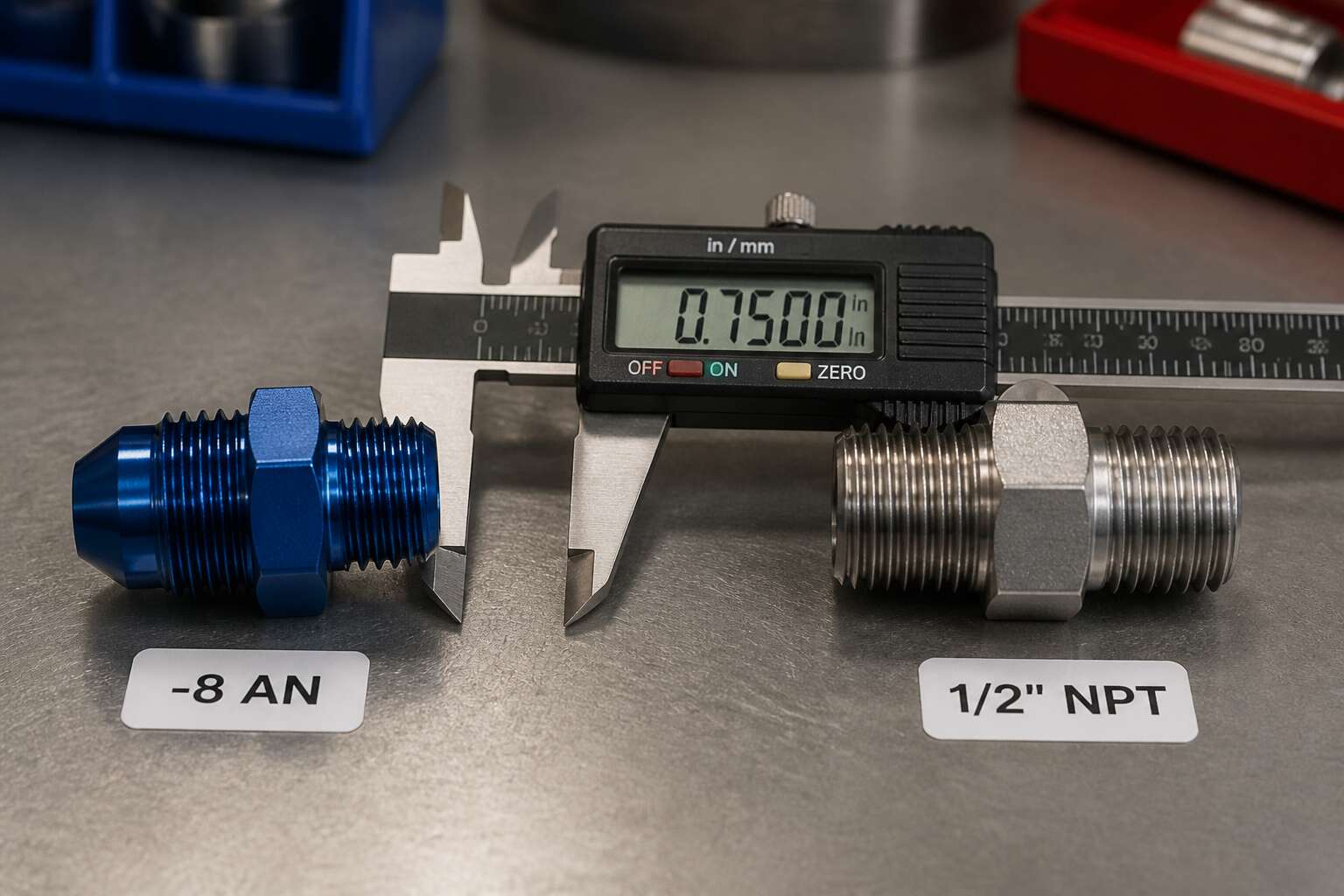
Visual Identification: Measuring Threads and Sizing
The thread pitch gauge removes all guesswork. Lay it against the fitting’s flanks and press gently. A pipe thread tapers, narrowing toward the end, while an AN thread runs straight with a 45 degree flare seat. Visual inspection alone often settles the question before any wrench touches metal.
To verify your measurements, follow this sequence:
- Clean the threads with a soft brush and solvent.
- Count the peaks over one inch using a pitch gauge.
- Measure the outer diameter at the widest point for pipe, or at the middle for straight threads.
The numbers tell the truth before you even ask are pipe fittings interchangeable with an fittings. A 1/2 inch NPT measures roughly 0.84 inches across, while an AN -8 measures 0.875 inches. That small divergence changes the seal completely.
So when you ask are pipe fittings interchangeable with an fittings, inspect the thread angle closely. Both use 60 degree profiles, but the taper and pitch differ! The real answer lies in the thousandths of an inch.
Selecting Reducers, Adapters, and Union Fittings
Choosing the right fitting begins with confirming whether are pipe fittings interchangeable with an fittings in your specific assembly. The answer is rarely a simple yes. For reducers, measure the larger and smaller thread diameters separately. A reducer from NPT to AN requires an adapter, not a direct swap. For adapters, check the seat type; a 45 degree flare from AN will not seal against a tapered pipe thread. Follow this selection sequence:
- Identify both thread standards on the original components.
- Determine the system pressure and temperature rating.
- Match the thread pitch and diameter exactly.
- Select a compatible seal method, whether taper or flare.
When choosing union fittings, align the halves without cross threading. Remember, are pipe fittings interchangeable with an fittings only when using a proper adapter. Never force a union; the nut must spin freely. By following these steps, you avoid leaks and premature failure in hydraulic, fuel, or pneumatic lines.
When to Rely on a Professional Fabricator or Engineer
Every failure begins in the quiet moment of assembly, when a thread that should not match is forced to comply. The question of whether are pipe fittings interchangeable with an fittings resolves itself in measurement, not hope. Begin by identifying the thread standard on each component with a pitch gauge. NPT is tapered, AN is straight and flared. One degree of angle is the difference between a sealed line and a weeping catastrophe.
- Measure the thread diameter and pitch on both mating parts.
- Compare the seat angles; a 45 degree flare will never seat against a tapered pipe thread.
- Check pressure and temperature ratings against your system’s operating envelope.
When the application sits beyond your documented ratings, or when the threads show any wear, call a fabricator or engineer. They trace the boundary between compatibility and disaster with instruments, not intuition. Whether pipe fittings are interchangeable with an fittings in your assembly is a question best answered before the wrench turns, not after the line pressurises.

0 Comments