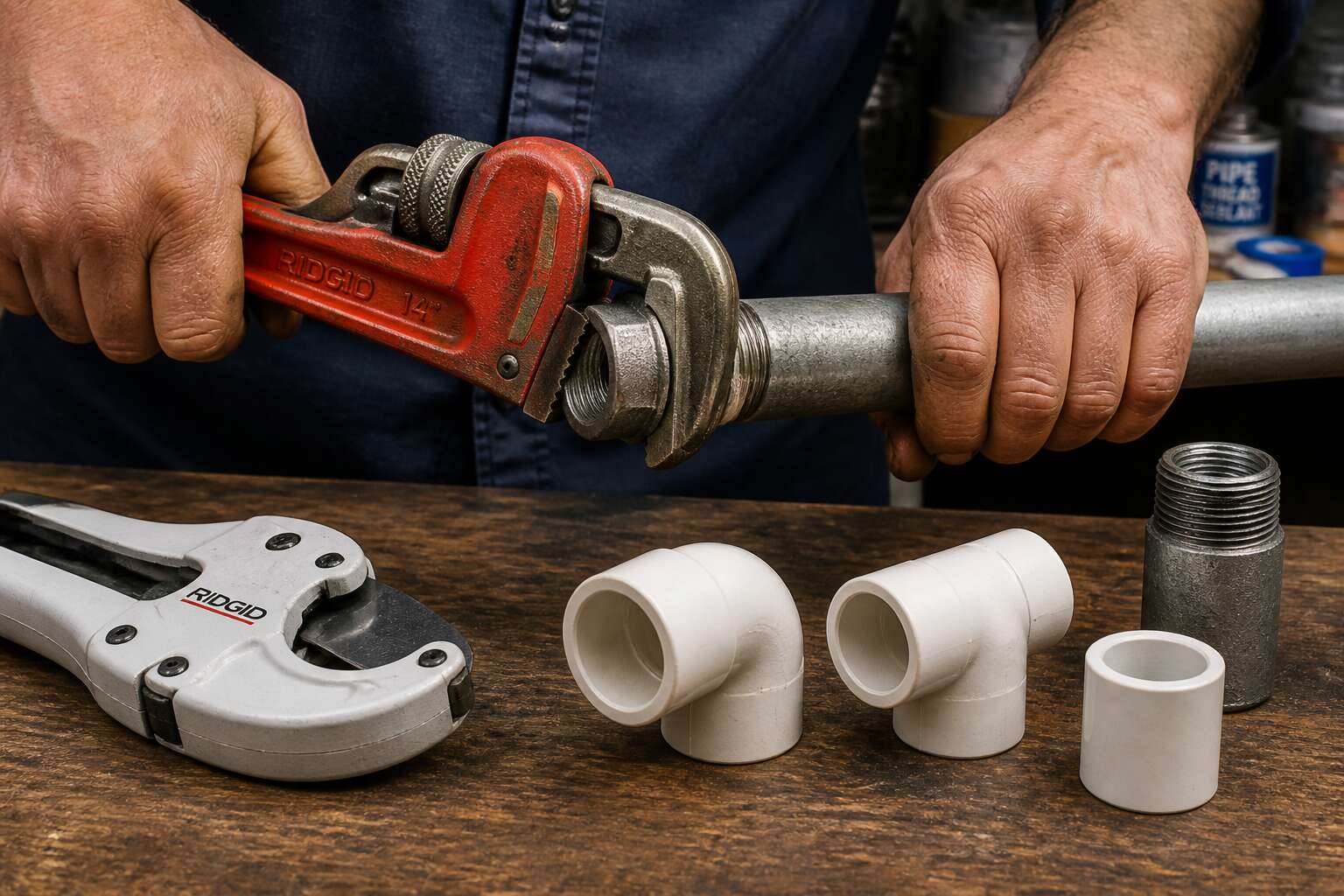
Understanding Pipe Fitting Basics
What Is Pipe Fitting and Why It Matters
In South Africa, municipal water losses often exceed 35 percent in older networks, and a large share of that waste happens at failed joints. Pipe fitting kaise hota hai determines whether a connection holds for decades or fails within months. The process is not about brute force. It involves measuring the pipe’s outer diameter, deburring the cut edge, and choosing between solvent welding, threading, or compression fittings based on the material.
Thermal expansion gets ignored too often. PVC pipes move more than steel when temperatures shift, so a rigid joint will crack. Pipe fitting kaise hota hai, in everyday terms, comes down to preparation and patience. I’ve seen joints fail because someone skipped the primer, and that’s a mistake you only make once! Fit the pipe square, apply primer, then cement, and let the joint cure.
Steps that turn a mediocre joint into a lasting one:
– Clean the surfaces with the correct solvent
– Check for ovality before cutting
– Support the pipe after installation
This is how water stays where it belongs.
Types of Pipes and Their Applications
Walking through a Johannesburg hardware store, you notice the pipe aisle tells a story. Each material exists for a specific burden. PVC handles cold water and waste lines with quiet efficiency. Copper tolerates heat and corrosion, making it the choice for indoor hot water systems. HDPE, flexible and tough, dominates buried municipal mains because it survives ground movement.
The actual process, pipe fitting kaise hota hai, depends entirely on this material selection. Threaded joints suit galvanised steel, where threads bite into the metal. Solvent welding bonds PVC into a single piece. Compression fittings allow repairs without flame or glue. A list helps:
- Measure the outer diameter, not the nominal size
- Deburr every cut edge before assembly
- Match the joint type to the pressure rating
In South African sunlight, UV exposure degrades some plastics quickly. That is why certain pipes require paint or burial. Choosing the right pipe is the first fitting step, and the rest follows from there.
Common Pipe Fitting Joints and Connections
According to the South African Plastics Pipe Manufacturers Association, a significant number of municipal water losses stem from joint failures, not pipe ruptures. The connection points are where the system’s integrity truly lives or dies. Understanding pipe fitting kaise hota hai starts with recognising that the joint must match the material’s behaviour under pressure, thermal expansion, and ground movement.
Preparation is the silent prerequisite. The pipe must be cut square, and the ends must be free of burrs and debris. For threaded connections, this means applying a sealant tape in the correct direction. For solvent welding, it means a primer that etches the surface for a chemical bond. Skipping these steps creates a weak point that will eventually weep, corrode, or fail entirely.
The choice of connection method often defines the project’s complexity and tooling requirements:
– Threaded joints for galvanised steel and thick-walled PVC
– Solvent cement welds for pressure-rated PVC and ABS
– Compression fittings for rapid repairs and transitions between materials
– Push-fit connections for accessible, low-pressure applications
– Flanged joints for large-diameter pipes that require dismantling
Each method has a learning curve. Threading requires a die stock and a steady hand. Solvent welding demands timing and a proper application technique. Compression fittings are forgiving but require a precise tightening sequence to avoid over-stressing the ferrule.
The distinction between a temporary repair and a permanent installation often comes down to this step. The sequence of operations, the curing time before pressure is applied, and the alignment of the components all dictate the outcome. In older Johannesburg properties, mixing copper and galvanised steel without a dielectric union leads to accelerated corrosion. The fitting process is not just about making a physical connection. It is about managing the metallurgical and chemical interactions between dissimilar materials. The practical answer to pipe fitting kaise hota hai is that it is a discipline of patience and precision, where rushing the cure time or overtightening a nut leads to failure long before the pipe itself wears out.
Key Terminology Used in Pipe Fitting
Every trade has its own shorthand, and pipe fitting is no exception. A request for a “45” might mean an angle or a fitting size, depending on who is listening! Understanding pipe fitting kaise hota hai starts with terms like “nominal bore,” the approximate internal diameter, and “schedule,” the wall thickness rating. These words prevent ambiguity.
The “spigot end” slides into the “socket.” Confuse them, and your solvent weld may leak. A “dead leg” is a stagnant section of pipe, a real hazard in potable water systems. This vocabulary separates a professional from a guesser.
Terms worth knowing:
- Spigot: the plain pipe end inserted into a fitting
- Bore: the internal diameter of the pipe
- Ferrule: the compression ring that creates a seal
- Dead leg: a pipe run with no water flow
Clients who know these terms can communicate clearly with a contractor, avoiding the costly misunderstandings that arise when words get fuzzy.
Essential Tools and Materials for Pipe Fitting
Hand Tools Every Fitter Needs
Every fitter knows the difference between a job that goes smoothly and one that does not. The right hand tools make that difference. In South Africa, where water supply lines and mining infrastructure demand precision, you cannot improvise with a worn pipe wrench. You need tools that match the material you are working on.
Essential hand tools include:
- Pipe wrenches in multiple sizes
- A sturdy hacksaw or pipe cutter
- Threading dies for steel pipes
- A reamer to remove burrs
- Teflon tape and pipe dope for sealing
These tools answer the question of pipe fitting kaise hota hai before you even touch a joint. A good level and measuring tape keep your work straight. Without these basics, theoretical knowledge of fittings and joints fails under pressure.
Power Tools for Cutting and Threading
The true work begins when manual effort meets the machine. In South Africa’s demanding environments, where steel pipes groan under pressure, a power tool is not a luxury. It is the difference between a clean cut and a ruined joint.
Power tools for cutting and threading include:
- A portable bandsaw for precise cuts on heavy wall pipes
- An electric threading machine that carves threads into steel with mechanical consistency
- An angle grinder with a cutting disc for quick, rough work
- A deburring tool to smooth the ragged edges left behind
These machines answer the question of pipe fitting kaise hota hai with raw efficiency. They do not forgive inattention. A misaligned thread or a hasty cut will haunt the joint for years, leaking in the dark, buried under ground where no wrench can reach.
Selection of Fittings and Connectors
The quiet decisions happen before you ever shift a wrench. A fitting must match the pipe’s material, the pressure rating, and the environment it will endure. In South Africa, heat and cold, dry earth and moisture test your choices every day. I have seen good piping fail because the fitter picked the wrong connector.
What matters most in the fitting bay:
- Pipe material and surface hardness.
- Thread standard and existing line connection.
- Heat tolerance of the seal and housing.
- Spare seals and washers close at hand.
When you understand pipe fitting kaise hota hai, you see that every elbow, gate and reducer does a small job. The unremarkable parts are the ones that keep a system honest for years.
Sealants and Thread Lockers
Sealant and thread locker are where pipe fitting kaise hota hai gets sticky, literally. PTFE tape is the old reliable, but paste sealants handle bigger gaps better. Thread lockers, from low strength to high strength, decide whether you will ever get that joint apart again. Use the wrong one and you are cutting the pipe out. The right one means a tight seal that still allows future maintenance. In South Africa, heat and dry earth make the choice even more critical.
- PTFE tape for clean threads
- Paste sealant for worn or tapered threads
- Thread locker for vibration-prone lines
- Primer, if the locker demands it
Always check the sealant’s compatibility with the fluid and the temperature range. A joint sealed beautifully with the wrong compound will weep within a month.
Measuring and Marking Instruments
One millimetre of greed at the measuring stage can leave a coupling a finger’s width short or a joint that refuses to align. The real craft of pipe fitting kaise hota hai happens on the steel, before a spin wrench or threader ever enters the story.
A steel measure, properly made and long enough for the whole run, acts as the work’s spine. A combination square pulls angles true when the eye would rather guess. Dividers copy the accurate mouth of a fitting onto a pipe surface. And the level matters, yes, but not the way you’d think: it serves the sight line, not the vanity.
Selection is deliberate, so build a kit that earns its place:
- Steel measurement for the full tack of the build
- Combination square with the degree head
- Spring of dividers for transferring diameter
- Scriber or a vitreous chalk of lasting against a sprinkle
A soft dot of wording that washes off is almost as bad as not being surveyed at all. For South African dust and humidity, the marking method must withstand both. Pipe fitting kaise hota hain is build on those small, durable records of intent.
Step-by-Step Pipe Fitting Process
Preparation and Measurement Techniques
Preparation is the quiet hero of any pipe fitting job. Before a single wrench turns, I clear the workspace and wipe down every pipe end. Oil, dirt, and old sealant will ruin a joint faster than a wrong cut. Believe me, that is the kind of care that separates a lasting system from a recurring headache!
Measurement is where patience pays. I use a steel tape for straight runs and a caliper for exact diameters. Mark every cut with a pencil, then measure once more. This careful rhythm is what pipe fitting kaise hota hai looks like on the ground. It is not glamorous, but it is honest work.
- Measure the full distance, then subtract the socket depth of each fitting.
- Account for threading length on steel pipes before cutting.
- Always dry fit the full assembly before applying any sealant.
These small habits save material and prevent leaking connections.
Threading for Screwed Connections
Threading is the step that separates a well cut pipe from a reliable joint. The die must rest square with the pipe end. If the tool tips sideways a couple of degrees on the first turn, the thread will be a weak or irregular, and the connection will leak under system pressure. I keep my body straight above the die and let the cut come clean.
Most South African screwed connections use BSP taper threads. The taper is what creates the seal. As you tighten the fitting, the two threads come closer, so the roughness or damage in that thread edge is still carried all the way in. No paste can fix that.
My bench order never changes with respect to this:
- Cut a full rotation forward, then reverse a quarter turn to break the chip.
- Apply threading oil during every pass, especially at the third turn.
- Check the thread depth against the gauge before the final stroke.
Pipe fitting kaise hota hai is the clean sequence you see at this moment. Each cut builds on the last, and the thread becomes the first and final point of hold between the pipe and fitting.
Joining Methods: Soldering, Welding, and Gluing
Nearly 60% of pipe failures in Johannesburg trace back to poorly executed joints, not pipe quality. The joining method decides how long the installation survives. Soldering needs clean copper and precise torch control. Flux bubbles, solder flows into the gap by capillary action, and the joint cools solid. Welding fuses the metal itself and demands higher heat and a steadier hand. Gluing, standard for PVC drainage, relies on solvent cement that softens pipe surfaces so they bond into one piece.
Each approach changes how pipe fitting kaise hota hai happens in practice. Soldering follows a strict order: clean, flux, heat, apply solder. Welding moves from tack to full weld to inspection. Gluing is quick but unforgiving of damp surfaces.
Material, pressure, and site conditions dictate the right method. The joint is where every installation stands or leaks.
Installation and Alignment Tips
Installation is where preparation pays off or quietly fails. The sequence looks simple, but every step hides a potential failure point. Pipe fitting kaise hota hai becomes visible in the discipline of the fitter, not the complexity of the tools.
Start by laying out the entire run without adhesive or solder. This dry fit reveals misalignments before they become permanent. Mark a continuous line across each joint to spot any twist during assembly. Then apply your chosen joining method and tighten supports gradually, not all at once.
- Check every horizontal run with a spirit level
- Confirm drainage slopes of at least 1%
- Ensure flanges sit square to the pipe axis
Lock the supports, then walk the full line again. Pipe fitting kaise hota hai depends on this final inspection. A joint that looks fine from one angle often reveals a gap from another. Correct small deviations now, because once the system is pressurised, they become expensive lessons in Johannesburg and beyond.
Testing for Leaks and Final Adjustments
Installation is complete, but the real work starts. Testing for leaks separates proper work from guesswork. Pipe fitting kaise hota hai becomes obvious when you pressurise the system and watch every joint with patience.
Start with low pressure and build up slowly. Carry a spray bottle of soapy water and work the run methodically. Each joint gets a coat, and you watch for fine bubbles that signal a leak. In my experience, this step reveals the most faults.
1. Open the supply valve a quarter turn and wait two minutes.
2. Inspect every joint visually for weeping or dampness.
3. Apply soap solution to any suspect connection.
4. Mark bubble formations with chalk for later.
Once the line holds pressure, make final adjustments. Re-tighten clamps that shifted, realign sagged hangers, and verify drainage slopes still meet the one percent minimum. A steady gauge reading confirms the job is right. Pipe fitting kaise hota hai is proven in this patient observation, not in the speed of assembly.
Common Pipe Fitting Techniques
Flanging and Flanged Connections
Flanged connections offer the rare luxury of disassembly. Where welds bind permanently, flanges let a pipe surrender its grip without violence. A pair of forged rings, bolted face to face, compresses a gasket between them. That gasket endures heat, pressure, and the slow creep of corrosion.
Flanges suit high-pressure systems in mines, refineries, and waterworks across South Africa. They demand precise alignment and controlled torque. One uneven bolt can cause a weep that widens into a failure.
Understanding pipe fitting kaise hota hai becomes clearer when you observe a flange. The bolt pattern, the facing type, the gasket material, each detail matters.
Standard types include:
– Weld neck flanges: the bore matches the pipe, reducing turbulence.
– Slip-on flanges: slipped over the pipe, then welded.
– Blind flanges: seal off pipe ends entirely.
Each serves a purpose, none forgiving of haste.
Compression Fitting Essentials
Compression fittings solve a problem that plagues every plumber and fitter: how to join pipes when you cannot apply heat or spin a heavy thread. The principle is simple. A nut, a body, and a ferrule work together to crush the ferrule onto the pipe surface. This mechanical grip creates a seal that holds water, air, and even some chemicals. No flame. No solder. No waiting for glue to set.
This is where pipe fitting kaise hota hai becomes a matter of feel as much as force. You slide the nut over the pipe, slip on the ferrule, and push the pipe into the fitting body. Then you tighten the nut by hand until snug. From there, a spanner takes over. The trick is knowing how much extra turn to give it.
Over-tightening is the classic beginner error. It distorts the ferrule and ruins the seal. Under-tightening leaves a weep. The correct movement follows this sequence:
- Hand tighten until the nut meets resistance.
- Mark the nut and the body with a line.
- Turn the nut one full quarter turn past the mark.
- Check for leaks and adjust only if needed.
Compression fittings work well for copper, PEX, and some plastic pipes, provided the pipe is clean and round. A burr or a scrape on the surface will give you grief. In South African homes, these fittings are a favourite for repairing existing copper lines where soldering is too risky. A hot flame near a wooden joist is never a good idea. The compression joint eliminates that danger entirely. It also allows you to work in tight spaces where a torch cannot fit and a threader has no room.
One more nuance: these joints remain serviceable. You can dismantle them, replace a valve, and reassemble without cutting fresh pipe. That flexibility explains their enduring presence in commercial and residential work. Understanding pipe fitting kaise hota hai often comes down to choosing the mechanical method that gives you room to manoeuvre. Compression fittings provide exactly that breathing space.
Expansion and Bending of Pipes
Bending pipe without kinking is a skill that separates a fitter from a hobbyist. A manual bender works for copper and steel, while a spring bender suits softer tubing. The trick is to bend gradually, not in one sharp movement. For PEX, heat guns are rarely needed; the material bends by hand.
Expansion joins pipes by widening one end to accept another. This technique works well for PEX and some multilayer pipes. An expansion tool stretches the pipe mouth, then the fitting slides in. As the pipe contracts, it locks onto the fitting. This creates a strong joint without glue or solder. Both show how pipe fitting kaise hota hai adapts to modern materials.
On a South African job site, both techniques handle tight spaces and awkward angles. Understanding pipe fitting kaise hota hai means mastering these moves. They remove the need for extra fittings, which keeps the system clean and the cost down.
Working with Different Pipe Materials
Each pipe material asks for a different hand. Steel resists, so it needs threaded ends or welded joints. Copper accepts gentle bending but demands clean flux and heat. PVC and uPVC fuse fast with solvent cement, while PEX prefers crimp rings or expansion tools. The fitter reads the material before choosing the method, and pipe fitting kaise hota hai becomes a quiet negotiation between tool and tube.
On a typical Johannesburg retrofit, a plumber might face galvanised steel, copper, and PEX in one building. The steel requires a die stock, the copper a torch, and the PEX a cinch tool. Each system carries its own rhythm. Forcing one technique onto another material is an invitation to leaks.
Safety Measures and Best Practices
Personal Protective Equipment for Pipe Fitting
Every year, thousands of fitters face avoidable injuries because they treat gloves and goggles as optional accessories. Pipe fitting kaise hota hai is a question that begins with preparation, and preparation starts with what you wear. Your hands are your primary instruments, so cut resistant gloves are non negotiable. Safety glasses protect against metal shavings and flux splatter. Steel toed boots guard against falling sections of pipe.
Hearing protection matters when using power tools, and a respirator becomes essential when soldering or grinding. The following items belong in every kit:
- Cut resistant gloves
- Impact rated safety glasses
- Steel toed footwear
- Ear muffs or plugs
- Respirator with appropriate cartridges
A clean, dry work area completes the picture. Pipe fitting kaise hota hai ultimately depends on your ability to work without distraction, and proper PPE provides that foundation.
Safe Handling of Tools and Materials
Accidents breed from complacency, and on a busy site, the difference between a smooth operation and a stoppage often comes down to the mundane rituals of handling gear. The moment you pick up a wrench or a length of pipe, the potential for injury activates. It is not the dramatic failures that cost the most time, but the quiet, repetitive mistakes in tool handling and material movement. You must develop a tactile awareness of your environment, sensing where the weight of every object sits and how the floor beneath you reacts to the clutter around your feet.
The physical separation of tasks is a primary defense. Cutting, threading, and soldering generate debris that can compromise the integrity of a clean joint, yet they also present distinct hazards to anyone working nearby. A tidy layout allows you to move with intention rather than reaction. To that end, establishing a set of routine checks protects both the worker and the material:
1. Inspect every tool for loose handles or cracked housings before shifting them around the work area.
2. Keep sharp edges and cut ends of pipe pointed away from walkways and bodies.
3. Use lifting straps or carts for any section exceeding fifty kilograms, avoiding the strain of manual carrying.
4. Store solvents and flux in sealed, labelled containers away from ignition sources.
Moving pipe through a crowded space requires a different kind of focus, one that anticipates the arcs of swinging loads. Your hands are rarely the only points of contact, so maintaining a clear line of sight is vital. When you understand how pipe fitting kaise hota hai as a sequence of controlled movements, you begin to see safety as an extension of skill rather than a separate checklist. The materials themselves dictate the rhythm. Cast iron resists but shatters under sudden impact, while copper bends and kinks, each demanding a distinct handling approach. The mental state of the fitter mirrors this physical reality. A distracted mind produces erratic actions, which is why the safest crews call out their next move, confirming the space is clear before engaging the task. This ongoing chatter, the constant verbal and physical feedback loop, turns a high risk environment into a manageable one. It is the quiet discipline of these habits that ultimately determines whether a project finishes on schedule or stalls under the weight of an avoidable incident.
Preventing Leaks with Proper Sealing
I have watched a perfect joint fail because one grain of sand hid in the thread compound. That is the reality of pipe fitting kaise hota hai: sealing is a ritual of attention, not a single action. The leak appears later, when the system heats up and the smallest oversight expands into a visible failure.
Prevent that by controlling the environment around every seal. Clean the faces, dry the threads, and apply the sealant in a continuous bead. Torque each fitting to the specified value, then mark the joint. After the first pressure cycle, return and inspect every seal for the faintest dampness.
- Use a mirror to inspect hidden seals.
- Keep a torque log for every critical joint.
- Replace any sealant that has passed its shelf life.
Compliance with Local Codes and Standards
A pipe system that passes pressure tests can still fail an inspection if the paperwork is missing. In South Africa, compliance with local codes is not a formality; it is the backbone of every durable installation. Understanding pipe fitting kaise hota hai means recognizing that each joint carries legal and safety obligations.
Before any work begins, confirm the applicable standards for your region. The South African National Standards (SANS) govern materials, pressure ratings, and installation methods. Ignoring these specifications creates risk that no sealant can fix.
- Verify that all pipes and fittings carry the correct SANS mark.
- Submit a detailed plan for approval before modifying existing systems.
- Schedule inspections at every critical stage, not just at the end.
Safety measures extend beyond personal gear. They include proper isolation of the work area, lockout procedures for live lines, and clear communication with the team. When pipe fitting kaise hota hai follows these protocols, the result is a system that serves its purpose without endangering anyone.
Maintenance Tips for Longevity
The real cost of a pipeline failure is never the price of a new gasket. It is the shutdown, the repair crew, and the quiet erosion of client trust. Safety in pipe fitting kaise hota hai begins with operational discipline, not just a hard hat. Skilled fitters isolate live systems completely and tag every isolation point. They treat a depressurized line as a loaded spring until proven otherwise.
Maintenance is a continuous habit, not a scheduled event. A small investment in observation prevents major disruptions later.
– Document every installation detail, including torque values and material batch numbers.
– Check for micro vibrations or thermal movement at support points every six months.
– Re-torque flanged connections after the first thermal cycle.
– Monitor pressure gauges for slow drifts, which indicate silent leaks.
Fittings fail quietly before they fail loudly. Regular inspection creates a baseline that helps you spot deviations early. This hands-on awareness of the system is where pipe fitting kaise hota hai transforms from manual skill into a documented discipline. Keep records as detailed as the work itself.

0 Comments