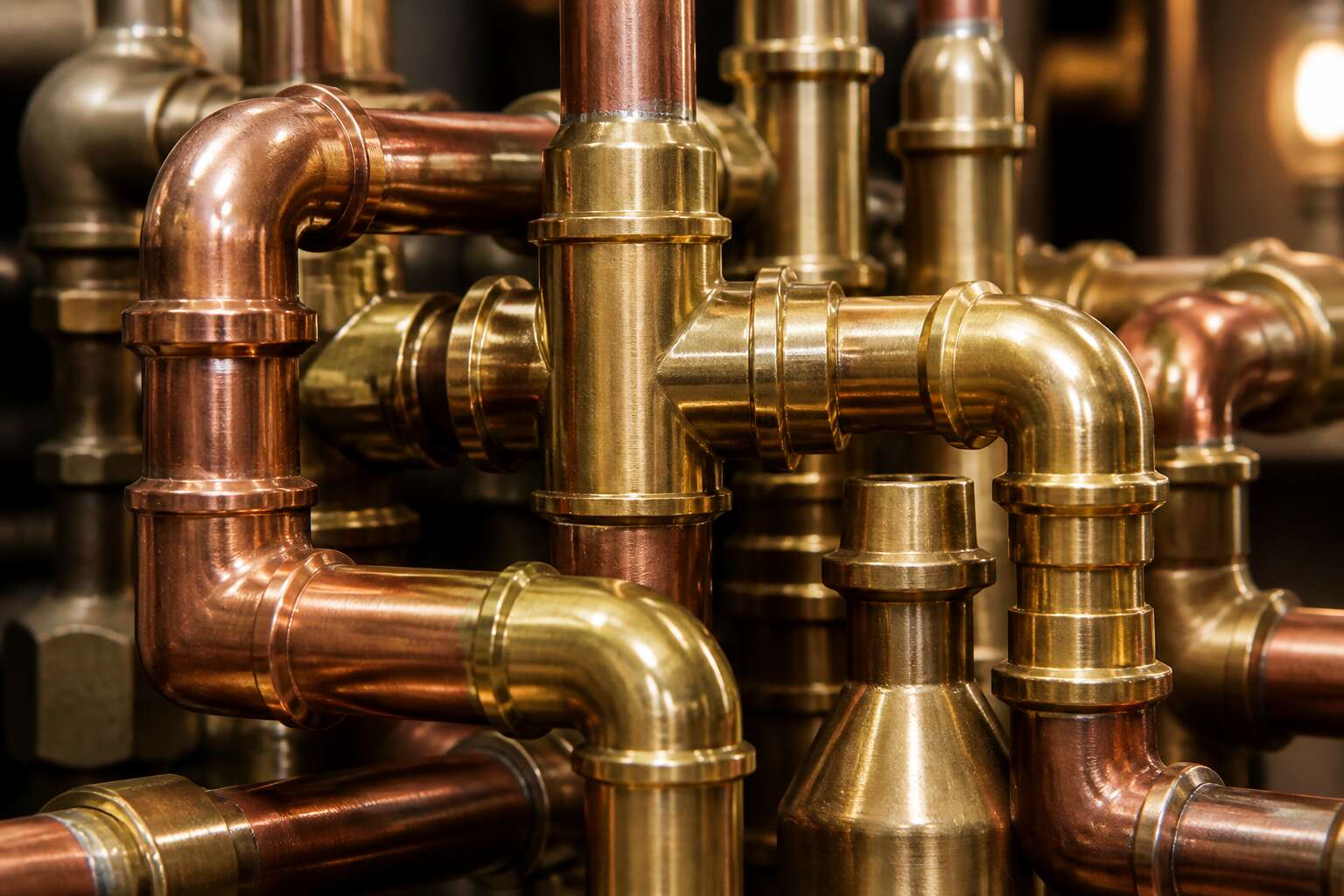
The Role of Fittings in Piping Systems
Why Fittings Are Essential for Fluid Flow
Pipe fittings and components manage the flow of fluids in ways that pipes alone cannot. A simple elbow redirects a pipeline without losing pressure. A coupling joins two sections cleanly, while a flange creates a strong, detachable connection for maintenance. These roles might seem ordinary, but they are decisive in real world systems!
Consider a pumping station in Johannesburg. If the wrong reducer is installed, velocity changes drastically, causing wear or even water hammer. Fittings also accommodate thermal movement, preventing stress fractures in long pipelines.
- Maintaining consistent flow rates across changes in direction
- Isolating sections for repair without draining the entire system
- Mixing different materials while ensuring a leak proof seal
Without properly selected pipe fittings and components, pressure drops and contamination become frequent problems. In South Africa’s aging water infrastructure, the difference between a reliable supply and regular outages often comes down to these small details.
Common Applications Across Industries
From Sasol’s chemical plants to Cape Town’s desalination projects, pipe fittings and components are the quiet enablers of industrial expansion. A piping system isn’t a single artery; it is a network of direction changes, size transitions, and access points. Fabricated spools let workers pre assemble sections in controlled conditions, while threaded fittings allow small bore lines to be reconfigured on site.
Common applications show the range:
- Mining slurries use wear resistant bends and long radius elbows.
- Food processing lines rely on tri clamp fittings for rapid sanitation.
- Power stations use expansion joints to absorb thermal stress.
Each sector demands different alloys, gaskets, and joint methods. The selection of pipe fittings and components directly affects downtime and safety, which is why South African engineers treat them as critical design elements rather than afterthoughts.
How Fittings Connect to Pipes and Valves
The true genius of any piping network lies in its joints. A flange holds two pipes together while introducing a point of deliberate disassembly. When a valve needs servicing, the entire line should not be sacrificed to the angle grinder. Thoughtful arrangement of pipe fittings and components lets an engineer isolate one section while the rest of the plant continues its business. Bolted connections, welded ends, and compression joints each carry different trade-offs. Welders demand permanence. Maintenance crews prefer a quick release. The best systems accommodate both with grace. Consider how pipe fittings and components connect a valve into a line:
– Bolted flanges allow removal without disturbing adjacent sections.
– Welded joints provide leak-tight integrity for high-pressure duty.
– Threaded ends suit smaller bores where speed matters more than brute force.
Each method changes how the whole assembly behaves under vibration, thermal cycling, and repeated servicing.
Pressure and Temperature Considerations
Pressure and temperature impose absolute limits on every piping network. A fitting rated for 16 bar at 25 degrees Celsius behaves differently when the medium reaches 200 degrees. Thermal expansion alters the geometry of each joint. The material loses rigidity. What worked in a cool morning start-up may fail by mid-shift. Pipe fittings and components carry these loads silently, but they are not infallible.
- Carbon steel fittings lose tensile strength above 400 degrees Celsius.
- Thermal cycling loosens threaded connections, demanding periodic re-torquing.
- Expansion loops and flexible couplings absorb dimensional change before it reaches the valve body.
The wise engineer selects pipe fittings and components with these variables in mind. Pressure ratings are not abstract figures; they are laboratory results from controlled environments. Field conditions rarely match those parameters exactly.
Exploring Different Fitting Materials
Metallic Options: Steel, Copper, and Brass
Material choice quietly determines how long a pipe network survives. Steel offers raw strength for high-pressure lines. Copper brings a certain refinement to domestic water systems. Brass balances corrosion resistance with machinability.
I have seen pipe fittings and components made from each of these metals fail for separate reasons. Steel rusts when neglected. Copper develops pinholes under aggressive water chemistry. Brass dezincifies in salty coastal air, a real concern in Cape Town or Durban.
Each metal performs best in a particular setting:
- Steel handles industrial heat and mechanical abuse.
- Copper manages hot and cold potable water with grace.
- Brass suits tight spaces where a wrench cannot swing freely.
These traits matter more once you consider your local water quality and climate. A metal that performs beautifully in Gauteng’s dry air may disappoint near the ocean.
Plastic and Polymer Fittings
They say a plastic pipe lacks the dignity of copper. Tell that to a Johannesburg plumber hauling a bundle of PVC up three flights of stairs. Polymer fittings win on practicality, and in South Africa, that practicality pays off.
HDPE handles ground movement, a real advantage in clay soils that shift with every rain. PVC resists corrosion and costs a fraction of the metallic alternative. PPR presses hot water systems together without a flame.
Pipe fittings and components in polymer shine because:
- Zero rust, inside or out
- Low thermal conductivity, so less heat loss
- Lighter weight, which saves your back and your budget
Chemical resistance makes these pipe fittings and components a staple for effluent lines. I have personally watched polymer fittings outlast brass in coastal humidity. Just keep them out of direct sunlight unless you spec UV-stabilised grades. The Karoo sun finds weaknesses fast.
Specialty Materials for Corrosive Environments
In a Mpumalanga chemical plant, the wrong fitting fails within months. The right one outlasts the machinery it serves. Specialty alloys and engineered composites handle what standard metals cannot.
Duplex stainless steel resists chloride stress corrosion cracking where standard 304 or 316 would pit. Titanium stands up to seawater and chlorine. I have seen nickel alloys such as Hastelloy handle hot acids that dissolve lesser pipe fittings and components.
The choice depends on your specific chemistry:
- Temperature and concentration of the media
- Presence of chlorides or sulphides
- Abrasion from suspended solids
Matching the metallurgy to the environment costs more upfront but saves replacements, downtime, and safety incidents. South African mining operations run slurry lines that would destroy standard pipe fittings and components within a season. This durability determines whether plant stops happen on schedule or as emergencies.
Material Selection Based on Fluid Type
Selecting pipe fittings and components begins with the fluid itself. A slurry of coal and water in a Limpopo processing plant behaves nothing like clean municipal supply. The pH, velocity, and particulate load dictate what material holds its integrity without constant teardowns.
Caustic soda solutions demand lined or chlorinated polyvinyl chloride fittings, while sulphuric acid at moderate concentrations suits cast iron or high silicon iron. Hydrocarbon vapours call for carbon steel with proper sealing faces.
- Caustic soda: rubber lined or PVC
- Sulphuric acid: cast iron or high silicon iron
- Hydrocarbons: carbon steel
Each choice trades cost against expected service life. For high purity pharmaceutical lines, electropolished stainless steel prevents bacterial harbouring. For abrasive mining tailings, rubber lined components absorb impact where hard metals erode. The fluid does not forgive guesswork, so matching the material to its chemical reality is the only honest engineering.
Coatings and Corrosion Protection
A single pinhole leak in a poorly protected fitting can halve a plant’s throughput before anyone notices. Coatings extend the useful life of pipe fittings and components by decades, provided they match the service conditions. Fusion bonded epoxy, hot dip galvanising, and elastomeric linings each behave differently under abrasion or chemical attack.
I have watched pipelines fail because the coating looked flawless but was applied over a contaminated surface. Surface preparation determines corrosion protection more than the coating itself. The right profile, usually achieved by abrasive blasting, lets the coating mechanically key into the metal. For pipe fittings and components in cyclic duty, thermal expansion mismatch causes micro cracking that lets moisture reach the substrate.
- Fusion bonded epoxy for internal linings
- Hot dip galvanising for external atmospheric exposure
- Polyurethane for abrasion resistance
Selecting coatings without considering cathodic action can accelerate failure, particularly in marine environments around Durban or Saldanha.
Key Components Beyond Fittings
Flanges and Gaskets for Secure Joints
When a joint fails, the culprit is rarely the flange. It is often the humble stud or nut doing the real work. In South African plants, I have watched engineers insist that real security lies in the fasteners and the discipline of assembly. Bolts, washers, and thread lubricants work alongside pipe fittings and components to manage stress, vibration, and thermal movement.
Consider the properly torqued bolt. It creates the clamping force that compresses the gasket uniformly. Without that force, even a fine flange is just decorative.
Here is what a conscientious fitter checks before closing a joint:
- Stud grade and material compatibility
- Washer type and hardness rating
- Thread condition and lubrication
Each element contributes to a joint that holds under pressure, and pipe fittings and components depend on this integrity. A mismatched nut or an overtightened bolt can compromise the entire system. Attention to these details separates a secure installation from an expensive surprise!
Valves: Controlling Flow and Pressure
Valves are the control points of any pipeline network. Without them, pipe fittings and components would simply carry fluid with no means of regulation. A butterfly valve in a Gauteng water treatment plant does more than block flow. It modulates pressure with a quarter turn, protecting downstream equipment from surges.
Consider the pressure-reducing valve. It takes high inlet pressure and delivers a steady, usable outlet pressure. This matters in mining operations across the Witwatersrand, where erratic pressure can damage sensitive instrumentation. I have seen plants struggle with cavitation simply because the wrong valve was specified.
Different valves serve different purposes:
– A globe valve excels at throttling.
– A ball valve offers tight shut-off.
– A check valve prevents reverse flow.
Each valve type works with pipe fittings and components to create a system that responds to demand, not a static network of pipes.
Pipe Supports and Hangers
A pipeline that looks flawless on paper can fail in the field for one simple reason: the support structure was an afterthought. Pipe supports and hangers carry the real burden of any installation, yet they rarely get the attention they deserve. In South Africa, where industrial plants run through demanding environments, these components quietly determine whether a system survives its first year or its thirtieth.
Supports do more than hold weight. They manage thermal expansion as pipes heat up and cool down. They absorb vibration from pumps and compressors. They keep joints aligned so that pipe fittings and components do not experience unnecessary stress. The wrong hanger spacing can lead to sagging, leaks, and premature wear on pipe fittings and components.
Consider the types of systems you might specify:
- Rigid supports for vertical and horizontal loads
- Spring hangers for systems with thermal movement
- Guide supports that control lateral displacement
Each one serves a different purpose. A rigid support in a high-temperature steam line will fail when the pipe expands without room to move. A spring hanger in a static line adds cost without benefit. Matching the support to the service condition is an engineering decision, not a hardware choice.
Ground movement is another factor. In parts of Gauteng, historical mining activity causes subsidence that shifts pipelines. A well-anchored support system absorbs these movements before they reach the joints. The relationship between supports and pipe fittings and components becomes critical here. A flange or valve may be perfectly specified, but if the pipe moves out of alignment, that specification means nothing.
Expansion Joints and Flexible Connectors
Supports manage movement, but they cannot absorb it entirely. Pipes expand with heat, settle with ground shifts, and pulse with pump operation. Expansion joints and flexible connectors take up these forces before they reach the connections.
In Gauteng, where mining subsidence shifts the ground beneath pipelines, this matters. A bellows expansion joint compresses and extends with the movement. A rubber flexible connector isolates vibration from rotating equipment. Without them, stress concentrates at flanges and welds, and pipe fittings and components fail early.
Common configurations:
- Single bellows for axial expansion
- Tied bellows for lateral movement
- Rubber connectors for vibration and misalignment
Each type addresses a movement pattern. The correct choice depends on what the system experiences, not on what is cheapest.
Reducers, Adapters, and Couplings
Some components perform their duty in silence, never flexing, never moving, yet without them, the entire system grinds to a halt. Reducers, adapters, and couplings are the quiet workhorses of any pipeline network. While fittings change direction, these elements change size, material, or connection type. They are the translators enabling disparate parts to function as a unified whole.
A reducer manages the transition between different pipe diameters. This is not merely about physical connection; it is about managing velocity and pressure. A sudden change in bore size creates turbulence, which erodes the inner walls and increases energy consumption. The reducer smooths that transition.
– Concentric reducers for vertical lines and pump suction.
– Eccentric reducers for horizontal lines to prevent air pockets.
– Dielectric unions to separate dissimilar metals and stop galvanic corrosion.
Adapters solve the problem of incompatible connection methods. A threaded end meets a flanged end, or a grooved end meets a socket weld. The adapter bridges the gap, translating one standard to another without requiring custom fabrication. Couplings, meanwhile, offer a repair solution or a permanent joint. They allow for the quick replacement of a damaged section of pipe without cutting the entire line. In a country where downtime costs real money, these small elements are critical. Selecting the wrong piece here creates a weak point, a place where the entire network becomes vulnerable to future failure. The safety and longevity of the whole system depends on these small but essential pipe fittings and components.
Inspection and Testing Accessories
Inspection and testing accessories rarely appear in a system diagram, yet they carry the weight of every safety certification. When a municipality in Gauteng pressures a new main, the test plugs and gauges are what prove the pipe fittings and components can handle real conditions. These tools reveal hidden flaws. A poorly seated test plug fails loudly, and that failure is far cheaper than a rupture later. Pressure relief valves protect equipment during hydrostatic testing. Instrumentation taps provide access for monitoring pressure and temperature. They allow the people in charge to make decisions based on data, not hope. You cannot assume a weld holds because it looks clean. You test it. You measure it. Then you know.
Sizing and Standards for Fittings and Components
Understanding Nominal Pipe Size (NPS) and Schedule
Nominal Pipe Size trips up newcomers. The NPS number does not match the actual outside diameter. A 2 inch NPS pipe measures 2.375 inches across. NPS references the approximate inside diameter of the original cast iron pipe, and the naming stuck. The pipe fittings and components you pair with that pipe must respect this standard, otherwise joints will fail.
Schedule defines the wall thickness. Higher schedule numbers mean thicker metal or plastic, which allows for higher internal pressures. Plain and simple! Here is a rough breakdown:
- Schedule 40: the default for most water and air lines
- Schedule 80: thicker, used where pressure or mechanical strength matters
- Schedule 160: heavy wall for demanding hydraulic service
When selecting pipe fittings and components, always match the schedule of the fitting to the pipe. Mismatched wall thicknesses create weak points where leaks start. NPS and schedule together give you the geometry of any connection.
Common Thread Standards (NPT, BSP, Metric)
Threads are the first place connections fail, and the cause is almost always a standard mismatch. In South Africa, BSP threads dominate through British engineering heritage, while NPT threads arrive with American equipment. Metric threads follow European ISO standards. These systems do not interchange. I have seen joint failures caused by a single mismatched thread on pipe fittings and components.
- NPT: tapered American thread, seals through deformation
- BSP: parallel or tapered British thread, seals with gaskets or O-rings
- Metric: defined pitch and angle, common on newer machinery
Mismatched profiles ruin joint integrity. A quick check of pitch and angle before assembly saves both time and money.
Flange Ratings and Pressure Classes
A flange rating is not a suggestion. It is a calculated limit that shrinks as temperature rises. A Class 150 flange that holds at 20°C can fall to a fraction of that rating at 260°C. Engineers who ignore this derating curve invite silent fatigue and sudden failure.
Sizing pipe fittings and components requires the same logic. The bore size tells you the flow path; the pressure class tells you the survivability. In South Africa, ASME classes such as 150 and 300 sit alongside European PN ratings. Confusing the two systems is a fast route to joint failure.
- Class 150: low pressure water and steam lines
- Class 300: moderate pressure systems with thermal swings
- Class 600 and above: high pressure gas and hydraulic services
For pipe fittings and components, the rating stamped on the flange links directly to a material and a temperature curve. A replacement flange of the same class but different material does not carry the same limits.
International Standards (ISO, ASTM, DIN)
A standard is a promise. It says a fitting will hold, will seal, will fit. In South Africa, that promise is complicated by history. ISO, ASTM, and DIN all appear in the same plant, sometimes in the same line. The ISO drawing defines the geometry. The ASTM grade defines the material. The DIN legacy speaks to what was installed decades ago.
Pipe fittings and components cannot be swapped across these systems without consequence. A DIN fitting might mate with an ISO flange, but its pressure rating could belong to another era. The engineer who treats standards as interchangeable is making a calculation with missing data.
- ISO 5752: face-to-face dimensions for flanged valves
- ASTM A105: carbon steel for forged fittings
- DIN 2501: flange dimensions in legacy installations
Choosing the wrong standard for pipe fittings and components is a quiet error. It hides in the pipe rack until the test pressure rises, and then it speaks.
Installation and Maintenance Best Practices
Proper Joining Techniques: Threading, Welding, and Solvent Cement
Proper joining determines the lifespan of any system. Threading suits steel pipes and allows future disassembly. A sharp die and cutting oil make clean threads. Apply sealing tape or compound to avoid leaks. Welding creates a permanent connection, ideal for high pressure lines. Welders must preheat thick wall sections to prevent cracking. Solvent cement bonds PVC components in seconds. Prime first, then apply cement and insert with a twisting motion. I always hold the joint for thirty seconds.
Installation practices affect maintenance later:
- Torque threaded joints to manufacturer specifications.
- Inspect welds for undercut or porosity.
- Keep solvent cement containers sealed when not in use.
Pipe fittings and components demand respect for their joining methods. A poor joint will fail. Good technique ensures decades of service. Each method has strengths, so choose deliberately. The quality of your pipe fittings and components matters only as much as the joint you create.
Sealing and Leak Prevention Strategies
The steady hiss of a pressure gauge dropping overnight remains a stark reminder of how much faith we place in the integrity of our systems. In the highveld summer heat, a single overlooked joint can cause a pump to cycle erratically and waste precious kilolitres. Sealing strategy begins with the choice of thread sealant. For ferrous pipes, I favour a PTFE tape with a higher density rating, wrapped clockwise so it does not unwravel during makeup.
Achieving a leak free joint requires discipline in preparation. The faces of flanges must be free of debris and old gasket material. A wire brush and a rag with solvent are standard tools. When installing a new gasket, I always verify its rating matches the pressure class of the flange. Here is the order I follow for critical connections:
1. Clean both flange faces thoroughly.
2. Inspect for scratches or pitting.
3. Align the gasket perfectly before torquing.
A common failure is the over tightening of bolts to compensate for a poor seal. This distorts the gasket and creates a path for leaks. Torque in a crisscross pattern, and give the joint a second pass after the system has reached operating temperature. For threaded connections on smaller bore lines, a liquid sealant with PTFE provides a robust barrier against vibration.
The subtle art of leak prevention extends to the condition of the pipe itself. A galvanised pipe with a burr on the thread will shred the sealant. Re-cut the thread if it feels rough. The final system is only as secure as the weakest seal. These practices, while mundane, separate a reliable plant from one that demands constant attention. The quiet confidence of a dry joint is worth the extra minutes during assembly. Every component has a duty to perform, but it relies entirely on the quality of the seal we create between them. For the longevity of any pipeline, this is where the true value of skilled workmanship lies.
Routine Inspection and Replacement Schedules
A maintenance schedule is a promise a system makes to itself. That promise is broken slowly. A skipped inspection becomes a stubborn weeper next quarter, and a weeper becomes a failed fitting before the annual shutdown. No pump failure is sudden. Every breakdown sends warnings first.
I treat replacement as a decision based on evidence, not age. Rust alone does not force replacement. A hairline crack does.
For pipe fittings and components in high vibration service, follow a simple order:
- Inspect monthly for visible damage.
- Torque check quarterly.
- Replace any cracked or deformed fitting immediately.
The discipline of examining pipe fittings and components on a fixed rhythm turns surprises into scheduled events. It is not dramatic work. It is the difference between a plant that plans its downtime and one that suffers it.
Troubleshooting Common Fitting Failures
Most installation failures in pipe fittings and components trace back to one of two causes: dirt or torque. A single grain of grit on a seating face becomes a leak path within hours. I always wipe the bore and the mating surface before assembly, even when the part looks clean. Cross-threading is the other silent killer. Stainless steel fittings gall easily when run fast or dry. Slow the action down, chase the threads with a wire brush, and use the correct lubricant for the material.
Troubleshooting a failed joint starts with the evidence at the failure point. Cracks that run parallel to the pipe axis indicate over-torquing. Cracks that circle the fitting usually mean flex fatigue. A loose nut on a compression fitting signals that the tube was not bottomed out properly. When a fitting seizes during disassembly, the fault lies in galvanic corrosion, not the thread compound.
Log these signs when you see them:
– White powder around a brass fitting, which indicates dezincification
– Hairline spiderwebs on chrome surfaces, a signal of stress corrosion
– Scored threads from reaming the pipe too aggressively
Each observation points to a specific error. The repair begins with the habit, not the part.

0 Comments