Selecting the Right Diameter for Drainage Systems
How Pipe Size Impacts Flow Rate and Capacity
Flow rate scales with the 8/3 power of pipe diameter. Cut the bore by ten percent, and capacity drops by nearly a quarter. That’s why selecting the right diameter for drainage systems demands care.
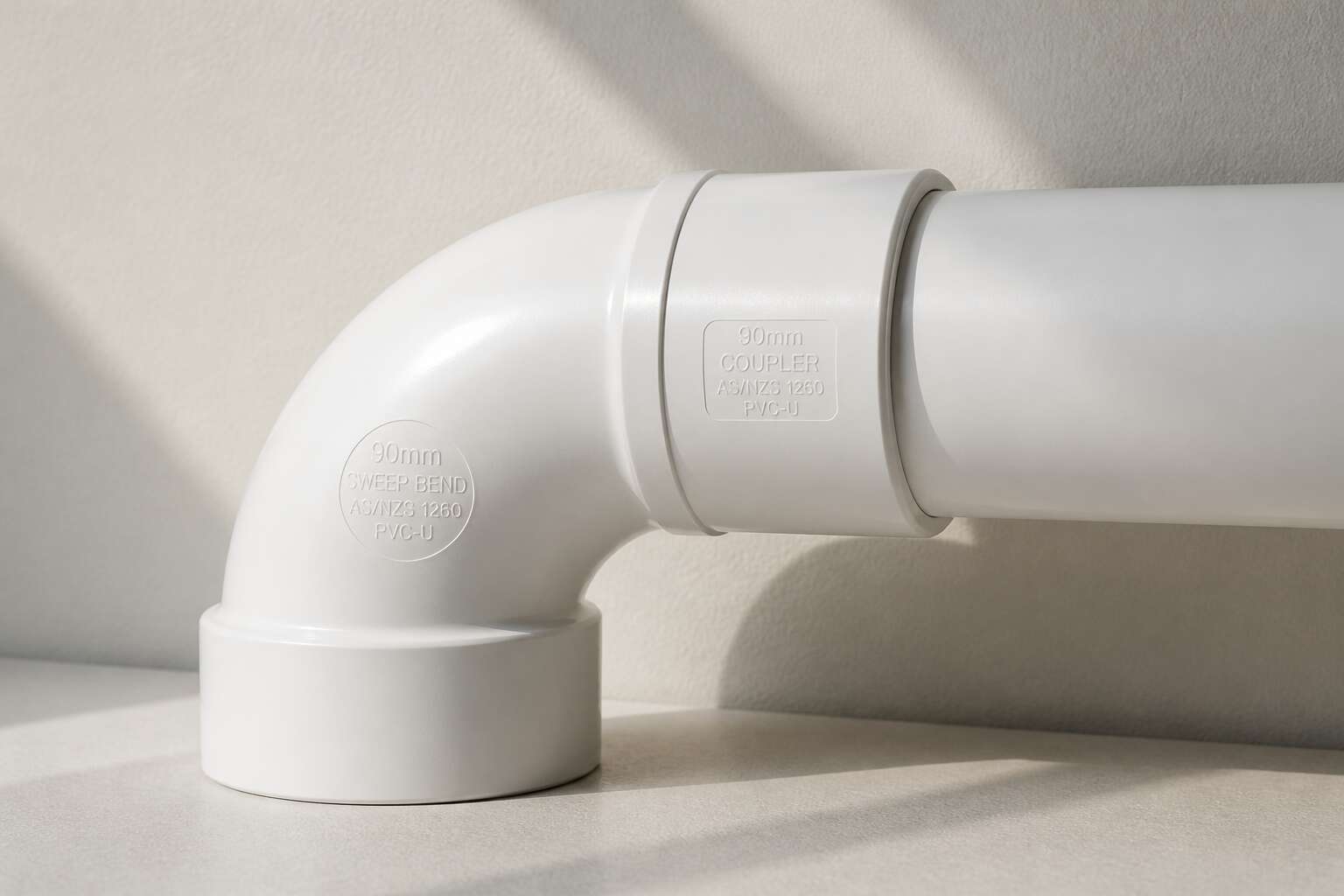
For household waste, we find 90mm waste pipe fittings offer a solid balance. The internal bore handles showers, basins, and washing machines without surcharging. But diameter alone isn’t enough.
Actual capacity depends on:
- Slope; too flat causes pooling, too steep lets solids outrun the liquid.
- Fittings and bends; each turn adds turbulence and reduces flow.
When you install 90mm waste pipe fittings, remember pipe size impacts flow rate and capacity in dynamic ways. A long horizontal run with several elbows can restrict flow when the nominal bore is correct. A short vertical drop handles more volume than the same pipe laid flat. These variables determine whether your drainage runs clean or backs up!
Metric vs. Imperial Measurement Standards
South Africa’s plumbing industry carries a dual heritage. We install metric pipes, yet many older homes and imported fixtures still reference imperial sizes. 90mm waste pipe fittings sit close to the old 3 inch pipe, but not exactly. That difference matters when you connect new drainage to existing cast iron or galvanised systems.
Choosing the right diameter means understanding which standard your supplier uses. Metric measurements are based on outside diameter. Imperial sizes refer to nominal bore. A mismatch creates gaps that leak or narrow the flow path. I have watched homeowners pay twice because the first fitting was measured wrong.
- Stamped markings on existing pipes are the first clue.
- Callipers give the outside diameter.
- Supplier catalogues state whether dimensions are metric or imperial.
90mm waste pipe fittings work well for most household waste lines, but always verify the standard before you cut.
Understanding Wall Thickness and Pressure Ratings
Wall thickness determines how much pressure a drainage system can endure. 90mm waste pipe fittings manufactured for gravity drainage use a different wall profile than those rated for pumped systems. The pressure rating, measured in kilopascals, tells you exactly what the fitting can handle. Domestic South African installations typically require lower ratings, but commercial kitchens and industrial laundries push higher volumes through the same nominal diameter.
A thicker wall reduces the internal bore even though the outside diameter stays fixed. This matters when you join 90mm waste pipe fittings from different manufacturers. One brand’s socket might grip a pipe that another brand measures as slightly loose. The difference hides in the wall thickness schedule.
Here is what I check before specifying:
– The SANS standard printed on the fitting
– The pressure rating in kPa or bar
– The wall thickness in millimetres at the socket
– The material grade, usually uPVC or HDPE
These figures tell you whether a fitting suits a simple gravity line or a sewerage pump connection. Selecting the right diameter alone does not guarantee performance. Wall thickness and pressure ratings carry the real responsibility.
Material Options for High-Capacity Waste Pipes
uPVC and Its Role in Modern Plumbing
South Africa’s drainage systems hum with the quiet reliability of uPVC. This unplasticised polyvinyl chloride resists chemical attack and abrasion better than traditional metal pipes, which is why I recommend it for high-capacity waste lines. The material’s smooth bore keeps effluent moving freely, and its UV stability suits our harsh sunlight. For 90mm waste pipe fittings, uPVC delivers longevity that few alternatives match!
Consider how the material behaves under pressure. It flexes slightly instead of cracking, and it withstands daily exposure to corrosive soaps, acids, and organic waste. Modern manufacturing has improved joint integrity, reducing leakage risks at connection points. These qualities make uPVC the logical choice for contractors who value durability:
- Lightweight sections that reduce handling costs
- Resistance to scaling and bacterial growth
- Compatibility with solvent cement for secure joints
When you specify 90mm waste pipe fittings, the material determines the system’s lifespan. uPVC continues to prove itself across the country, from coastal homes to inland industrial sites.
ABS Pipes: Pros, Cons, and Installation Differences
ABS enters when uPVC’s rigidity becomes a liability. This acrylonitrile butadiene styrene blend handles impact better, making it useful where pipes face knocks. For 90mm waste pipe fittings, ABS offers a lighter alternative with better sound dampening, so you hear less gurgling inside wall cavities.
ABS degrades under prolonged sun exposure. Leave it outside for a few months and the surface becomes chalky and brittle. That limits its use to interior runs or buried sections. Installation differs critically: ABS requires its own solvent cement. Using uPVC glue on ABS creates a weak bond.
- Impact resistance exceeds uPVC by a noticeable margin
- No primer needed for most ABS solvent joints
- Lower softening point means keep it away from hot discharge
I find ABS particularly useful in tight spaces where dropped 90mm waste pipe fittings might crack. The choice between ABS and uPVC comes down to where the pipe lives.
Polypropylene for Chemical and Heat Resistance
At 80 degrees Celsius, most plastics begin to soften. Polypropylene, however, holds its form and its seal in conditions that would warp uPVC or distort ABS. For environments like laboratories, breweries, and commercial kitchens, that resilience matters more than tensile strength, and it shows!
These 90mm waste pipe fittings tolerate aggressive acids, alkalis, and solvents without leaching or cracking. I have seen polypropylene handle drain lines where nothing else survived a single quarter.
- Resists continuous heat up to 90°C
- Withstands intermittent surges to 110°C
- Unaffected by most industrial cleaning agents
The material also weighs less, which simplifies overhead installations. If your discharge carries chemical loads or thermal spikes, polypropylene offers a quiet, reliable answer for high-capacity waste systems.
Comparing Durability, Cost, and Lifespan
Most drainage failures trace back to one overlooked decision: material. For high-capacity systems, that choice determines lifespan, cost, and reliability. With 90mm waste pipe fittings, the differences are measurable!
uPVC offers the lowest price and a service life of roughly twenty five years. ABS costs slightly more but absorbs impact better. Polypropylene sits at the premium end, withstanding chemical and thermal stress. Cast iron remains the heavyweight, pricey but virtually indestructible.
- uPVC: low cost, 25 year lifespan
- ABS: moderate cost, better impact resistance
- Polypropylene: high cost, superior chemical tolerance
- Cast iron: premium cost, exceptional longevity
Match the material to the discharge. Hot effluent justifies polypropylene. Standard flows suit uPVC. I have learned that installation quality affects the lifespan of any 90mm waste pipe fitting more than the material itself.
Recycled and Eco-Friendly Material Alternatives
High capacity drainage exerts relentless pressure. Standard pipes creep under the load. Modified polypropylenes and layered composites resist this stress better. These advanced 90mm waste pipe fittings maintain their shape under cyclic loading, avoiding micro-cracks that compromise the entire network.
Sustainability now intersects with heavy duty performance. Recycled engineering polymers have evolved significantly. The following alternatives offer the structural integrity required for demanding applications while lightening the environmental load:
- Recycled HDPE: Exceptional impact strength and chemical resistance.
- Post-industrial ABS: Maintains durability while diverting waste from landfills.
- High-grade recycled polypropylene: Offers thermal stability for hot effluent lines.
Selecting these materials for 90mm waste pipe fittings changes the moral calculus of a project. We are no longer just installing a drain. We are taking responsibility for the entire lifecycle of the product. It is a quiet admission that the future we build is shaped by the waste we choose to reuse today.
Essential Fittings and Connectors for Soil and Waste Systems
Couplers and Straight Connectors for Pipe Extension
In my years inspecting waste systems, I have found that the coupler is where most failures begin. The 90mm waste pipe fittings that connect two lengths of pipe look simple, but their performance depends on preparation and precision. A coupler that is forced, misaligned, or undercut will leak eventually, no matter how good the pipe is.
A straight connector extends a run while preserving the full bore, and among 90mm waste pipe fittings it is the most straightforward option. The internal stop inside a well made fitting prevents over-insertion, which matters when thermal expansion puts stress on the joint.
- Measure the socket depth before applying solvent
- Cut the pipe end square to the axis
- Remove burrs so nothing catches on the seal
These steps are tedious, and they are the difference between a system that works quietly for decades and one that needs attention every rainy season. The connection becomes the strongest part of the run only when that tedium is honoured.
Bends and Elbows for Directional Changes
There is a reason plumbers call a 90mm waste pipe fittings run a game of chess. Every turn you take now dictates where the board ends later. When you need to change direction, you stop thinking about pipe and start thinking about sweeps.
Bends and elbows are where the physics of waste movement gets interesting. A long radius bend lets water and solids maintain their momentum, while a short elbow forces everything to slow down and think about its choices. In my experience, the tight fittings are for vertical drops only. Use them horizontally and you are building a clog factory.
The geometry of the 90mm waste pipe fittings matters more than the material for once. The internal radius dictates the pressure change and the risk of solids snagging.
– Select a 45 degree bend for gradual directional shifts in long runs.
– Choose a 90 degree long radius elbow when space allows for the bigger turn.
– Use 2 x 45 degree bends instead of a single sharp 90 degree corner.
I have seen maintenance crews unlock entire buildings because someone saved 40mm of space with a tight bend. The pipe does not care about your space constraints. It will punish you with a blockage at 2 AM. Respect the turn radius and the system stays quiet. Cut the corner and you will own that noise forever.
Tees and Crosses for Branching Drain Lines
A single tee can influence whether a drainage line flows for decades or fails within a year. In a 90mm waste pipe fittings system, branching is where most design mistakes surface. Tees and crosses create the junctions that connect a washing machine, a shower, and a basin to one common pipe.
I have yet to see a clean installation that uses a cross in a waste line. The sanitary tee is the standard for vertical transitions, but its orientation matters. The curved inlet guides waste without creating a suction effect. Crosses, however, cause opposing flows to collide, so plumbers avoid them entirely!
- Sanitary tee for horizontal to vertical transitions
- Combination tee with a 45 degree sweep
- Reducer tee for joining a smaller branch into a 90mm waste pipe fittings main
Each junction shifts the pressure balance downstream. The wrong tee for a branch line leads to recurring blockages.
Reducers and Adapters for Transitioning Sizes
South African plumbing relies on the 90mm waste pipe fittings system as the standard for soil and waste lines. The moment you need to connect that main line to a 40mm basin trap or a 50mm shower outlet, you enter the territory of reducers and adapters.
A reducer does more than shrink a pipe. It manages the transition so that waste continues its journey without pooling at the joint. The eccentric reducer is worth special attention because it keeps the top of the pipe level, which is vital for venting.
Common transition types I see on site:
– Solvent weld reducers for uPVC
– Push fit adapters for quick connections
– Rubber adapters for joining different materials
Each performs a specific task in a 90mm waste pipe fittings system. Choose incorrectly, and the problem will surface at the worst possible moment.
Access Plugs and Inspection Chambers for Maintenance
A blocked waste line never announces itself at a convenient hour. That is why access plugs and inspection chambers provide the necessary entry points in a 90mm waste pipe fittings system. These components allow you to reach the interior without dismantling the entire run.
An access plug, also called a rodding eye, sits at terminal points. It seals under pressure but opens quickly when the flow stops. Inspection chambers offer a larger entry, suitable for clearing serious clogs or sending a CCTV camera down the line.
Every installation needs these access points in predictable spots:
- At the base of a vertical stack where debris first collects
- Just before a long horizontal run that offers no other entry
- Within two metres of every 45 degree junction
Gaskets and Seals for Watertight Connections
Water finds the smallest flaw. In drainage, that flaw usually sits at a joint. For 90mm waste pipe fittings, every socket, spigot and coupling depends on a seal that handles pressure, movement and chemical exposure without giving in.
Push-fit systems rely on a rubber gasket compressed inside the socket. Solvent weld joints fuse pipe and fitting into a single piece. Both demand clean surfaces and proper insertion depth. A skewed fit invites weeping joints!
EPDM gaskets handle most domestic and commercial waste. Neoprene resists oils and hydrocarbons. When joining different materials, use a transition adaptor with a captive seal. Joint integrity depends on three things:
- Smooth, burr-free pipe ends
- Correct gasket seating before assembly
- Manufacturer-approved lubricant for push-fit systems
The best 90mm waste pipe fittings fail when paired with the wrong gasket. Seal selection determines whether that fitting leaks or lasts.
Step-by-Step Installation Guidance for Drainage Pipes
Preparing Pipe Ends and Ensuring Clean Cuts
Before any solvent weld or push-fit joint is made, the pipe end must be square and clean. A hacksaw with fine teeth works, but a pipe cutter gives a truer cut for 90mm waste pipe fittings. Measure the length, mark it with a pencil, and cut in one steady motion. You want a burr-free edge. A sharp utility knife removes the plastic shavings that cling to the rim.
Deburring is not decorative. A rough edge breaks the seal and creates a weep that stains ceilings within a year. Scrape the outside and inside of the pipe until smooth. Then dry-fit the connection:
- Slide the fitting onto the pipe by hand.
- It should seat with moderate resistance, not force.
- If it takes a hammer, the cut is poor or the fitting is wrong.
The same discipline applies to a 110mm soil stack or a PVC drainage line. South African soil conditions shift, and a clean joint prevents movement from turning into leaks.
Solvent Welding vs. Push-Fit Joint Techniques
When working with 90mm waste pipe fittings, the solvent method fuses the pipe to the socket, creating a permanent bond. Push-fit relies on an internal rubber seal, which allows later disassembly. Both require a clean, square cut; the discipline diverges from that point.
For solvent welding, apply primer to the pipe end and socket, then solvent cement. Insert the pipe immediately and twist a quarter turn. Hold firm for thirty seconds. Push-fit systems call for a thin lubricant and a straight push until the pipe meets the socket abutment. Use a pencil to mark the insertion depth.
- Dry-fit every 90mm waste pipe fitting before applying adhesive.
- Clean the joint with a purpose-made cleaner and allow it to evaporate fully.
The choice affects maintenance access. A solvent weld is permanent; a push-fit can be sprung apart with a spanner. Know the difference before the adhesive sets.
Calculating the Correct Fall or Gradient
Few domestic arguments begin with pipe gradients, yet a poorly laid drain will manufacture one soon enough. For 90mm waste pipe fittings, the correct fall is a practical compromise. South African plumbing standards recommend a gradient between 1:40 and 1:80. In plain terms, each metre of pipe should drop between 12.5 and 25 millimetres.
Measure from the outlet invert back to the highest fixture. Mark the fall on the wall before cutting. A laser level helps, though a taut string line works admirably. Then consider the pipe clips.
- Set the first clip near the socket.
- Run a straight edge along the pipe to verify the slope.
- Tighten clips progressively from the outlet upwards.
Too steep a gradient lets water race ahead of solids. Too shallow leaves them marooned. For most domestic runs, a 1:60 fall for 90mm waste pipe fittings keeps everyone civil.
Supporting Long Pipe Runs with Clips and Brackets
Long runs punish careless support. Each run of 90mm waste pipe fittings demands a clip within 300mm of the socket, then further clips at 1.2 metre intervals. Brackets must grip the pipe without crushing it, so check the lug depth before tightening.
- Position the first bracket at the outlet end.
- Lay the pipe into the clips, working back towards the highest point.
- Snug each bolt gently, then test the fall with a spirit level.
Over-tightening distorts the bore. Under-tightening lets the pipe sag between supports, creating low spots where waste settles. Careful clip spacing prevents the gurgle of a struggling drain.
Pressure Testing and Leak Detection Methods
Dry fit every component first. The full run of 90mm waste pipe fittings should sit together without glue. Twist and adjust each socket until the alignment feels right. Mark the positions.
Pressure testing requires a test plug at the outlet and water in the system. Fill slowly to release trapped air. Ten minutes of steady level means the joints are honest. A drop means a weep, and a weep is a polite leak.
For leak detection on 90mm waste pipe fittings, the soap bubble method works well. Spray diluted soap on each joint and pressurise. Bubbles form at the escape point. Or listen for a faint hiss, which is the pipe whispering its failure.
Do not trust a visual inspection alone. A tiny crack in a socket can hide behind the fitting. Pressure testing gives you certainty. It is the difference between a drain that sleeps and one that gurgles.
Common Installation Mistakes and How to Avoid Them
Begin with the fall. Every metre of 90mm waste pipe fittings needs a gradient of roughly 18mm, no more. Lay the run out on supports before gluing anything. This lets you see where the weight settles and where the clips will carry the load.
Cut each pipe square. A hacksaw with a guide block works well. Deburr the inside and outside edges, because a rough socket will tear the seal or trap debris. Dry fit the full run, then solvent weld one joint at a time, holding each for thirty seconds.
- Not deburring the cut edge, which causes poor sealing.
- Using too much solvent cement, which softens the socket and leaves a weak joint.
- Forgetting to support long horizontal runs, leading to sagging and pooling water.
Most failures come from rushing the preparation. The pipe is forgiving, but the 90mm waste pipe fittings demand a clean, square cut and a firm twist when seating. Take the extra minute per joint and the system will last decades.
Building Regulations and Practical Applications
Compliance with Local Sanitary and Plumbing Codes
In South Africa, the National Building Regulations and local municipal bylaws govern every drain and vent. The 90mm waste pipe fittings must meet SANS 1040 or SANS 1249 certification, or a whole system can be invalidated during inspection. I have seen beautifully executed work rejected over a missing approval stamp. Compliance is a legal contract, not a formality!
For practical applications, submit your drainage layout for pre-approval before any concrete is poured. Municipal authorities will check whether the fitted components correspond to the documented specification. Keep a copy of the specification file at the worksite. The essential checks include:
- Verifying the SANS certification number
- Ensuring the fitting type is approved for the intended effluent
- Confirming the installation matches the approved drawing
Venting Requirements and Air Admittance Valves
A gurgling drain signals a venting failure. Water rushing through 90mm waste pipe fittings creates a negative pressure zone that can siphon traps dry, allowing sewer air into living spaces. Traditional vent stacks solve this problem, but they are not always practical in retrofits or tight spaces. Air admittance valves offer a mechanical alternative, opening when pressure drops and sealing shut when equilibrium returns. South African regulations permit them under specific conditions, provided they are accessible for inspection.
In my years of site inspections, I have seen perfectly graded systems fail because venting was an afterthought! For a drainage system to function properly, air relief must be balanced. A 90mm waste pipe fitting layout that ignores this will struggle against its own flow. The valve must be sized for the stack, and installation must follow the manufacturer’s orientation. A vertical orientation is non negotiable.
Here are the practical checks for venting retrofits:
- Confirm the AAV is certified for the effluent type.
- Place it above the flood level rim of the highest fixture.
- Provide an access panel for future servicing.
Soundproofing Solutions for Vertical Stacks
South African building regulations have opinions about vertical stacks that are almost as loud as the pipes themselves. The National Building Regulations set clear requirements for fire ratings, ventilation, and acoustic performance. Nobody expects a 90mm waste pipe fittings system to whisper, but a cascade from a third floor bathroom should not sound like a shopping mall fountain.
Acoustic wraps and lagging help, yet the real culprit is often the pipe clip. A rigid metal clip acts like a loudspeaker cone for every flush. Rubber lined brackets interrupt the vibration before it reaches the building fabric.
Consider these practical soundproofing measures:
– Fit acoustic foam sleeves around the stack.
– Install brackets with rubber grommets.
– Maintain separation from stud walls.
Practical applications matter. A 90mm waste pipe fittings installation that satisfies the inspector while keeping the occupants sane is a rare and beautiful thing.
Retrofitting Older Buildings with Modern Fittings
Retrofitting a century old Johannesburg bungalow with modern drainage is a negotiation with time. Building regulations dictate the outcome, but older structures rarely present straightforward pathways. I often find that the selection of 90mm waste pipe fittings decides whether the system fits or forces invasive structural changes.
Practical applications hinge on a full assessment of what already exists. Work through these steps before lifting a spade:
- Survey the original drainage route for unexpected bends.
- Identify legacy materials, such as cast iron or asbestos cement.
- Coordinate with local authorities for heritage approvals.
Modern fittings must respect the building’s loadbearing walls and existing openings. The process demands patience, yet a compliant retrofit rewards both the owner and the inspector.

0 Comments