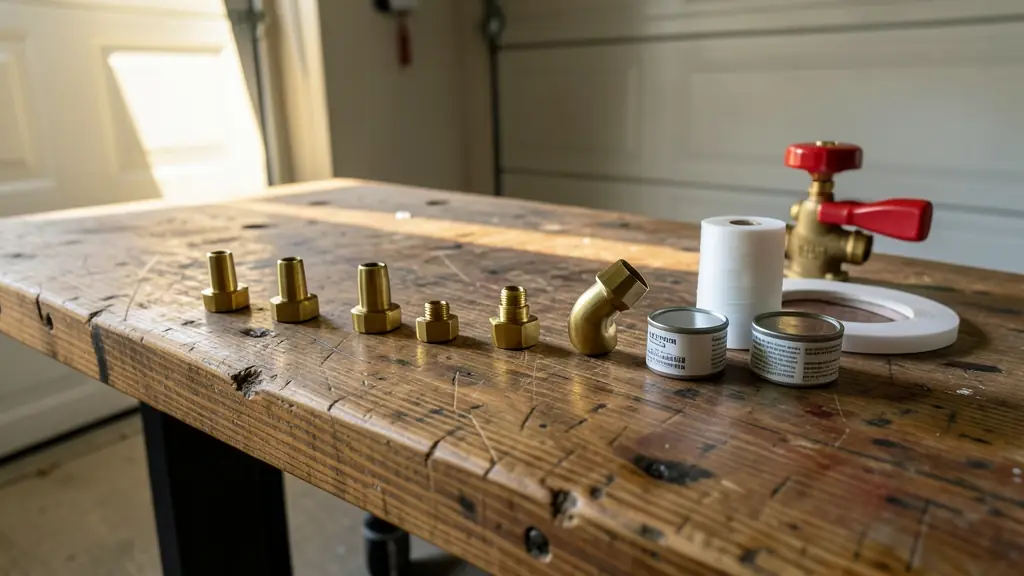
Brass pipe fittings are the small threaded parts that let a tap, a meter, a valve or a hose meet the pipe. Most leaks at a garden tap or a meter box come down to one of three things: the wrong thread, the wrong sealing, or cheap brass that split. Here is how to buy the right piece the first time.
The pieces you will ask for
- Nipples and barrel nipples: short male to male pieces joining two female ends.
- Sockets and bushes: a socket joins two male threads; a bush steps a thread down, say 3/4 to 1/2 inch.
- Elbows and tees: threaded turns and branches for tight spaces.
- Unions: let a valve or pump come out without turning the pipe.
- Hose tails, meter couplings and tap adaptors: the end pieces at a hose, a municipal meter or a tap. Meter work needs the municipality's say so.
Pictures of every shape sit on our types of pipe fittings guide.
BSP threads in plain words
Plumbing brass in South Africa uses BSP inch threads: 1/2, 3/4, 1, 1 1/4, 1 1/2 and 2 inch are the common ones. A taper thread (BSPT) wedges tighter as it goes in and seals on the thread. A parallel thread keeps the same width and usually seals on a washer or an O ring at the face. Screw a taper into a parallel socket and it may hold for a week. The thread name is not the pipe's outside size: a 1/2 inch thread is about 21 mm across, so check the pipe size chart. NPT from imported machines will not seal in BSP.
Sealing: tape, or hemp and paste
Wind thread tape clockwise looking at the end of the male thread, so tightening smooths it down; wound the other way it bunches and tears. Use enough turns to fill the thread, not a fat wad that splits a female fitting. Hemp and paste suits older steel threads and joints that need a little adjustment after tightening. Never tape a thread that seals on a washer.
Plumbing fittings brass: DZR, chrome and cheap
Ordinary brass can lose its zinc in some water and turn porous and pink. Dezincification resistant (DZR) brass is the one to ask for on drinking water, with the SABS mark. Chrome plated brass is for show under a basin. Very light, unmarked brass often cracks at the hex when tightened. Pair brass with brass ball valves, copper or hose fittings.
What to put in your request
- Photograph the old fitting next to a tape
- Say male or female, and the inch size
- Mention taper or parallel if you know
- Ask for DZR on drinking water
- Say how many of each you need
Brass Pipe Fittings: who asks for them and why
- Homeowners: a new garden tap on the stoep wall with a nipple, elbow and wall flange
- Complexes, landlords and body corporates: replacing split couplings at a row of meters in the complex's meter boxes
- Plumbers and pipe fitting contractors: a bin of nipples, bushes and sockets kept on the bakkie for any job
- Builders and developers: tap adaptors and hose union bibcocks for every unit on a housing site
- Farms and smallholdings: hose tails and unions at troughs, tanks and the borehole pump outlet
- Factories, food plants and workshops: threaded branches to wash down points and the water inlet of a machine
- Mines and heavy industry: small threaded water and air take offs at workshops on surface
- Municipalities and civil contractors: brass connections on standpipes and meter installations for a township water project