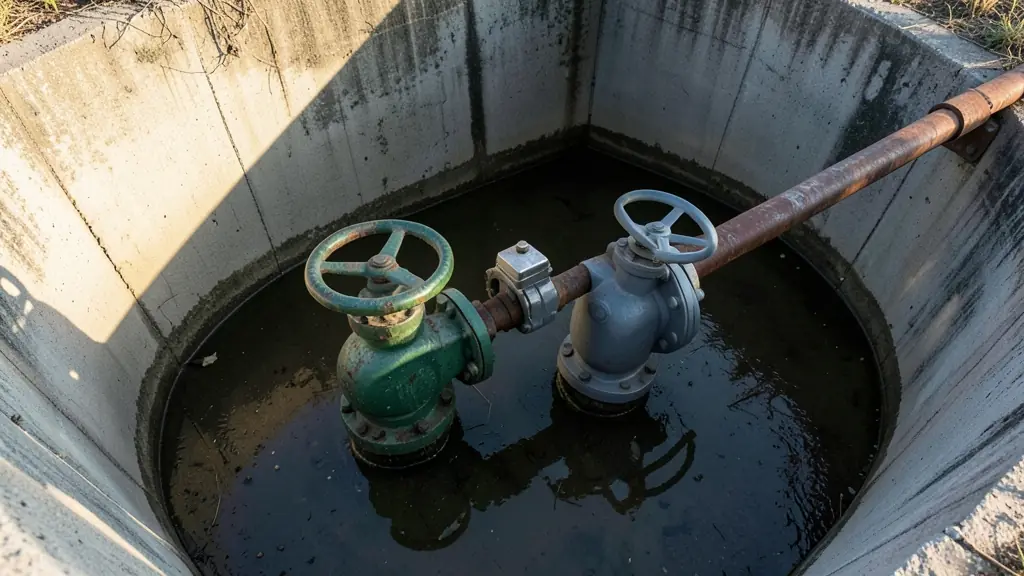
Gate valves and butterfly valves are what you reach for once a line grows past the size where a ball valve makes sense. They isolate a reservoir outlet, a pump, a section of a municipal main or a plant header so the rest can keep working. Which one belongs where depends on space, pressure, how often it is turned and whether anything gritty runs through it.
Gate valves: slow, full and tough
A gate valve lifts a wedge clear of the bore with many turns of a handwheel or a key. Open, it leaves a straight passage with little loss. Resilient seated gate valves, with a rubber coated wedge, are the usual choice on water mains because they seal without a pocket at the bottom where grit collects. Small brass gate valves still turn up under old houses, but they wear and weep, and most plumbers now swap them for ball valves.
Butterfly valves: short and light
A butterfly valve is a disc on a shaft that turns a quarter of the way. It is far shorter and lighter than a gate valve of the same size, which matters in a crowded pump room. Wafer types clamp between two flanges on long bolts; lug types have threaded ears, so one side of the pipe can come off while the other stays live. Large ones get a gearbox so nobody can slam them shut. Check that the flange drilling matches the valve before ordering.
Globe valves and where each one sits
| Place | Usual choice |
|---|---|
| Municipal main, buried | Resilient seated gate valve with a key |
| Pump suction and delivery | Butterfly valve, lug type |
| Reservoir outlet | Gate valve or geared butterfly |
| Flow you trim by hand | Globe valve |
A globe valve forces water through a seat, so it throttles well but costs pressure. Work out what a partly closed valve does to your line with the friction loss calculator.
Chambers, keys and actuators
A buried valve needs a chamber or a surface box and a long key that fits its square cap. Electric or pneumatic actuators let a plant open and close valves from the control room. On a farm, mark every buried valve on a sketch: in ten years nobody will remember. For the steel pipe around them, see steel pipe and fittings.
What to put in your request
- Give the DN size and PN rating
- Say which flange drilling your pipe has
- Say gate, butterfly or globe
- Mention dirty water or slurry
- Ask for a gearbox or actuator price
Gate and Butterfly Valves: who asks for them and why
- Homeowners: an old brass gate valve at the meter that weeps and should become a ball valve
- Complexes, landlords and body corporates: a gate valve at the bulk meter and butterfly valves on the booster pump room
- Plumbers and pipe fitting contractors: replacing a seized gate valve on a 50 mm line feeding a block of flats
- Builders and developers: isolating valves on the site main and the fire line ahead of the hydrants
- Farms and smallholdings: a gate valve at the reservoir outlet and butterfly valves at the pump house
- Factories, food plants and workshops: butterfly valves on cooling water headers and globe valves to trim flow
- Mines and heavy industry: geared butterfly and knife gate valves on dewatering and slurry lines
- Municipalities and civil contractors: resilient seated gate valves with surface boxes along a new water main
Frequently asked questions
Gate valve or butterfly valve on a pump station?
Can I fit a butterfly valve on HDPE pipe?
Are there butterfly valves suppliers in South Africa for big sizes?
Does a municipal main valve need permission?
Work it out first
- Pipe size calculatorFlow and a velocity limit in: the smallest pipe that keeps the water under it, and the sizes either side out
- Friction loss calculatorPipe, size, length, fittings and flow in: the pressure lost along the run, in bar and metres of head out
- Pipe volume calculatorPipe, size and length in: litres in the line, the weight a metre empty and full, and the total weight out