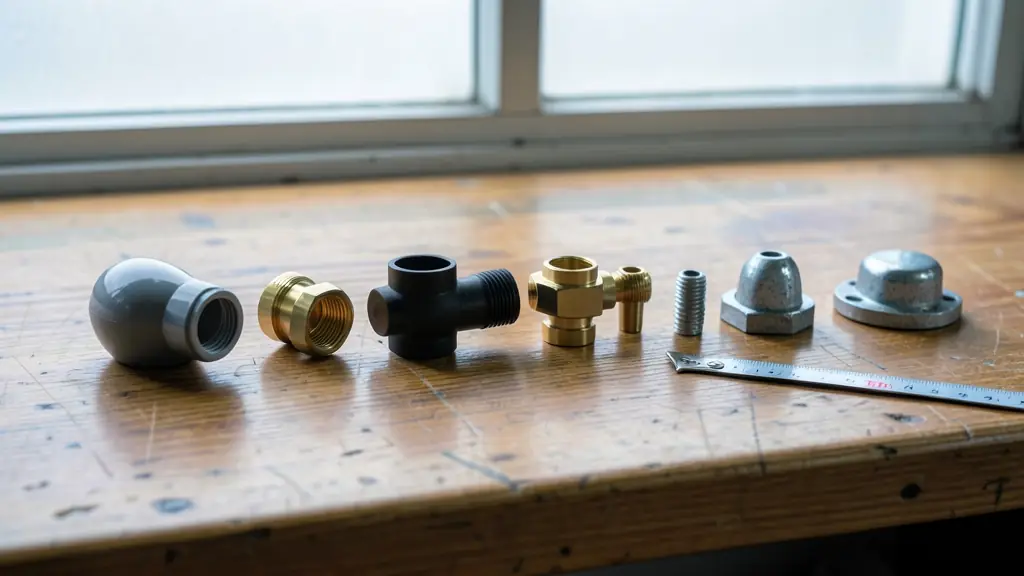
Knowing the types of pipe fittings by name saves the back and forth at a trade counter and stops the wrong part coming home. Most fittings do one of four jobs: turn a corner, split a line, join or change size, or close an end. The names shift a little between plastic drainage, copper and steel, which is where most mix ups start. This guide covers the common shapes and where each one goes.
Turning corners: elbows and bends
An elbow turns the line, usually at 90 or 45 degrees. A short radius elbow turns tight; a long radius one, or a bend, sweeps wider and loses less pressure. In drainage people say "bend", and long radius bends let a rod pass. In copper an elbow is the tight capillary fitting, while a bend is often made by bending the tube itself. On steel lines long radius butt weld elbows are normal, with short ones where space runs out.
Pipe fittings names in a table
| Name | What it does |
|---|---|
| Equal tee | Branch the same size as the run |
| Reducing tee | Smaller branch off a bigger run |
| Cross | Four ways at one point |
| Coupling or socket | Joins two pipe ends in a straight line |
| Union | Joint that undoes without turning the pipe |
| Concentric reducer | Steps down size on the centre line |
| Eccentric reducer | Steps down with one side flat |
| Bush | Fits inside a fitting to take a smaller size |
| Nipple | Short piece threaded at both ends |
| Y junction | Angled branch for drains |
Closing ends and connecting to other things
A cap fits over the outside of a pipe or male thread; a plug screws into a female thread; drainage uses an end cap or a rodding eye. An adaptor moves from one joint to another, say solvent weld to a BSP thread. On steel headers, olets are welded on to take a small branch without a full tee. Flanges bolt a valve or pump in so it can come out later.
Saying it right on the order
Give the material, the size (outside diameter for plastic and copper, NB or inches for steel and threads), the joining method, then the name: "25 mm PVC class 16 equal tee, solvent weld". Check sizes on the pipe size chart, count the pieces with the fittings list calculator, and photograph the old piece lying beside a tape measure.
What to put in your request
- Name the material and size of each fitting
- Say solvent, compression, thread, weld or flange
- Send a photo next to a tape measure
- Say male or female for threaded ends
- Give a count for each fitting
Types of Pipe Fittings: who asks for them and why
- Homeowners: naming the broken fitting under the basin before driving to the hardware store
- Complexes, landlords and body corporates: a caretaker ordering the right union and reducer for a pump room repair
- Plumbers and pipe fitting contractors: a counter order phoned through with exact names so nothing comes back wrong
- Builders and developers: a bill of quantities that uses the same fitting names as the merchant
- Farms and smallholdings: telling a tee from a saddle when ordering spares for the irrigation main
- Factories, food plants and workshops: maintenance staff naming olets, reducers and flanges on a process drawing
- Mines and heavy industry: a shutdown list of elbows, tees and reducers by NB and wall thickness
- Municipalities and civil contractors: matching tender line items to fitting names on a water main drawing