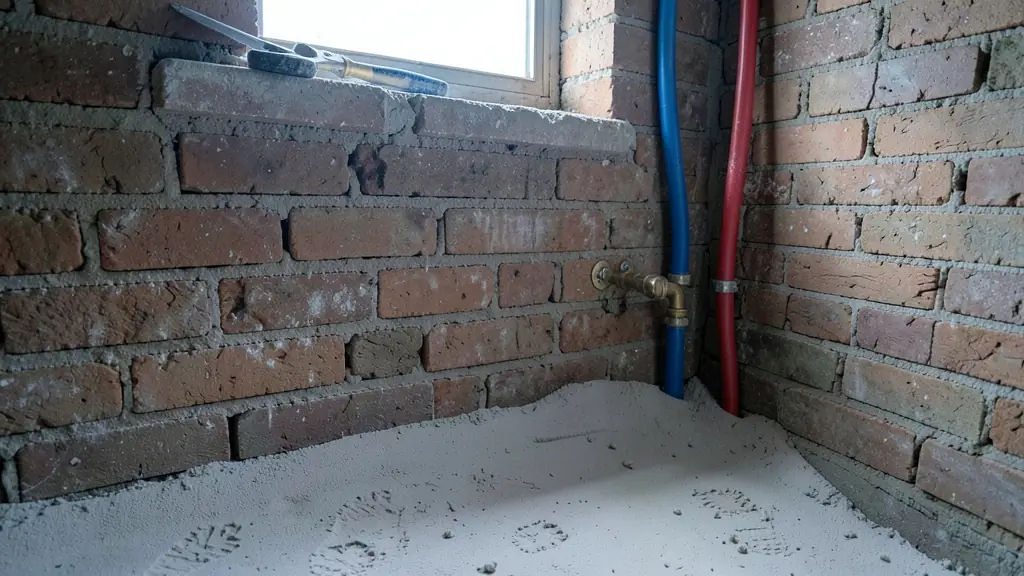
PEX pipe fittings suit the jobs copper makes hard: a bathroom moved across a 1970s house, a geyser in a low roof space, a run through a wall that turns twice. The pipe comes in coils and bends round corners, so there are fewer joints. It joins with push fit, crimp or press fittings, and each system is a family whose pipe, fittings and tools belong together.
Push fit, crimp or press
| Joint | How it works | Suits |
|---|---|---|
| Push fit | The pipe slides past an O ring and a grab ring; a collar or clip releases it | Repairs and a few joints, with only a cutter |
| Crimp | An insert goes inside, and a ring is crimped over the pipe with a hand tool | Whole houses, at a lower cost per joint |
| Press | A sleeve is pressed over the fitting by a press tool, often on multilayer | Plumbers doing many joints a day |
Push fit costs more per fitting; crimp and press need a costly tool, so a plumber who owns one can often quote the joints for less.
PEX, multilayer and polybutylene
Plain PEX is cross linked polyethylene. Multilayer adds an aluminium layer, so it holds a bend and grows less when hot. Polybutylene is an older, softer flexible system still found in many houses. All three come in 16 and 20 mm and look alike, but walls and fittings differ: a PEX fitting on multilayer may seal on the bench and let go under hot water. Unless the maker states in writing that two products match, keep one system per house.
Inserts, calibrating and the tools
Most fittings need an insert or support sleeve so the pipe does not collapse under the ring. Cut square with a pipe cutter, not a hacksaw, then deburr and round the end with a calibrator, as multilayer goes oval when cut. Mark the insertion depth with a pen: a push fit seated halfway can hold cold water, then blow off once the geyser heats up.
Hot water, transitions and support
PEX takes hot water, but many installers run the first stretch out of the geyser in copper, where the geyser valves sit. Join PEX to copper with a transition fitting made for both, or with compression fittings if the system's maker allows it. Clip it so it never sags, keep it out of roof sunlight, sleeve it through brick and pressure test before the wall is closed. The pipe size chart compares 16 and 20 mm with copper sizes.
What to put in your request
- Say which system is already in the house
- Photograph the pipe and an old fitting
- Give the number of hot and cold points
- Say push fit, crimp or press
- Mention the joint to copper at the geyser
PEX Pipe Fittings: who asks for them and why
- Homeowners: moving a bathroom, a new en suite or replacing burst copper without breaking every wall
- Complexes, landlords and body corporates: riser to unit runs in a renovation, with access panels at each manifold
- Plumbers and pipe fitting contractors: crimp or press fittings by the box, inserts and one tool family for every job
- Builders and developers: first fix hot and cold in new houses, coils pulled through walls before plaster
- Farms and smallholdings: worker houses and a farmhouse renovation, where flexible pipe follows crooked old walls
- Factories, food plants and workshops: change rooms, canteens and staff showers, kept apart from the process lines
- Mines and heavy industry: hostel and change house hot water, replaced block by block during maintenance
- Municipalities and civil contractors: first fix in housing projects, where speed per house and fewer joints count
Frequently asked questions
Are PEX plumbing fittings fine for drinking water?
Can I hide push fit quick connect fittings in a ceiling?
Do I need special tools for PEX pipe fittings?
Should a plumber fit it, or can I?
Work it out first
- Pipe size calculatorFlow and a velocity limit in: the smallest pipe that keeps the water under it, and the sizes either side out
- Friction loss calculatorPipe, size, length, fittings and flow in: the pressure lost along the run, in bar and metres of head out
- Pipe volume calculatorPipe, size and length in: litres in the line, the weight a metre empty and full, and the total weight out