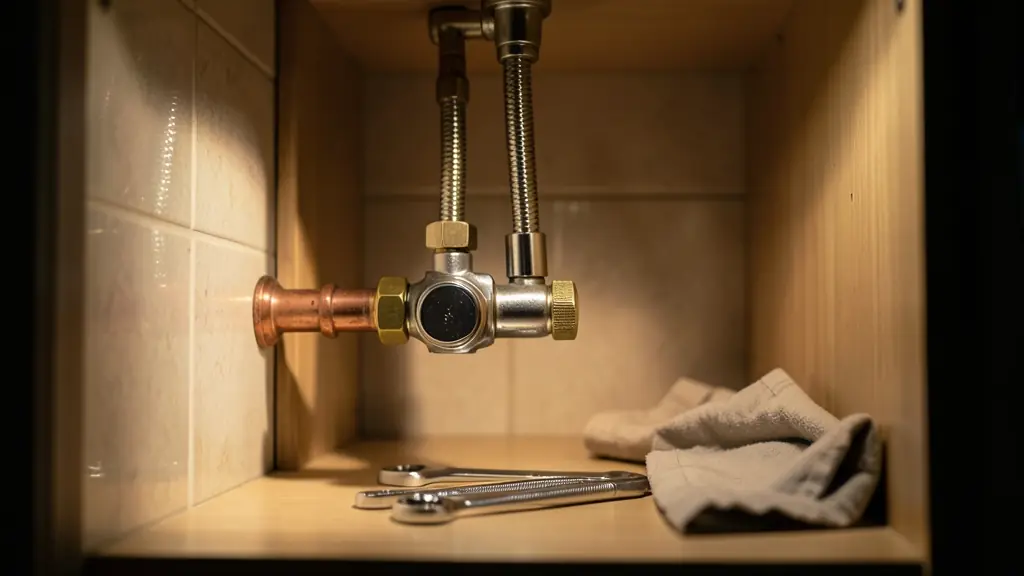
Compression fittings join pipe by squeezing: a nut drives a ring onto the pipe and seals it against the body, with no glue, no solder and no flame. They are the plumber's repair kit and the farmer's everyday joint. Two families share the name and do not swap; knowing which you have and how far to tighten it prevents most leaks.
Two families that share a name
- Plastic compression fittings for HDPE and LDPE: usually a black or blue body, a nut, a split clinch ring that bites the pipe and a rubber O ring that seals. Sizes follow the pipe's outside diameter, about 20 to 110 mm. More on the pipe at HDPE pipe fittings.
- Brass compression fittings for copper: a brass body and nut and a soft olive that deforms onto the tube. Homes mostly use 15 and 22 mm. See copper pipe fittings.
A 15 mm brass fitting will not seal on 16 mm multilayer or old 1/2 inch steel, however hard you lean on it.
When compression is the right choice
Use one when heat is a bad idea; when the line cannot be drained dry for soldering; when you join two different pipes, such as copper to PEX or HDPE to a threaded valve; or when the joint must come apart again, like the isolating valve under a basin. They cost more per joint than solder or press, so on new copper most plumbers keep compression for the ends.
How tight is tight
Brass with an olive: slide on the nut, then the olive, over a square cut, deburred tube. Push the tube fully into the body, tighten by hand, then about one more turn with a spanner while a second spanner holds the body. Too little and it weeps; too much and the olive crushes the tube. If it weeps, nip it a quarter turn at a time.
Plastic for HDPE: chamfer the end, mark the insertion depth and push the pipe through the ring to the mark. Finish with the fitting spanner, never a pipe wrench.
Soft pipe such as PEX needs an insert so the ring has something firm to bite.
Why they weep
- The pipe was not pushed fully home, so the ring grips only the very end.
- A scratched or oval pipe end.
- Thread tape on the nut: on brass the olive seals, not the thread, so tape there only hides a bad seat.
- An old olive reused on fresh tube.
- Grit or a dry, cut O ring on the plastic type.
Check the outside diameter before you buy; the pipe size chart lines up mm, copper and inch sizes.
What to put in your request
- Say which pipe the fitting goes on
- Give the outside diameter of each end
- Ask for inserts if the pipe is soft
- Ask for spare olives or O rings
- Say if it is an urgent repair
Compression Fittings: who asks for them and why
- Homeowners: a late night repair on a split copper pipe or a weeping basin isolating valve
- Complexes, landlords and body corporates: isolating valves on each unit's supply so one flat can be shut off alone
- Plumbers and pipe fitting contractors: brass couplings and olives on the bakkie for repairs where a torch is unwise
- Builders and developers: joining new PEX or copper to the existing supply during an extension
- Farms and smallholdings: plastic couplings and tees on the poly line to troughs, with spare rings in the shed
- Factories, food plants and workshops: quick repairs on cold water and wash down lines without stopping for hot work
- Mines and heavy industry: temporary service water lines on poly that are moved as the workings advance
- Municipalities and civil contractors: house connection fittings from the ferrule to the meter on poly service pipe