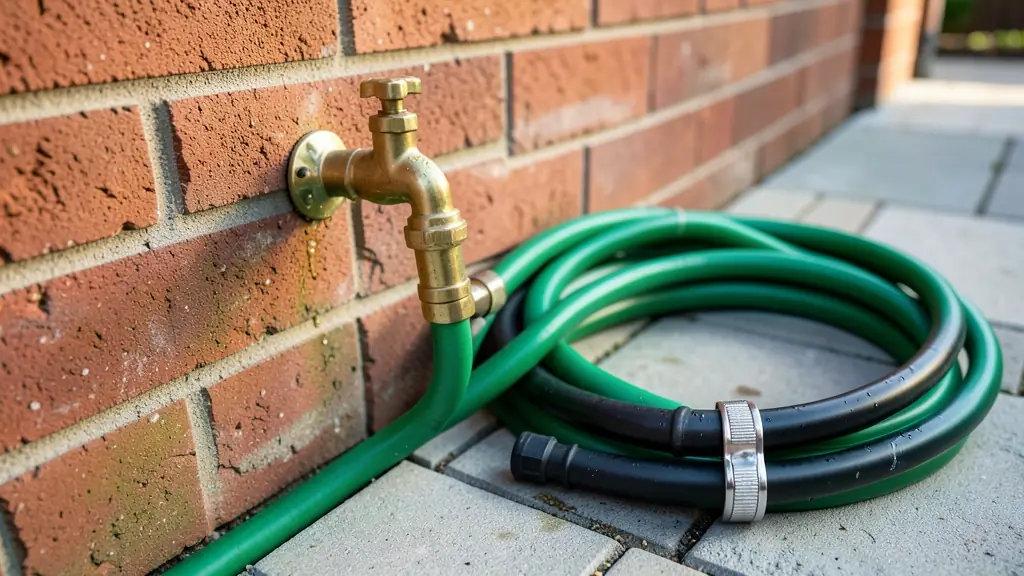
Hose to pipe fittings join a flexible hose to a tap, a pump, a tank or a rigid line. Most of the trouble at the counter comes from one fact: hose is sized by its inside bore, while plastic pipe is sized by its outside diameter and taps by their BSP thread. A 20 mm hose does not fit a 20 mm pipe fitting. Bring the hose, or a photo of its cut end beside a ruler, and the tap or pipe it must meet.
Garden hose pipe fittings: clicks and tap adaptors
The click system has three parts: a tap adaptor that screws onto a 1/2 or 3/4 inch tap, a hose connector on each end of the hose, and accessories like a spray nozzle or a sprinkler. Common hose bores are 12 mm (1/2 inch) and 20 mm (3/4 inch); the connector must suit the bore or it pulls off under pressure. If a click weeps, the small O ring inside is usually flattened or missing. A pack of spare O rings costs less than a new connector.
Barbed tails, clamps and hose to pipe adaptors
For a permanent join, push the hose over a barbed hose tail and close it with a stainless worm drive clamp, or two on a pump line. A brass or plastic hose tail with a BSP thread screws into a tee or a ball valve. To go from hose to a plastic line, use an adaptor with a barb on one end and an HDPE compression end for 15, 20 or 25 mm pipe on the other; see compression fittings. Warm a stiff hose in hot water before pushing it on; never grease the barb.
Camlocks, layflat and pump suction hose
Camlock couplings join pump hose, tanker hose and dewatering lines without tools: a grooved male adaptor locks into a female coupler with two cam arms. They come in aluminium, polypropylene, brass and stainless, usually from 1 to 4 inch. Layflat hose for transfer and irrigation uses a tail and a band clamp or a bolted collar. On the suction side of a pump, use reinforced suction hose that will not collapse, and seal every joint: one air leak and the pump loses its prime. The friction loss calculator shows what a long, narrow hose costs you in pressure.
Why cheap clicks leak, and other returns
- Thin plastic clicks crack in the sun after one summer.
- A 3/4 inch tap adaptor bought for a 1/2 inch tap.
- Garden fittings used on a high pressure washer: they need fittings rated for that machine.
- A single clamp on a vibrating pump hose, which walks off within weeks.
What to put in your request
- Give the hose inside bore
- Say the tap thread: 1/2 or 3/4 inch
- Name the pump or tanker for camlocks
- Say suction or delivery side
- Send a photo of the old fitting
Hose Fittings: who asks for them and why
- Homeowners: a click system on the garden tap, a hose reel and a spray gun for the car
- Complexes, landlords and body corporates: hose bibs on the common garden taps, with lockable taps so hoses are not left running
- Plumbers and pipe fitting contractors: barbed tails, clamps and tap adaptors kept in the bakkie for quick call outs
- Builders and developers: a site hose on the standpipe for mixing and curing concrete, and a camlock dewatering line
- Farms and smallholdings: camlock couplings on the transfer pump, layflat to the dam and hose to the trough
- Factories, food plants and workshops: wash down hose with stainless fittings on hot or cold water points in the plant
- Mines and heavy industry: dewatering pumps with large camlock couplings and reinforced suction hose in the pit
- Municipalities and civil contractors: water tanker hose, standpipe connections and sewer bypass pumping with camlock lines
Frequently asked questions
What hose pipe fittings do I need for a new tap?
Can I join two hoses together?
Are camlocks from different suppliers interchangeable?
Where do the hose fitting quotes come from?
Work it out first
- Pipe size calculatorFlow and a velocity limit in: the smallest pipe that keeps the water under it, and the sizes either side out
- Friction loss calculatorPipe, size, length, fittings and flow in: the pressure lost along the run, in bar and metres of head out
- Pipe volume calculatorPipe, size and length in: litres in the line, the weight a metre empty and full, and the total weight out