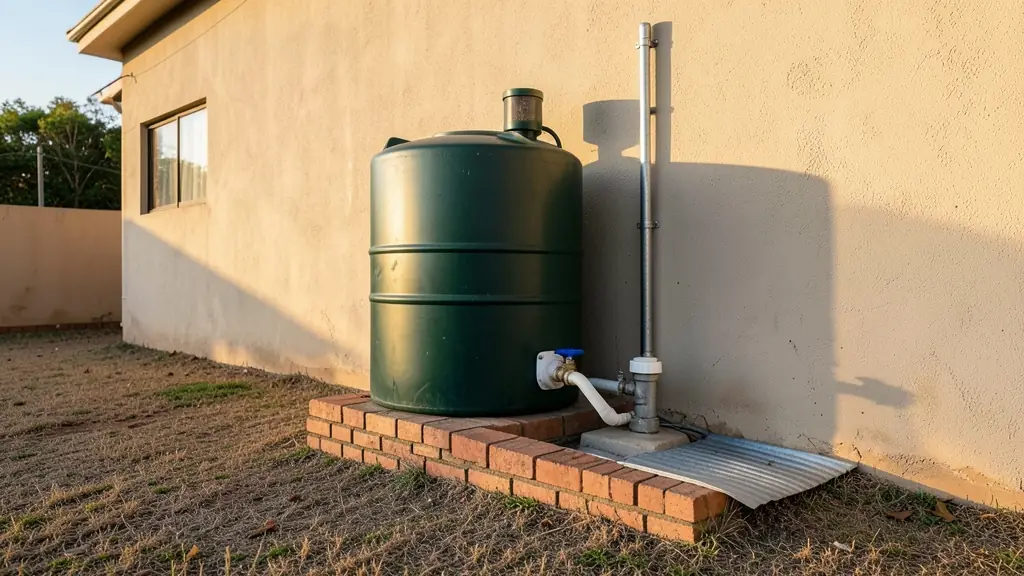
Water tank pipe fittings turn a plastic or steel tank into a working supply: water in from the roof or the municipal line, water out to the garden, the house or a pump, and spare water away through the overflow. Most tank problems come from the fittings, not the tank: a bulkhead that weeps, an outlet set too low that sucks up silt, or an overflow with no screen that breeds mosquitoes.
Bulkhead pipe fittings: the hole in the tank
A bulkhead tank connector passes through the tank wall with a rubber washer each side and a backnut, giving a thread or a socket on both faces. Sizes run from about 20 to 50 mm, or 3/4 to 2 inch. Drill the hole with a hole saw on a flat part of the wall, not a rib, and tighten the backnut by hand plus a little: plastic walls flex, and over tightening squeezes the washer out. Many tanks come with a moulded outlet; check its thread before buying the rest.
Inlet, float valve, overflow and first flush
A tank filled from the mains needs a float valve so it stops when full; the arm must clear the tank wall and the float must suit the supply pressure. Rainwater from gutters goes through a leaf screen and a first flush diverter, which sends the first dirty water off the roof to waste. The overflow should be at least as big as the inlet, piped away from the stand, with a mosquito screen on its end and on every opening.
Ball valves for water tanks and the pump link
Set the outlet a little above the tank floor so silt stays behind. Fit a ball valve right at the outlet so the tank can be isolated, then a short line to the pump with a non return valve to hold the prime, and a union so the pump can come out. On a tank stand without a pump, every metre of height gives about 0.1 bar, so a low stand gives a weak flow; the friction loss calculator shows how much you lose on the way to a far tap. See ball valves and PVC fittings for the line.
Connecting two tanks
Link tanks with a balance pipe between their bottom outlets on the same level, with a valve each side so one can be drained. Tanks must stand at the same height and on a flat, solid base. Steel tanks need fittings that will not react with the tank.
What to put in your request
- Give the tank size and material
- Say rainwater, mains or borehole fill
- Say if a pump is on the outlet
- Give the pipe size to the house or garden
- Count tanks to link together
Water Tank Fittings: who asks for them and why
- Homeowners: a rainwater tank for the garden or a backup tank and pump for water cuts
- Complexes, landlords and body corporates: a bank of tanks in the plant room feeding the units through a pressure pump
- Plumbers and pipe fitting contractors: bulkheads, float valves and pump kits for backup water installs in suburbs
- Builders and developers: tanks on new houses with the inlet, overflow and pump link done at first fix
- Farms and smallholdings: reservoir and trough tanks fed from the borehole, with floats and large outlets
- Factories, food plants and workshops: process and fire water tanks with flanged outlets and level controls
- Mines and heavy industry: elevated tanks for dust suppression and wash bays, with large bulkhead outlets
- Municipalities and civil contractors: water tanks at clinics and schools, and temporary supply tanks during main repairs