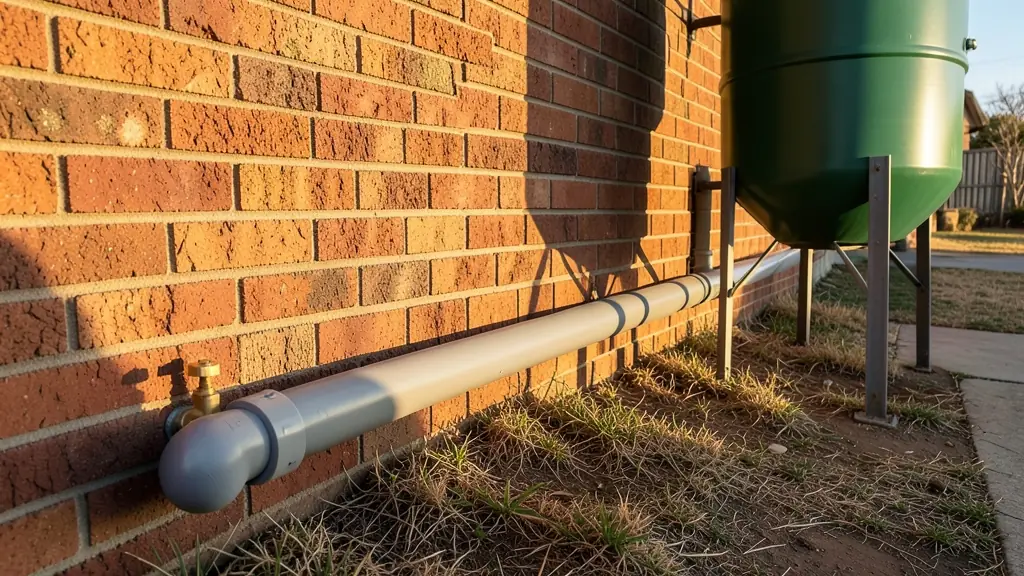
PVC pipe fittings are the grey sockets, elbows, tees and reducers that glue onto PVC pressure pipe for cold water. They are light, cheap and quick to assemble, and they forgive almost nothing: a joint made without primer, a low class tee on a pump line or a fitting baked by three summers will let go, usually at night.
Match the class of the fitting to the line
PVC pressure pipe comes in classes of about 4, 6, 9, 12 and 16, the number being roughly the working pressure in bar. The fitting must be at least the class of the pipe, and both must suit the highest pressure the line will see. A borehole pump against a closed tap can push far beyond what town mains deliver. Class 9 is a sensible floor for a house; a pump line usually wants 12 or 16. PVC takes cold water only, never a geyser or solar line; for hot water use copper.
Solvent weld, step by step
- Cut square and take the burr off inside and out.
- Dry fit: the spigot should go part way in before it tightens.
- Wipe both surfaces with primer until the shine is gone.
- Cement the pipe, a thinner coat in the socket, push home with a quarter twist and hold.
- Wait before pressure, longer in cold weather and on big sizes; overnight where you can.
Most weeping joints people bring back were filled within the hour. Keep the lid on the tin: stringy cement makes a weak weld.
Common sizes and the threaded ends
Houses and gardens use 20 and 25 mm; 32 and 40 mm feed a smallholding or a complex; 50 mm runs to tanks, pool pumps and troughs. A 20 mm PVC fitting will not take 20 mm HDPE, a plastic that cannot be glued anyway (see HDPE pipe fittings). Where PVC meets a tap, a pump or a ball valve, use a threaded adaptor with a BSP end, taped and only a quarter turn past hand tight: a plastic female thread splits when metal is forced in. Torn between 25 and 32 mm on a long run? Try the friction loss calculator.
Look alikes, and what sunlight does
- Conduit fittings for cable look similar but carry no pressure rating.
- Drainage fittings are for gravity flow only; see drainage pipe fittings.
- mPVC and PVC-O are tougher grades for municipal and farm mains, mostly joined with rubber ring sockets rather than glue. Treat them as a separate system and ask for matching fittings.
- Sun: exposed PVC turns chalky and brittle. Bury, sleeve or paint it.
What to put in your request
- Give the pipe class as well as the size
- Say if a pump feeds the line
- Count the threaded adaptors separately
- Ask for primer and cement on the quote
- Say if the line will be in full sun
PVC Pipe Fittings: who asks for them and why
- Homeowners: a cold line from the main tap to a tank, a garden tap or a pool fill point
- Complexes, landlords and body corporates: replacing brittle exposed PVC on the garden taps and irrigation feed of a complex
- Plumbers and pipe fitting contractors: boxes of 20 and 25 mm sockets, elbows and adaptors for cold water jobs
- Builders and developers: cold water first fix in PVC to standpipes and yard taps on a housing project
- Farms and smallholdings: 50 mm lines from the borehole tank to troughs and the house, buried below the plough
- Factories, food plants and workshops: cold process water and chemical dosing lines where the medium suits PVC
- Mines and heavy industry: low pressure service water to change houses and wash bays on the surface
- Municipalities and civil contractors: standpipe and connection fittings on a rural water scheme with rubber ring mains
Frequently asked questions
Is there a PVC pipe fittings catalogue for South Africa?
Will a 40 mm fitting glue onto 1 1/2 inch pipe?
How soon can I turn the water on?
Who will quote my list of plumbing fittings in PVC?
Work it out first
- Pipe size calculatorFlow and a velocity limit in: the smallest pipe that keeps the water under it, and the sizes either side out
- Pipe volume calculatorPipe, size and length in: litres in the line, the weight a metre empty and full, and the total weight out
- Fittings list calculatorA run with bends, tees, ends and valves in: the pipe lengths, couplings, elbows, tees and solvent or tape out