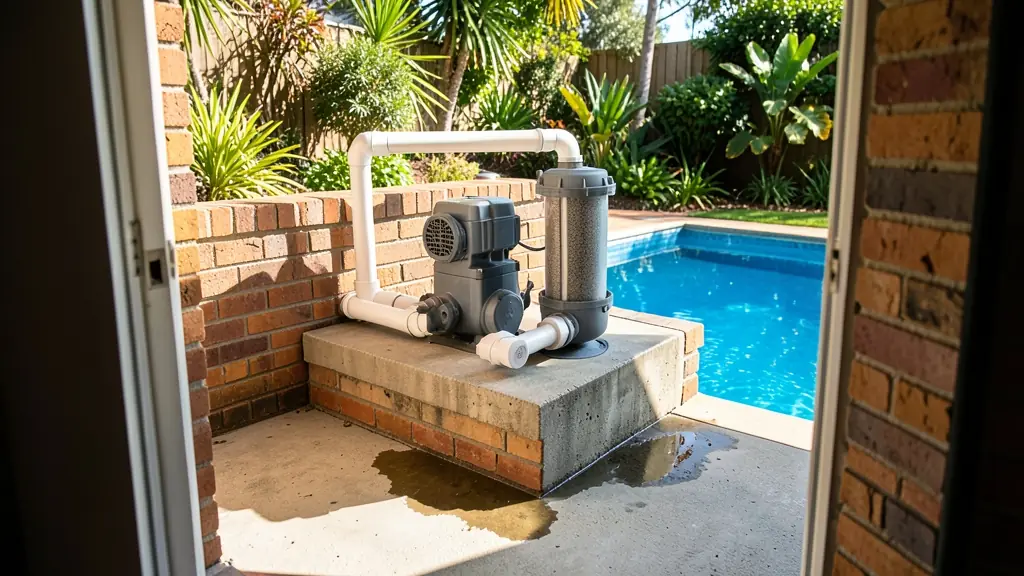
Most questions about pool pipe fittings begin with a puddle under the pump, a hissing filter or a pool that drops a few centimetres a week. Behind a Centurion or Bloemfontein pool wall there is little: a skimmer line and maybe a main drain, a pump, a sand filter with a multiport valve and a return line to the eyes. Nearly all of it is 50 mm PVC.
Suction side and pressure side
Pipe from the skimmer and main drain to the pump is the suction side. It runs under vacuum, so a leak lets air in: bubbles at the return eyes, a pump that loses prime, a basket lid full of air. From the pump onwards, via the filter to the eyes, is the pressure side, where a leak sprays or drips. Every elbow costs the pump some push too; the friction loss calculator puts a number on a far pump room.
Barrel unions and the leak at the pump
A barrel union has two tails and a big nut with an O ring between them, so the pump lifts out without cutting pipe. The usual leak is a flat, dry or missing O ring, or a nut done up skew. Clean the faces, fit a new ring with a smear of silicone grease and tighten by hand. Thread tape on the nut does nothing, since the O ring makes the seal. If a tail cracks, cut it out and glue in a new one with PVC solvent weld fittings.
Pool valves and the fittings around them
- Multiport valve: on or beside the filter, with pump, return and waste ports; match port size and thread when replacing it.
- Ball valves: PVC ball valves on the skimmer and main drain lines balance suction or close a line for repairs.
- Check valve: stops water running back when the pump sits above the water; most solar loops need one.
- Return eyes: threaded eyeballs in the pool wall that aim the water.
The valves guide covers the wider family.
Solar heating lines and Highveld winters
Roof solar panels add a tee, a diverter valve, a check valve and an air release at the top of the loop. A hard Highveld frost can split water standing in exposed pipe and filter heads, so run the pump for a while on the coldest nights or drain the solar loop for winter. Bare PVC in full sun turns chalky and brittle after a few years; paint it or cover the pump room.
What to put in your request
- Photograph the pump, filter and valves
- Say where it leaks: pump, filter or ground
- Give the pipe size, usually 50 mm
- Mention solar heating if fitted
- Say if the pump loses prime
Pool Pipe Fittings: who asks for them and why
- Homeowners: a leak at the pump union, a new pump, or solar heating added on the roof
- Complexes, landlords and body corporates: the shared pool in an estate, its pump room and a maintenance contract
- Plumbers and pipe fitting contractors: unions, valves and 50 mm PVC fittings for pump swaps and pump room rebuilds
- Builders and developers: new pool plumbing from skimmer to pump room before the coping and paving go down
- Farms and smallholdings: a farmhouse or guest cottage pool, often with a long run to a separate pump room
- Factories, food plants and workshops: fountains, ponds and water features at the entrance, plumbed like a small pool
- Mines and heavy industry: club pools in mining towns, with bigger pumps, filters and flanged pump rooms
- Municipalities and civil contractors: municipal swimming bath plant rooms with large filters and balancing tanks
Frequently asked questions
What size are pool pipe fittings?
Why does my pool pump keep losing prime?
Can I use ordinary PVC plumbing fittings on a pool?
Who will quote for pool plumbing fittings?
Work it out first
- Pipe size calculatorFlow and a velocity limit in: the smallest pipe that keeps the water under it, and the sizes either side out
- Friction loss calculatorPipe, size, length, fittings and flow in: the pressure lost along the run, in bar and metres of head out
- Pipe volume calculatorPipe, size and length in: litres in the line, the weight a metre empty and full, and the total weight out