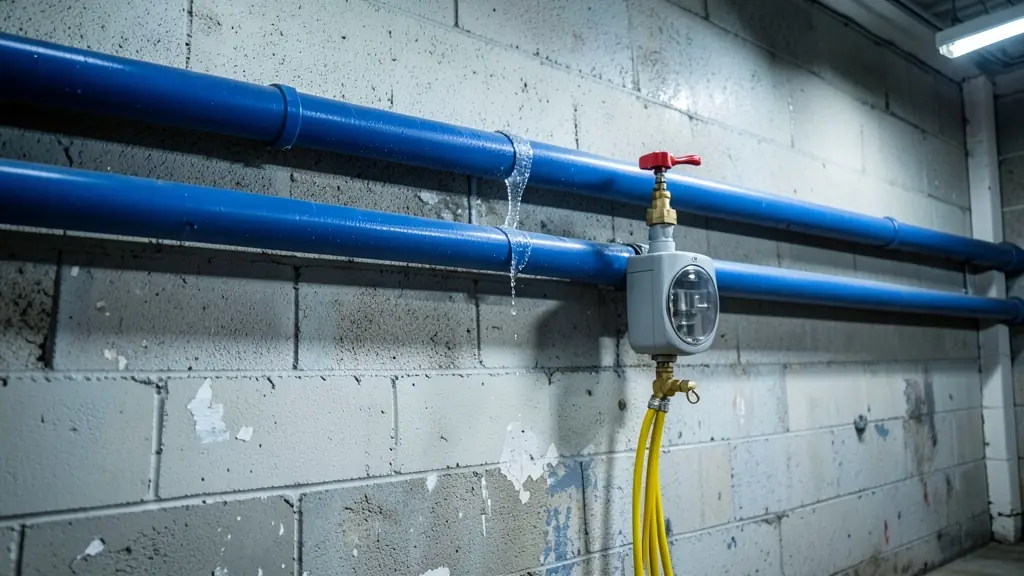
Pneumatic pipe fittings carry compressed air from the compressor to the spray gun, the tyre changer or the cylinder on a packing machine. Air is less forgiving than water in one way: a leak makes no puddle, it just hisses while the compressor runs longer and your power bill climbs. Getting the main, the drops and the small fittings right keeps the pressure where the tool needs it.
Push in fittings and tube on machines
Machines use push in fittings on nylon or polyurethane (PU) tube, sized by the tube outside diameter: the usual run is 4 mm up to 12 mm in even steps. Cut the tube square with a tube cutter, push it in past the O ring until it stops, and release it by pressing the collet. A threaded body screws into the valve or cylinder port, usually 1/8 to 1/2 inch BSP; some imported machines have NPT or metric ports, so check before ordering a box of elbows. PU bends tighter; nylon holds pressure better in heat.
Air compressor pipe fittings for a ring main
A workshop main is best laid as a loop, so air reaches each point from two sides. Aluminium systems with push on or clamp fittings go up quickly and do not rust; copper and galvanised steel are the older choices, and steel rusts inside and sheds scale into tools. Avoid PVC for compressed air: it can shatter. Lay the main with a slight fall towards a drain point, take every drop off the top of the main, and fit a drain valve at the low end. Size the pipe for the flow, not the compressor outlet; the pipe size calculator is a good start.
Filter, regulator, lubricator and couplers
At each drop, the FRL unit cleans the air, sets the pressure for that tool and, where the tool needs it, adds a mist of oil. Many paint and food lines skip the lubricator. Quick couplers come in several profiles that do not mix, so pick one profile for the whole site. Put a ball valve above each FRL so it can be serviced without shutting the main.
Finding the leaks
Walk the plant on a quiet weekend with the compressor running and listen, then brush soapy water on couplers, hose tails and push in fittings. Worn couplers and split tube ends are the usual culprits. Mark them, fix them and check the compressor's running hours a week later.
What to put in your request
- Give tube sizes and port threads
- Name your quick coupler profile
- Sketch the ring main with drop points
- State the working pressure
- Say if the air is for paint or food
Pneumatic Fittings: who asks for them and why
- Homeowners: a small compressor in the garage with a coupler for the tyre gauge and a blow gun
- Complexes, landlords and body corporates: a compressor in the maintenance room for the gate motor workshop and tyre pressure
- Plumbers and pipe fitting contractors: air fittings for pressure testing lines, with a gauge and a coupler on a test rig
- Builders and developers: site compressor hose to nail guns and breakers, with couplers that survive the dust
- Farms and smallholdings: a workshop compressor for tractor tyres, a spray gun and blowing out filters
- Factories, food plants and workshops: an aluminium ring main to packing machines, with an FRL and push in tube at each
- Mines and heavy industry: rock drill air lines and workshop mains with heavy couplers and water traps
- Municipalities and civil contractors: compressor trailers feeding jackhammers on a road job, with hose whip checks
Frequently asked questions
Can I use water fittings on compressed air?
What are pneumatic valves?
Why is there water in my air line?
Who quotes on pneumatic fittings?
Work it out first
- Pipe size calculatorFlow and a velocity limit in: the smallest pipe that keeps the water under it, and the sizes either side out
- Friction loss calculatorPipe, size, length, fittings and flow in: the pressure lost along the run, in bar and metres of head out
- Pipe volume calculatorPipe, size and length in: litres in the line, the weight a metre empty and full, and the total weight out