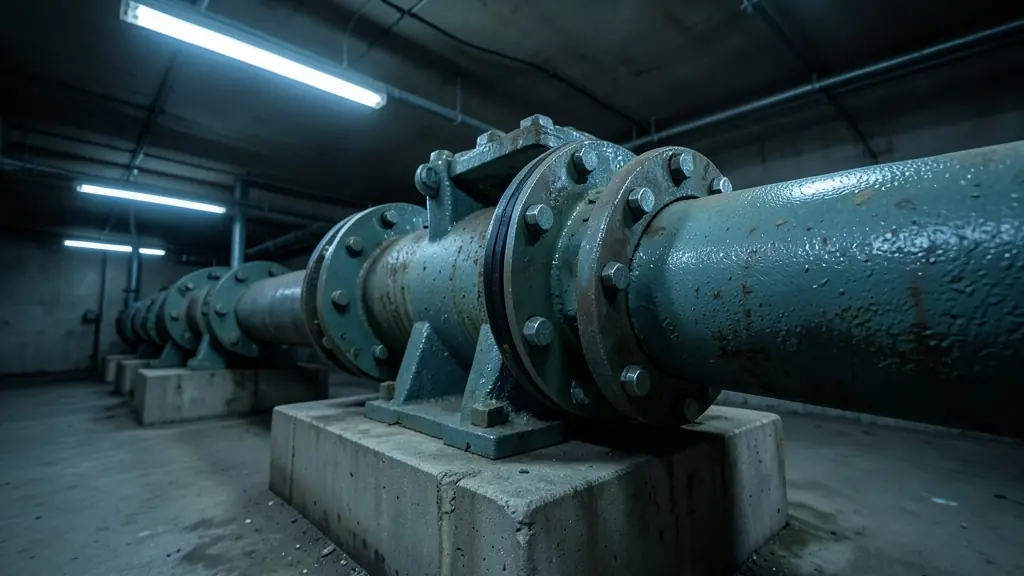
Flanges turn a pipe end into a bolted face, so that a pump, a valve or a meter can be unbolted and lifted out without cutting the line. Two flanges, a gasket between them and a ring of bolts make the joint. What sinks most orders is a flange that looks right but is drilled to a different table, so the bolt holes never line up with the one it meets.
Flanges types and where each goes
- Slip on: slides over the pipe and is welded inside and out; quick and common on water lines.
- Weld neck: a tapered hub butt welded to the pipe; used for high pressure, heat and cyclic loads.
- Blind: a solid disc that closes a line or a spare branch.
- Threaded: screws onto threaded pipe where welding is not allowed.
- Stub flange with a backing ring: for HDPE, the stub is fused to the pipe and a loose steel ring bolts it up, see HDPE pipe fittings.
Drilling, face and rating: the three things to match
Every flange is drilled to a table or a PN rating, which fixes the bolt circle, the number of holes and the bolt size. Two flanges of the same pipe size but different drilling will not bolt together. Read what is stamped on the old flange, or count the holes and measure across two opposite holes from centre to centre. Then match the face: a raised face meets a raised face, and a flat face is what cast iron pumps and valves need, as a raised face can crack them. Where the standards differ, an adaptor flange or a drilled spacer bridges the gap.
Flanges gasket choice
Rubber gaskets suit cold water and are forgiving on flat faces. Compressed fibre takes more heat and many oils. Spiral wound gaskets, a steel winding with a filler and a guide ring, suit steam, hydrocarbons and high pressure on raised faces. A gasket is used once: a squashed one taken off a valve during maintenance will not seal again. Order spares for a shutdown, and say the medium and temperature so the stockist picks the right material.
Bolting up without a leak
Line up the faces so they are parallel before any bolt goes in; a flange pulled square by its bolts strains the pipe and leaks later. Tighten in a star pattern in three or four rounds, not one bolt hard at a time. On pressure lines the site gives the torque, so ask the engineer. Steel lines with flanged valves are covered on steel pipe and fittings and gate and butterfly valves. List every flange, gasket and bolt set in the fittings list calculator.
What to put in your request
- State the drilling table or PN rating
- Say raised face or flat face
- Give the pipe size and wall
- Name the medium and temperature
- Count gaskets and bolt sets separately
Flanges: who asks for them and why
- Homeowners: rarely at home, perhaps a flanged borehole pump outlet on a large property
- Complexes, landlords and body corporates: flanged booster pumps and the bulk meter in the complex pump room
- Plumbers and pipe fitting contractors: a pair of flanges and a rubber gasket to swap a pump on a commercial job
- Builders and developers: flanged fire pump sets and valves in the basement plant room of a new block
- Farms and smallholdings: stub flanges and backing rings joining big HDPE mains to pumps and filters
- Factories, food plants and workshops: weld neck flanges and spiral wound gaskets on steam and process lines
- Mines and heavy industry: hundreds of flanges, gaskets and studs staged on pallets before a shutdown
- Municipalities and civil contractors: flanged valves, meters and dismantling joints in a pump station chamber
Frequently asked questions
What are flanges on pipes for?
Are bolts and gaskets included with flanges?
Can I bolt a PN16 flange to a table drilled one?
Who quotes on flanges?
Work it out first
- Pipe size calculatorFlow and a velocity limit in: the smallest pipe that keeps the water under it, and the sizes either side out
- Friction loss calculatorPipe, size, length, fittings and flow in: the pressure lost along the run, in bar and metres of head out
- Pipe volume calculatorPipe, size and length in: litres in the line, the weight a metre empty and full, and the total weight out