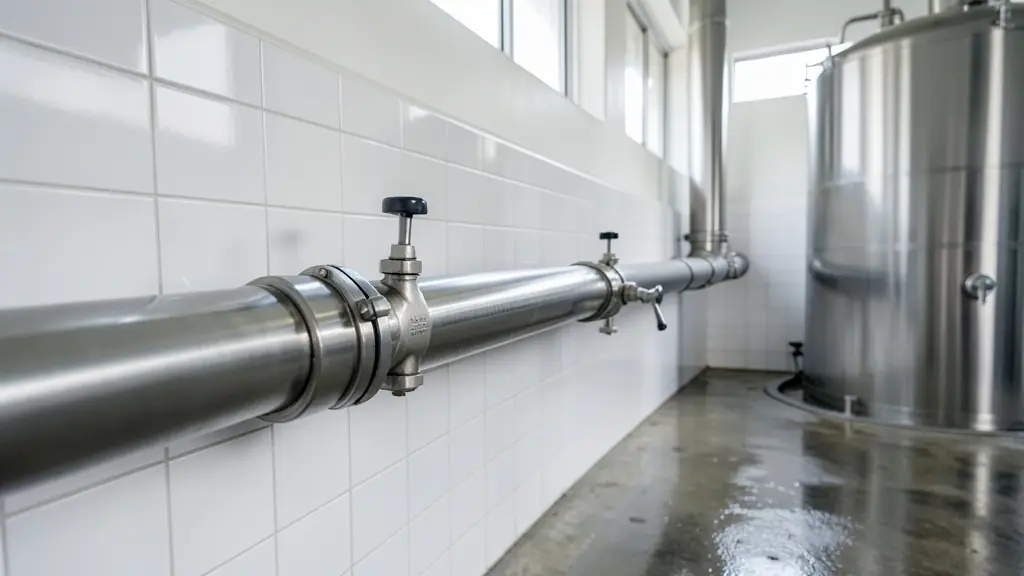
A stainless steel pipe fitting costs several times what carbon steel does, so buy it where it pays: milk, beer, juice, food, chemicals and salty air. This page is for a dairy rebuilding its milk line, a craft brewery adding a fermenter, a food plant passing a hygiene audit, or a coastal site tired of rust. It covers grades, the joint types, welding and the costly mix ups.
304 or 316
Grade 304 is the everyday stainless for water, milk and most food. Grade 316 adds molybdenum, which resists chlorides: sea air, salty process water, brine and many cleaning chemicals. On a site a few kilometres from the sea, or where chlorine is used to clean, 316 is the safer ask. Grades look identical on the shelf, so ask for the grade in writing and the mill certificate on a big order.
Fittings for stainless steel pipe, by joint
- Clamp ferrules: two ferrules, a gasket and a clamp; quick to strip and clean on a milk or wort line.
- Sanitary unions: a threaded nut and liner, common on older dairy lines.
- Butt weld fittings: elbows, tees, reducers and caps welded on for a smooth bore with no crevices.
- Threaded stainless: BSP sockets, nipples and elbows for chemical dosing, compressed air and coastal water.
Hygienic tube is sized by outside diameter, while threaded pipe follows inch nominal bore; check both on the pipe size chart. Valves to match are on ball valves and valves.
Welding and passivation in plain words
Stainless is TIG welded with gas purging the inside, otherwise the bore burns black and rough and bacteria find a home there. After welding, a pickling and passivation treatment restores the protective layer on the surface. Ask the welder how they purge and finish. See pipe welding and threading; on a food plant the site engineer and the hygiene auditor set the standard.
Mixing with carbon steel, and the cost
Carbon steel grinding dust or a carbon steel wire brush leaves specks that rust on stainless. Keep tools separate. Bolting stainless to a carbon steel line can corrode the carbon side; an insulating gasket kit at the flanges helps. Stainless is priced per fitting, with 316 and bigger sizes costing far more, so get a rough figure from the pipe fitting cost calculator.
What to put in your request
- State the grade, 304 or 316
- Give tube OD or the inch thread
- Say clamp, union, weld or thread
- Name the product and cleaning chemicals
- Ask if welding is included
Stainless Steel Pipe Fittings: who asks for them and why
- Homeowners: an outside shower or tap connection at a beach house where brass keeps pitting
- Complexes, landlords and body corporates: stainless connectors on pool showers and outside taps in a seaside complex
- Plumbers and pipe fitting contractors: a handful of 316 threaded fittings for a coastal job or a commercial kitchen
- Builders and developers: stainless lines in a food court kitchen or a hospital fit out
- Farms and smallholdings: rebuilding the milk line from the parlour to the bulk tank in clamp fittings
- Factories, food plants and workshops: hygienic lines in a brewery, juice plant or food factory that face audits
- Mines and heavy industry: 316 fittings on reagent dosing and chemical lines at a plant
- Municipalities and civil contractors: chlorine dosing lines and stainless pipework at a water treatment works
Frequently asked questions
Are stainless steel plumbing fittings worth it in a house?
Can I use rubber gaskets in clamp fittings for hot cleaning?
Do ss pipe fittings rust?
Who will quote my stainless order?
Work it out first
- Pipe size calculatorFlow and a velocity limit in: the smallest pipe that keeps the water under it, and the sizes either side out
- Friction loss calculatorPipe, size, length, fittings and flow in: the pressure lost along the run, in bar and metres of head out
- Pipe volume calculatorPipe, size and length in: litres in the line, the weight a metre empty and full, and the total weight out