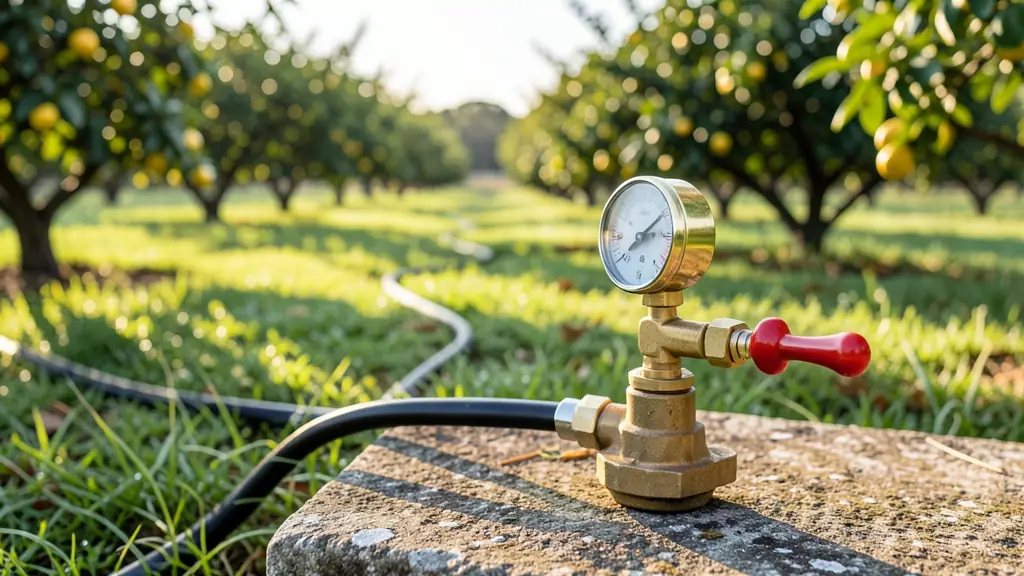
A pump that shows good pressure at the borehole can still leave a trickle at the far trough, because every metre of pipe and every bend takes a little of it. This friction loss calculator adds those losses up for water in a full pipe, so you can see the pressure drop before the trench is dug. It suits farm lines, irrigation pipe fittings and a supply up to a tank.
What the tool counts
The pipe loss uses the Hazen-Williams formula with a C value for the material: about 150 for PVC, 140 for HDPE and copper, and lower for steel. The tool fills C in when you pick the pipe; pick an old, scaled line and it drops. Each elbow, tee and valve adds a loss of its own, worked from a published coefficient, and threaded fittings on galvanised pipe lose far more than smooth ones. Rise is the height from the start to the end.
A worked line
40 L/min through 50 m of 32 mm HDPE PN16 with six elbows, two tees, two ball valves and a non return valve loses about 0.42 bar, almost all in the pipe. Lift the water 4 m to a tank and you need about 0.81 bar at the start, plus whatever pressure you want at the outlet. Halve the flow and the loss falls to about a quarter; one size up cuts it by more than half.
Limits of the answer
The formula is for cold water in a pipe running full. It does not cover slurry, air, steam, hot water lines or a part closed valve, and a blocked strainer or a dirty filter can lose more than the whole run. A pressure reducing valve sets its own outlet pressure. For a long main or a pump selection, ask the supplier or the engineer to check it.
When the loss is too high
Go up one pipe size before anything else: on a long line it is usually cheaper than a bigger pump that runs for years. Cut the bends where the route allows, use long radius bends in place of tight elbows, and fit full bore valves. Keep the strainer and filter clean, and fit a gauge at each end so you can see the loss once the line is running.
Frequently asked questions
What is a metre of head?
Why does old galvanised pipe lose so much?
Do the fittings matter on a long line?
Can someone check my pump and pipe?
More tools
- Pipe size calculatorFlow and a velocity limit in: the smallest pipe that keeps the water under it, and the sizes either side out
- Pipe volume calculatorPipe, size and length in: litres in the line, the weight a metre empty and full, and the total weight out
- Pipe offset calculatorOffset and fitting angle in: the travel, the run and the cut length between the two fittings out
- Pipe size chartA plastic, copper, steel or BSP size in: its outside and inside diameter and what it matches in the others out
- Fittings list calculatorA run with bends, tees, ends and valves in: the pipe lengths, couplings, elbows, tees and solvent or tape out
- Pipe fitting cost calculatorMaterial, size, metres, fittings, valves and labour in: a rough rand range for the job out